
10 Things That Don’t Really Exist Inside High Schools Anymore That Were Common Even A Few Years Ago
 PeopleImages | Shutterstock
 You wouldn't expect high school to remain the same from generation to generation, but what about from decade to decade? In families, even the oldest and youngest siblings' high school experiences can be vastly different when it comes to technology, security, and even what is in the school vending machines.
While there are many reasons that some things that were common just a few years ago don't exist in high schools anymore, they are surprising just the same. With new rules around phones and tech, it's easy to wonder if there really is one objective best way to teach teenagers. After all, it seems each generation finds new ways to learn, have fun, bond with friends, and find their way around new rules.
These are 10 things that don't really exist inside high schools anymore that were common even a few years ago
1. Lockers
 antonioodiaz | Shutterstock
The first common thing that doesn't really exist inside high schools anymore is lockers. Once upon a time, each student was given a locker to store their notebooks and textbooks in. Not thinking much of it, having a locker and visiting it at least a few times daily was normal for the average student. However, as time passed, lockers slowly began to fade out of existence.
These days, you're less likely to see lockers and more likely to see couches lined against the walls. Principal Scott Gengler told reporter Kara Arundel, “Somewhere along the line, our students generally felt there wasn’t a high need or high demand for lockers."
After all, students have less stuff to carry. Most of the time, their materials can be accessed via laptop, and everything can be carried in their book bags. Student athletes often have a separate locker for their gear, but those don't often line the hallways the way previous generations' lockers did.
2. Textbooks
 Yuganov Konstantin | Shutterstock
As mentioned above, life hasn't been the same since the rise of laptops and other portable tech. For better or worse, you no longer see students carrying stacks of textbooks. Parents may be worried that their kids aren't studying if they don't have a stack of books in front of them, but they probably don't need to worry.
With so many online resources available, students no longer need to carry physical textbooks. It sounds crazy, but everything they've ever needed can be found in the Chromebook and even on their phone. Many students even make digital flash cards on their phones and can even study while reclining in bed.
3. Computer labs
 Pixel-Shot | Shutterstock
While the first laptop was invented in the 1980s, they were extremely expensive and vanishingly rare compared to today. Because of this, computer labs were created not just to fulfill students' word processing (and eventual internet) needs.
Back in the '80s, '90s, and early '00s, teens also spent time in computer labs learning proper typing technique, simple computer operations, and even basic coding. Many of today's adults also remember using the printer in the computer lab to hand in assignments. These days, laptops are affordable and common, so computer labs have become rare. As for printing, students hand in their papers via classroom tech, like Google Classroom. Most papers kids write today never even see a printer!
According to the associate CIO of the Illinois Institute of Technology, Eric Breese, there are many reasons computer labs faded out of existence. From students bringing their own laptops to it being too expensive to maintain these labs, it's no surprise that they've faded. Despite the usefulness, the cost to maintain these labs simply isn't worth it.
4. Summer reading
 Prostock-studio | Shutterstock
Everyone remembers how annoying those summer reading lists were. It doesn't matter how often we were told that summer reading is good for the brain. Students generally moaned and groaned when they got the list. Still, maintaining reading over the summer was said to help prevent learning loss during the summer months.
For better or worse, summer reading has slowly begun to fade from the high school experience. Maybe it's because teachers know that nobody ever really did their summer reading in the first place, or maybe it's reserved for AP or honors classes. Often, teachers simply ask kids to keep reading, without giving them a list. According to Harvard Health experts, giving kids the freedom to choose what they want to read may be the secret to keeping them reading. Either way, high schoolers aren't typically given a list. Now, with this freed-up time, students can enjoy their summer without worrying about last-minute assignments.
5. Barely any homework
 fizkes | Shutterstock
If you're a parent of a high schooler, it may seem like kids today have barely any homework. One of the most shocking changes that has come out of changes in high school is that teachers prioritize homework less and less, at least for kids in a standard educational track.
Sure, it may sound bizarre. However, there's a reason why this shift has occurred. According to a study published in the Journal of Experimental Education, while it may sustain advantages for students in high-performing schools, it actually hinders learning and well-being. From stress to less time spent with family, any homework assigned has to have a purpose and benefit, or it may be skipped entirely.
In addition, many schools now pad teens' schedules with mandatory study hall periods daily or three times weekly. This allows kids to get their work done while at school, to schedule make-up tests, or to ask a teacher for help when needed. As an educator wrote in Edutopia, study hall can be adapted to be "what I need" time for kids, helping them make it productive learning time, or simple decompression time when needed.
6. Scantrons
 Constantine Pankin | Shutterstock
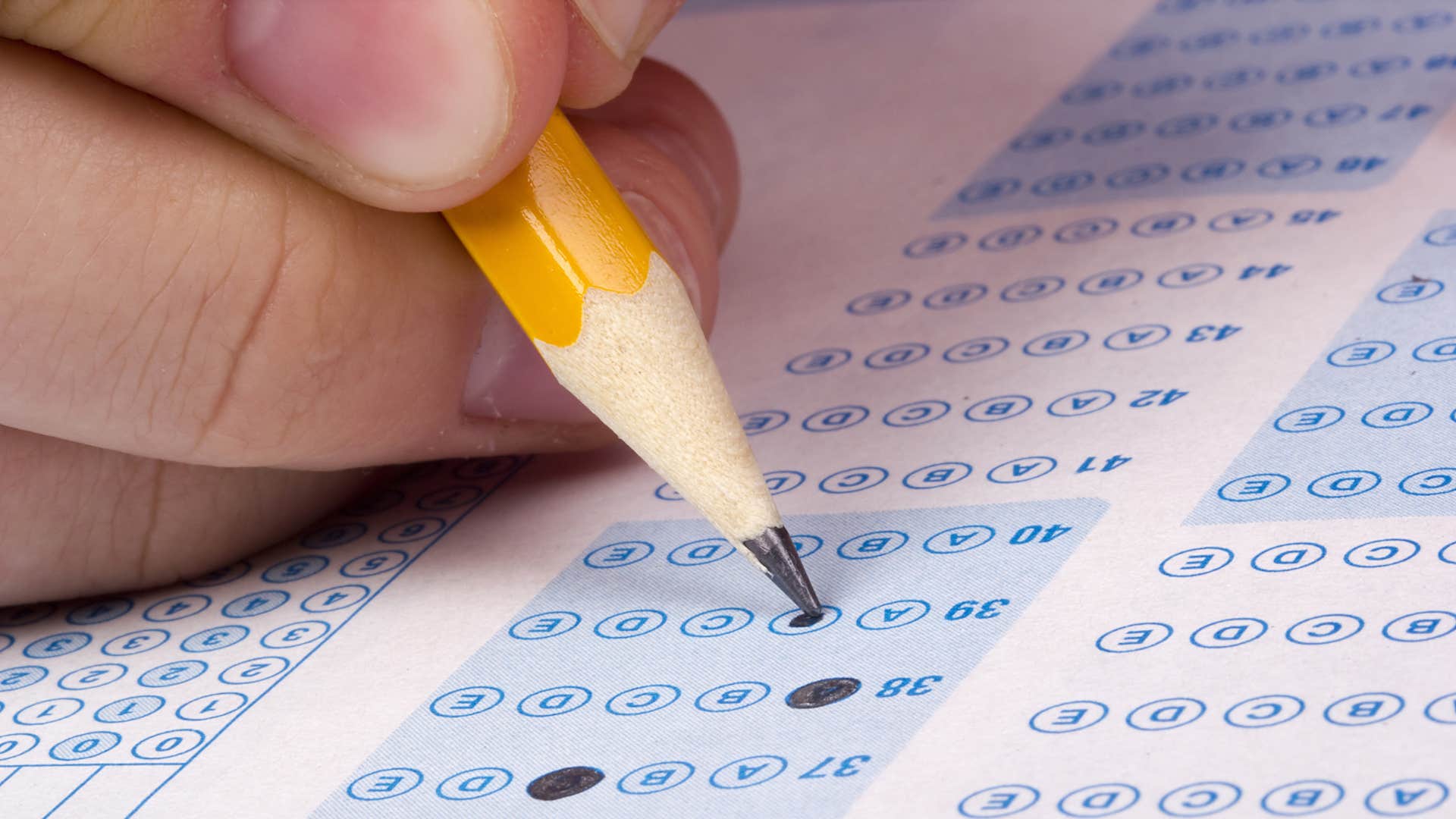
Everyone remembers filling in those little dots with a special Number 2 pencil. Whether it was for a high school class or a state test, every single one of us had to use a Scantron to take these tests. For many, using these Scantrons was pretty stressful. If bubbles weren't completely filled in, it could read incorrectly.
Yet, while this stress used to be universal, a thing that isn't all that common anymore, even for the PSAT, SAT, and the ACT, which offer computer testing in lieu of the old pencil-and-dots system. With the rise in technology and Lockdown Browser, there's no longer a need for Scantrons. While they were handy back in the day, technology has evolved since then, so using these little scraps of paper has slowly fallen out of style.
7. Multiple rough drafts
 Drazen Zigic | Shutterstock
For those who went to high school years ago, it wasn't enough to have one draft for an essay. Especially when it came to research-based topics, many teachers required multiple rough drafts before students could submit for an official grade. While submitting rough drafts can help students learn how to self-edit, it's much less common these days.
According to teacher Jesse Breite, when teachers leave comments and feedback, it's often dismissed and ignored anyway. So, rather than waste their time, multiple rough drafts have slowly become a thing of the past. Now, they focus more on feedback and on advanced drafts, leading to better outcomes.
8. Cash in the cafeteria
 Gorgev | Shutterstock
Remember back in the day, when a child could give a cashier a few dollars and get a full meal with a snack? Well, the time for cash-only cafeterias has slowly faded out of existence. Nowadays, everything is pretty much done online. From student accounts being online to money being uploaded online, students don't have to carry around cash.
If they're lucky, they may have a card they can swipe, but for now, most students give their student ID number and use it to pay for lunch. Sure, it isn't as fun and doesn't teach students as much about money. But for schools, it's an easier process than counting coins.
9. Physical hall passes
 PeopleImages | Shutterstock
Once upon a time, students couldn't leave the class without a good excuse. It doesn't matter whether they had to use the restroom or weren't feeling well. Without a hall pass, students were pretty much stuck in class until the bell rang.
The struggle of needing a pass isn't quite the same for the newer generations. Especially in high school, students no longer need a physical pass to wander around the hallways. With digital hall passes in place, it's much easier to get where you need to go.
10. Handwritten essays
 Gladskikh Tatiana | Shutterstock
Finally, a thing that doesn't really exist inside high schools anymore is handwritten essays. Nowadays, some kids write essays on paper so teachers can be sure their ideas are theirs alone, not written by an artificial intelligence program. But aside from this, most work isn't done on paper anymore. And while it is more convenient for teachers to no longer have to shuffle through papers, it's possible that kids are missing a number of mistakes because they aren't taking the time to write long-form.
With autocorrect built into word processing, many kids assume that mistakes and typos will be flagged, not realizing that autocorrect can only catch some very basic errors. Problems with flow and even using the correct word can easily be missed.
In addition, long-form handwriting may help kids in other ways, too. According to Director of the Media Psychology Research Center Pamela B. Rutledge, Ph.D., M.B.A., "Regularly practicing handwriting may improve brain structure and function." This is why it's crucial to continue writing essays by hand. Not only does it help us become better writers, but it also helps us process things much better.
Marielisa Reyes is a writer with a bachelor's degree in psychology who covers self-help, relationships, career, family, and astrology topics.
