
If You're The Eldest Daughter Of Your Family, You Likely Say These 11 Phrases On A Regular Basis
 Lighthunter | Shutterstock
 If you're the eldest daughter in your family, you've probably had the unique experience of carrying gendered expectations along with parental pressure to be perfect. You may even have been a caretaker for siblings or a financial breadwinner. That's a lot of pressure.
According to researchers and clinicians, this shapes the experience and even the identity of the eldest daughter. This has been tested in various settings, and while every oldest daughter will have a different experience and outcome, "Eldest Daughter Syndrome" seems to have some merit. Here are a few of those ways.
Here are 11 phrases eldest daughters often say well into adulthood
1. 'I can handle it on my own'
 fizkes | Shutterstock
If you're the eldest daughter in your family, you probably find yourself saying the phrase, “I can handle it on my own,” which displays a fierce sense of independence and need for control. According to Kati Morton, a licensed therapist, eldest daughters are responsible for more domestic labor than their siblings, and often succeed in this role when they're doing things on their own.
Morton acknowledges that Eldest Daughter Syndrome isn’t a clinical diagnosis, but rather, “A term coined to describe the unique pressures and responsibilities placed onto the oldest daughter in the family.”
She claims that eldest daughters have “an intense feeling of responsibility” along with overachieving tendencies, which are traits that lend themselves to an eldest daughter’s belief that she has to do everything by herself.
The phrase “I can handle it on my own” can be positive or neutral. It's a sign of strength when said with an upbeat, hopeful tone, but is often declared with undertones of defensiveness or emotional distress. Eldest daughters don’t necessarily want to complete every household task on their own, but the expectations placed on them in childhood makes it hard for them to ask for help.
2. 'I don't want to be a burden'
 MAYA LAB | Shutterstock
Another phrase eldest daughters in a family say on a regular basis is, “I don’t want to be a burden.” This phrase goes hand-in-hand with the idea that they have to do everything on their own, which can stem from the belief that they’re just “too much.”
Eldest daughters are often scared of imposing on other people, which means they struggle to take up space and get their needs met. At first, it feels heroic. Eventually, it exhausts them and resentment grows.
Morton maintains that eldest daughters often display people-pleasing behavior, along with having difficulty setting and upholding boundaries. These traits can affect the way eldest daughters enter relationships, since they carry over their childhood tendencies into their adult lives.
Therapist Nancy Carbone adds that people-pleasing can be a form of self-sabotage, noting that “If you're always people-pleasing, it may be a red flag that you're not practicing the self-love that you need.”
The patterns of people-pleasing behavior and discarding your own needs can be hard habits to break, but holding tight to the belief that you deserve to put yourself first in your own life is crucial to being your most authentic self.
3. 'Can I help?'
 Chay_Tee | Shutterstock
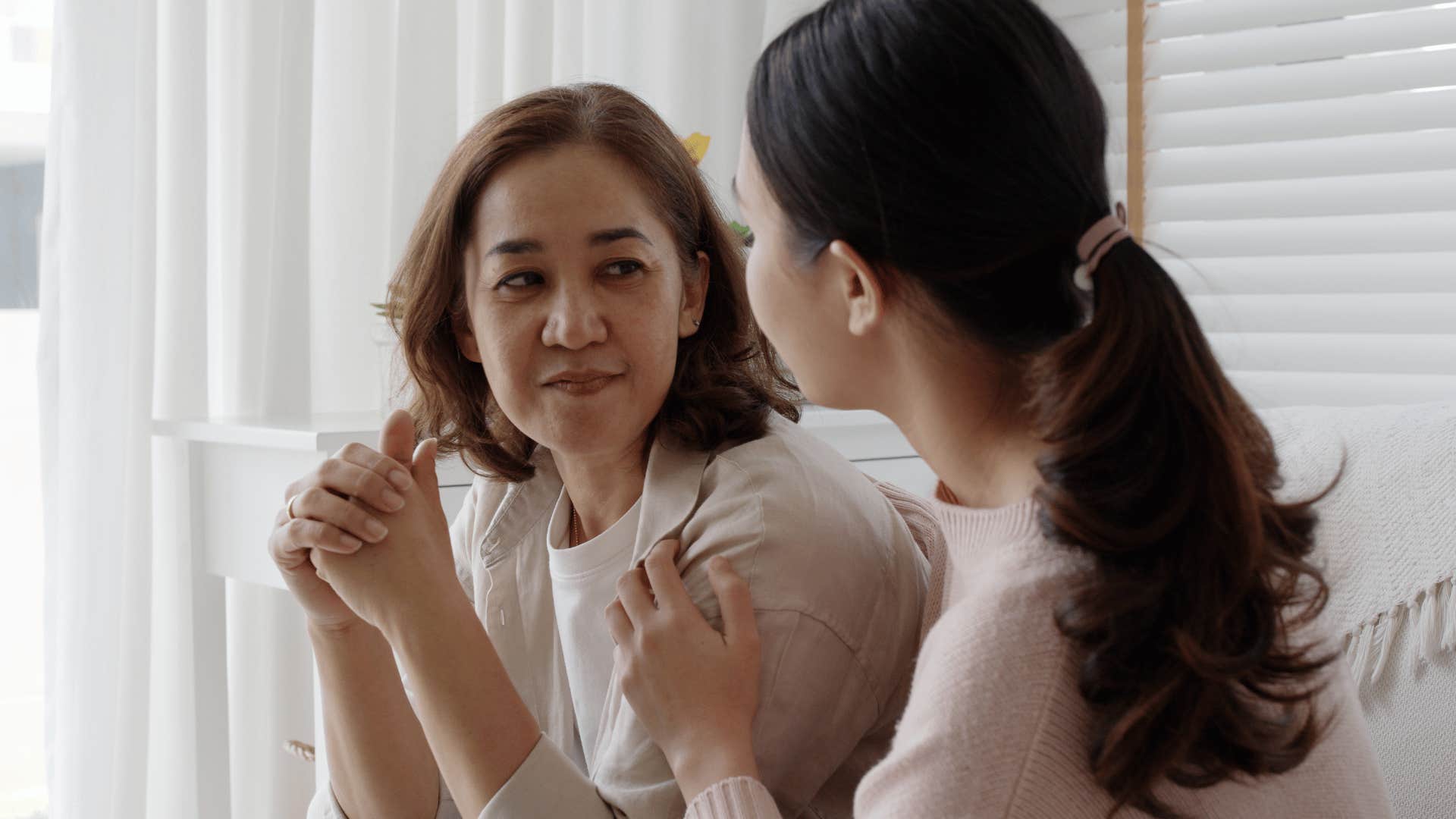
Eldest daughters in a family often ask everyone around them if they need help, because they’ve been trained to be caretakers and minders of other people’s emotions, according to Dr. Mark Travers. Eldest daughters who ask others if they need help exist at the intersection of family obligations and the societal expectations placed on women starting in childhood.
Young girls are told to be nice, more than anything else. They’re expected to check their own emotional needs in service of others. These expectations carry through into adulthood and become especially crystalized in motherhood.
All too often, moms are expected to take on more than they can handle and smile while they do it. These moms end up carrying the weight of their family on their shoulders, as they’re tasked with all the invisible and emotional labor it takes to keep a household running. It’s no wonder that so many moms are parenting from the trenches of burnout, just trying to keep their heads above water.
Kati Morton notes that eldest daughters often feel resentment towards their family and struggle with feelings of guilt, which isn’t particularly surprising. Living in the depths of contempt holds women back from cultivating relationships that fully nourish them. Letting go of the expectation that they have to help everyone is a move toward freedom and fulfillment.
4. 'I can't let anyone down'
 fizkes | Shutterstock
If you're the eldest daughter of the family, you've probably heard yourself say, “I can’t let anyone down.” At the very least, you've thought it.
See, eldest daughters internalize the pressure their parents put on them in such a way that they think any misstep will lead to extreme disappointment. Their need to not let anyone down dictates the path their life takes. They often make decisions based on their parents’ expectations of them, instead of what they want for themselves.
A major part of believing that they can’t let anyone down stems from being highly self-critical. Even if they were raised by parents who offered unconditional support and love, eldest daughters’ inner critics tend to skew negative. Parental expectations might come from a good place, but they usually end up being a heavy weight that keeps eldest daughters from living their own version of life.
5. 'I don't have time to relax'
 fizkes | Shutterstock
Eldest daughters often say “I don’t have time to relax” because they base their sense of self-worth on their level of productivity. They’re achievement-oriented, meaning that they judge themselves based on academic, professional or personal successes.
Some scholars believe that birth order not only influences personality traits, it also influences intelligence levels. According to a study in the Journal of Research in Personality, this theory holds that first-born children have higher levels of intelligence than their later-born siblings, often because of undivided attention on oldest siblings.
Whether or not birth order is associated with intelligence, eldest daughters often have a hard time letting themselves just do nothing, as they associate how busy they are with how worthy they are. They often crave that one-on-one praise and attention from when they were small.
Therapist Gloria Brame insists this level of productivity isn't helpful toward being successful.
“Sleeping well, getting a restful nap, making sure to move your body throughout the day, practicing gratitude, and making time for meditation all help your body and mind feel more vigorous and alive," she writes, "and helps you weather problems that life may throw your way."
6. 'I can't afford to make mistakes'
 SistersStock | Shutterstock
Another phrase you might say often if you're the eldest daughter in your family is, “I can’t afford to make mistakes.” This phrase ties into the idea that their productivity and success determines their worth.
Eldest daughters often define themselves through what they do: They’re moms and wives, they’re managers, employees, and students. They don’t realize that adhering to such a strict view of themselves cuts them off from so many other possibilities.
Because they build their sense of self around their accomplishments, they’re terrified to make mistakes, in case messing up means they’re not actually worthy of love and support.
As expert Sidhharrth S. Kumar explains, “Fear is one of the most common reasons for people not [to be] able to admit they are wrong at the right time. The worry associated with harm to their reputation and credibility derails their awareness and acceptance of being incorrect.”
Eldest daughters who were expected to reach the goals their parents imagined for them usually have a hard time letting themselves off the hook. If this feels relevant to you, remember that you deserve the type of unconditional love you've been giving others your whole life, too.
7. 'I have to hold everything together'
 fizkes | Shutterstock
Eldest daughters often say, “I have to hold everything together” because being responsible is deeply ingrained into their identities. This phrase captures the perfectionist tendencies that eldest daughters fall prey to. They’re so focused on being perfect and showing up for everyone in their lives that they don’t take time to just breathe or let things be as they are.
Archanaa Shyam, an Intuitive Visionary Strategist, shares the underlying reasons why indulging perfectionism is such a dangerous habit.
“When we are seeking perfection we will never be done,” she explains, defining this tendency as “The fundamental flaw of perfectionism.”
“But there is an alternative,” Shyam exclaimed. “Appreciating progress.”
If you're the eldest daughter in your family, please try to remember that progress, not perfection, is a more sustainable mantra. Releasing the idea of perfection and accepting the fact that we are always works in progress can help eldest daughters (and everyone else) live happier lives.
8. 'I'm happiest when I'm working'
 Dima Berlin | Shutterstock
If you're the eldest daughter of your family, you've probably heard yourself say, "I'm happiest when I'm working" at least once in your life. See, eldest daughters spend their childhood and early adult lives in service of others. Maybe they worked and earned money for the family, took care of younger siblings, or even cared for aging parents and grandparents. They are used to work, and it makes them feel valuable.
This is a positive thing, especially in light of an analysis of data from a survey of families in England showing that first-born daughters are the most successful and ambitious members of their families.
Head researcher Feifei Bu states that it's not all stress-induced, as “there are several possible explanations for the higher attainment and ambition of the eldest. It could be that the parents simply devote more time and energy to them— it could be that they are actually more intelligent. For me, I tend to lean towards the theory that parental investment is possibly at work here.”
Whatever the motivation, until eldest daughters learn that relaxation is crucial to keeping up their productivity, they’ll continue pushing themselves off the cliff of high expectations, and they won’t land softly.
9. 'I hate not having a plan'
 PeopleImages | Shutterstock
Another phrase eldest daughters often say well into adulthood is “I hate not having a plan.” They’re so accustomed to being relegated to the role of “the responsible one” that they struggle to just let things go with the flow.
As the study published in the Journal of Research in Personality explains, first-born children fill a traditional role within their family structure. In addition to having more responsibilities, they’re often held up as role models for their younger siblings, which makes them extra concerned about pleasing their parents. In contrast, later-born children fill the more “rebellious” role. They’re easy-going and sociable, as there’s less pressure on them to perform.
While younger siblings might have a more “Turn on, Tune in, Drop out” mindset, eldest daughters grow up feeling like they need to plan for every possibility. If you're the eldest daughter in your family, these are likely the reasons it's so hard to let other people take the reins.
10. 'Are you mad at me?'
 Josep Suria | Shutterstock
Asking “Are you mad at me?” is another phrase you likely say a lot, as the eldest daughter of your family.
See, eldest daughters often hold onto the belief that it's their job to make sure that everyone is happy and nobody They’re so wrapped up in navigating other people’s emotions that they often lack the self-awareness they need to recognize how they feel.
Managing our emotions and accepting the fact that we can only control how we feel, not how anyone else feels, is a big step on the journey to self-acceptance, one that many people have to go through, regardless of birth order. But for eldest daughters, taking the metaphorical temperature of every person you encounter is a habit that can be much harder to break.
11. 'Don't worry about it'
 wavebreakmedia | Shutterstock
If you're the eldest daughter, you probably say, “Don’t worry about it” way more often than you should.
Eldest daughters say this when someone in their life has disappointed them, but they don’t want to create waves by expressing their true feelings. Instead, they tamp down their emotions, and say, “Don’t worry about it.”
The phrase might be followed by a dismissive shrug or the exclamation, “Really, it’s fine. I’m fine,” when the truth is, they’re not fine. They’re hurt and scared to share that hurt, in case they get rejected. This often leads to resentment, which experts say is one of the most damaging emotions in any relationship.
While we can’t choose the family we’re born into or the order we were born in, we can choose how we show up for ourselves throughout our lives. Eldest daughters can take back their power by showing the full range of their emotions, even the difficult ones. They can acknowledge that trying to manage their feelings in service of other people doesn't make those feelings disappear, but rather, lay dormant until they come back even stronger.
Alexandra Blogier is a writer on YourTango's news and entertainment team. She covers social issues, pop culture analysis and all things to do with the entertainment industry.
