
The Art Of Being Unbreakable: 10 Tiny Habits Of Incredibly Strong People Who Rise No Matter What
How emotionally strong people rise through even the hardest moments in life.
 Tom Morbey | Unsplash
 Inner strength is inside your soul — and part of who you are. It’s what gets you through life’s toughest moments and is a combination of mental resilience (and toughness), and unbreakable self-discipline. And regardless of whether you feel like you have inner strength or not, it’s in there. What you need is to know how to find your inner strength and cultivate it. Here are smart tips to help you discover and expand your inner strength, no matter what direction life pulls you next.
Here are 10 tiny habits of incredibly strong people who rise no matter what:
1. They know their big 'why'
 insta_photos / Shutterstock
If you want to find your inner strength, you must know who you are and what gives you purpose and meaning. Insecurity blooms when you’re not clear on your purpose. When I talk about your big "why," I’m not talking about saving the world. And you don’t necessarily need to give up your career or make big changes to your life either. Often, small shifts have a big impact.
Understanding your "why" means that you’ve identified what drives you and what makes you behave the way you do. Your personal values act as a compass for how you make decisions for yourself and how you behave. And they are a large part of who you are, even if you’re unaware of them (because your subconscious knows).
To help you get clarity on your core values, ask yourself what you must have in your life (and must honor in how you act) to feel fulfilled, at peace, and fully you. Additionally, look to times when you’ve been incredibly upset with something you did (or didn’t do) and pay attention to common themes. These exercises will help you identify and define your core values.
Some examples of values include honesty, service, to uplift, accomplishing, educating, feeling connected, having fun, and having an impact. The possibilities are wide and varied. Why is it so important to understand your core personal values? Awareness leads to intentional action — including aligning your behavior and way of being within the world with your values. This will help you find your inner strength and will increase the faith you have in yourself and your self-confidence.
2. They build a life they don't need to escape from
 PeopleImages / Shutterstock
Prioritizing yourself means taking care of yourself to the point that you don’t feel the need to escape from your life. That’s what true self-care is (it’s not about taking a nightly bubble bath or going to the spa once a month — although those may be components that you have within your self-care routine).
Self-care is about your state of mind — feeling at peace, relaxed, and calm. And having the energy you need to get through your day without feeling spent at the end of it. Most of us spend a lot of time trying to find "balance." To be honest, real balance isn't possible. But that doesn't mean that you can’t (or shouldn't) put yourself first. Often, that's what’s missing when you’re searching for "balance."
There’s a lot of guilt wrapped around taking care of yourself. And it’s time to drop it because you can’t properly take care of anyone else if you can’t learn to first take care of yourself. Besides, it’s not selfish to take care of yourself. If you don’t prioritize yourself, then no one will.
When people lack a sense of control over their lives or decisions, they're more likely to experience feelings of helplessness, anxiety, and depression, while those with greater autonomy tend to report lower stress and better overall mental health. A 2021 study found that engaging in self-care lowers stress and increases psychological well-being, suggesting that actively prioritizing your own care can serve as a buffer against life's pressures.
Moreover, prioritizing yourself will help you get clear on what you most need, value, and desire out of your life and how to get it. This will help you finally feel in control of your life because you’ll be in control of what’s controllable instead of striving to be in control of the stuff that’s uncontrollable. And that increases confidence and your sense of self-worth, which are key components of inner strength.
3. They check in with themselves often
 Monster Ztudio / Shutterstock
Mindfulness is all the rage these days. Yet there’s a lot of skepticism too (which is because some have overstated the benefits). But humor me for a moment and allow me to make the case as to why this is so important. Life is busy — overly busy. And we’re constantly "on." Our increased work flexibility and ability to be contacted virtually anywhere (plus social media and increased screen time) have led to an overwhelmed and overworked lifestyle.
This hustle-bustle life leads to overthinking and stress. This high-stress overthinking state prohibits your ability to access your inner strength. If you want to find and grow your inner strength, you need white space in which to think and allow your subconscious thoughts to come to the surface so that you can deal with them.
Which brings me to mindfulness. The reason for practicing mindfulness is to allow yourself the "white space" your brain needs to think clearly and observe your thoughts and emotions. And this allows subconscious thoughts (that are trying to tell you something important) to bubble up to the surface. Although the benefits have been overstated, we do know that mindfulness practice helps:
- reduce mind-wandering and increase problem-solving capabilities
- increase the ability to pay attention to your environment
- increase stress-resiliency
- reduce the tendency to focus on the negative
- increase awareness of thoughts. Mindfulness increases your ability to be focused and disciplined, which is an important component of mental strength.
Mindfulness can be practiced in many ways. If you’re new to it, start with a simple breathing exercise. Set a timer for a few minutes (as little as 2-3 minutes works), close your eyes, and breathe slowly and deeply.
Focus on your breath by focusing on how it feels in your lungs, or the breath moving in and out of your nose. And that’s it. Deep breathing helps to slow down your thoughts, increase your resiliency to stress, and break your stress response — it’s kind of like hitting a reset button. And it will help you to reset an overly active mind and tap into your inner core, which happens to be where your inner strength resides.
4. They speak to themselves with kindness
 DimaBerlin / Shutterstock
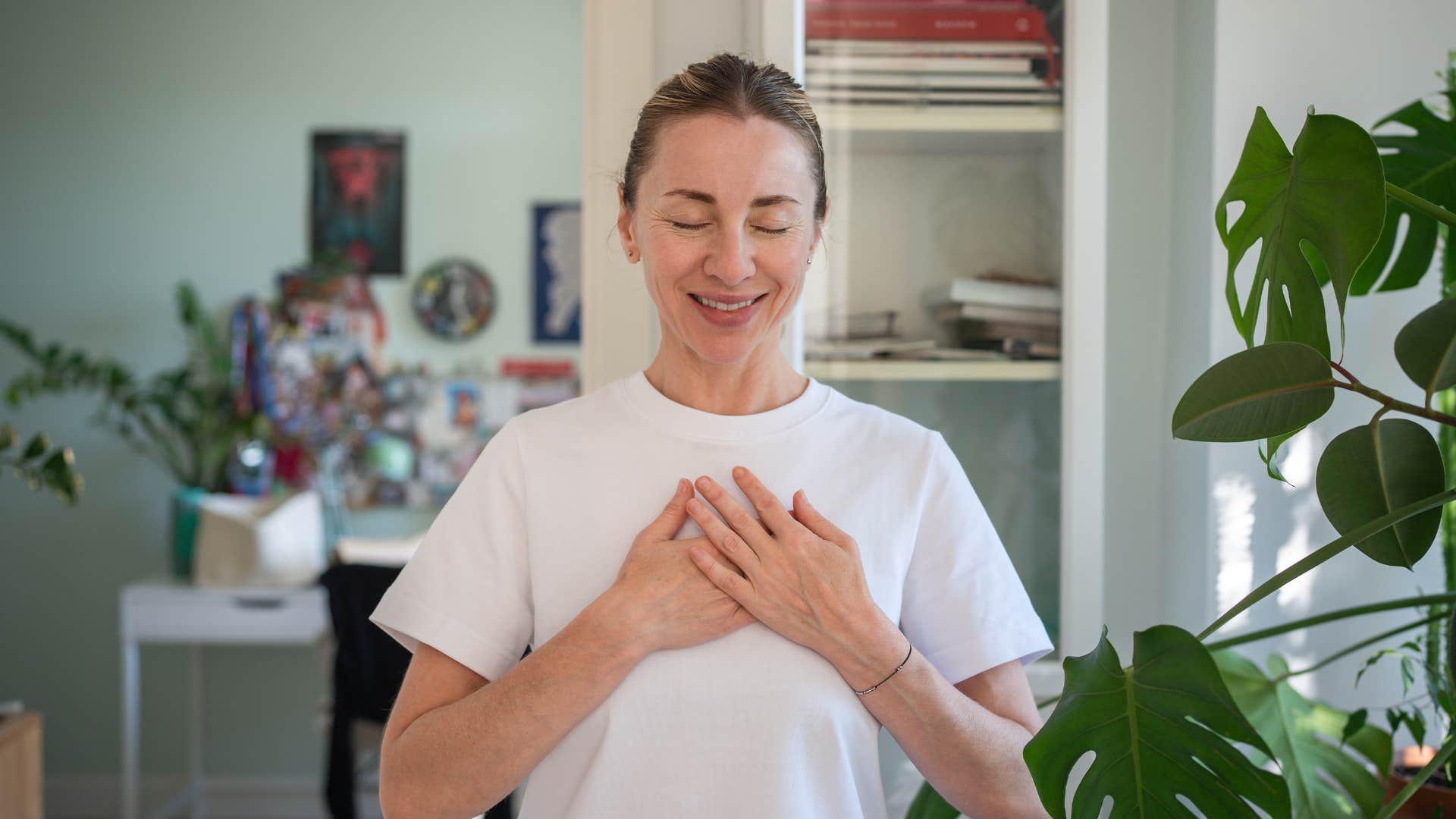
It’s time to be kind to yourself. You’re not perfect, so don’t expect perfection. This doesn't mean that you won’t strive to be and do better. But you can do that while being kind to yourself and embracing the fact that you’re human. Kindness means not falling into the trap of self-pity or self-punishment when you mess up or when you discover that some of your beliefs and thoughts have been holding you back.
And it helps you to adopt a growth mindset. A growth mindset is a key component of growing inner strength. It’s part of being emotionally intelligent and what will keep you moving forward in times of difficulty, and help you learn from your experiences and incorporate what you’ve learned into how you want to proceed so that you can move forward.
According to psychologist Dr. Kristin Neff, self-compassionate people are just as likely to have high standards for themselves as those who lack self-compassion, but they're much less likely to be hard on themselves when they don't meet those standards. Her research also found that self-compassionate people are more oriented toward personal growth than those who continually criticize themselves
5. They tidy their thoughts — and their space, too
 ViDI Studio / Shutterstock
This is simple, yet important. What you surround yourself with makes a difference to your mental state. If you have a lot of clutter around you, then your mind is likely to be cluttered as well. And, as discussed above, you need to de-clutter your mind to find inner peace, which is a necessary ingredient to having inner strength.
Now, this doesn't mean that everything must be impeccably clean. It does, however, mean that you’ll want to de-clutter your house and even your desk. You need to have space for yourself to think. When you give yourself the physical space to think, your mind has a better chance of following. And sometimes the clutter and disarray of your physical surroundings can prevent you from seeing the mental clutter within.
I once had a client who was seriously bothered by her closet so much that we had an entire coaching session about it. After figuring out why it bothered her so much and what was preventing her from cleaning and reorganizing it, she was finally able to do what she wanted, and something magical happened.
She realized that there was more to it than just her disorganized closet. This simple act uncovered other, more important areas within her life that were cluttered and needed her attention. Thus, she was able to give these issues the attention they needed and move on.
6. They savor what they have
 Stock Rojo Verde y Azul / Shutterstock
Having a gratitude practice is necessary for inner strength — and I’m talking about being grateful regardless of the circumstances. Now, gratitude gets a bad rap by some. The biggest reason for that is that many believe that it’s about having to be grateful for everything (including the bad) because there’s a lesson to be learned from the experience. Although tough times often bring the biggest learning opportunities, that doesn't mean that you must be grateful for them.
Also, gratitude isn't about creating false positivity. Practicing gratitude simply means that you find something (anything) to be grateful for at that moment. To work its magic, I recommend doing this every day (even more than once per day if possible). And let me be clear: there’s always something to be grateful for.
You can be grateful for the hot water in your morning shower, the sunshine on your face in the afternoon, or the sound of a bird singing outside. It’s that simple. How does this help? A regular gratitude practice helps to train your mind to look for the things to be grateful for. And that will increase your ability to see them. This simple practice will increase your mental resilience and emotional intelligence and help you cultivate the growth mindset mentioned above.
A 2022 study found that people who practiced gratitude experienced better mental health and significantly fewer symptoms of anxiety and depression. Consistent gratitude practice can rewire neural pathways. The more you practice, the more your brain adapts to this mindset, almost like exercising a "gratitude muscle" that grows stronger over time.
7. They give their body what it needs
 Drazen Zigic / Shutterstock
It’s difficult to feel strong within without feeling physically strong. Feeling physically powerful, having energy, and feeling well-rested results in increased self-confidence and positivity about yourself and the world around you, which leads to increased inner strength.
This doesn't mean that you must work out for an hour or more every day of the week. But it does require some exercise to help your physical strength and well-being. You get to choose whether that’s walking, running, yoga, Pilates, strength training, high-intensity cardio, or something else — the possibilities are endless.
Be sure to have some sort of regular exercise routine and mix it up so you don’t get bored. And nourish your body with food that makes you feel great (and that you love to eat.) Finally, get rest. We all know that sleep is a necessary ingredient for good mental health. So, ensure that you’re prioritizing it.
8. They accept life as it is
 G-Stock Studio / Shutterstock
Human beings tend to obsess over what they wish life could be — instead of accepting reality. But mental strength requires that you accept what is. And it also requires that you let go of worrying about what could happen and stressing over what’s already occurred.
Instead, stop worrying and stressing so much about what you can’t control and learn to live in the present moment (hint: mindfulness and practicing gratitude will help you be more present). The next step is important: accept reality. Accepting reality doesn't mean that you’re okay with it.
I’m not talking about being happy or trying to find a silver lining where none exists. It’s about learning not to react and let your emotions take control of you and, instead, learning to respond. What’s the difference? Reacting is what happens when your emotions take control.
Acting in anger, stress, and/or due to anxiety. Responding is what happens when you don’t allow your emotions to take control but learn to be more aware of them, think about them rationally, and choose how to respond. This doesn't mean that you abolish your feelings, but it will put you into a state of awareness and intentional choice. And it further develops your emotional intelligence, mental resilience, and mental toughness (hence increasing your inner strength).
Individuals who habitually accept rather than judge their mental experiences attain better mental health because acceptance helps them experience less negative emotion in response to stressors, a 2018 study found. When you learn to accept reality as it is instead of fighting against it, you free up mental energy that was being spent on resistance.
9. They're very comfortable saying no
 Antonio Guillem / Shutterstock
This one is difficult for so many people. Yet it’s necessary if you want to prioritize and take good care of yourself. For some reason, many people have trouble saying "no" because they feel guilty or selfish. Or they believe that people won’t like them or will get mad when setting boundaries. But that’s not true — especially if you’re setting appropriate boundaries and don't overdo it (which is unlikely if you traditionally worry about this).
There’s a misconception about what boundaries are. They’re not about putting others off. Boundaries are your internal rules about how you need to be treated to feel respected and loved. And everyone has these rules. Besides, saying "no" to others is about saying "yes" to you.
Having little to no boundaries leads to stress, overwhelm, and low self-esteem. And that eats at your mental reserves. However, setting and maintaining strong boundaries increases self-confidence and self-respect and decreases stress and overwhelm. And it’s using and strengthening your emotional intelligence and mental toughness.
10. They don't run from hard things
 insta_photos / Shutterstock
Fear breeds doubt and eats away at your core. And fear is what often prevents you from making much-needed (even wanted) changes to your life. Fear of change, fear of what others might think, and fear of failure — those are just a few fears that hold everyone back. But ignoring these fears makes it even worse because it leads to uncertainty and even a lack of self-respect.
This is why facing your fears head-on is so important to finding inner strength. I’m not talking about being fearless because that’s not possible. Some fears will never go away completely. But you can face your fears and learn to act despite them — that’s what courage is. To face a fear:
- Be specific about what the fear is. Give it a name and define it.
- Look behind the curtain to the beliefs you have that contribute to this fear. For example, fear of failure might relate to a belief that people don’t respect you if you don’t succeed at something.
The only way to move beyond your fears is to know exactly what they are and where they come from. Then it gets easier to deal with them. Also, sometimes, putting your fear into words will help you to realize that it isn’t as big as you thought, enabling you to move beyond it with ease.
Psychologist Dr. S.J. Rachman, who has spent decades studying courage in high-risk groups like bomb-disposal operators and paratroopers, defines true courage not as the absence of fear but as "the persistence of courageous behavior in the face of fear." His research consistently shows that people who develop this ability to act despite fear experience declining stress levels and build greater resilience over time.
Facing your fears and starting to move beyond them will give you courage and faith in yourself — and that’s what inner strength is all about. Finding and cultivating your inner strength is critical to your emotional well-being. It will guide you through life’s twists and turns. So do yourself a favor and find yours. I promise it’s in there. All you need is to shine a light on it and nurture it.
Heather Moulder is a career and life coach and the founder of Course Correction Coaching. She specializes in helping professional women have both a successful career and a happy home life with real work-life balance.
