
Most Middle Class Families Can Barely Afford These 11 Once-Basic Items
 Tania Volosianko | Shutterstock
 Having a middle class family used to be a foundation of The American Dream, a dream of security, access and opportunity. Or, at least, that's what it used to mean. From rising housing costs to the burdens of student loan debt and inaccessible grocery bills, many American families today can barely afford some of the items that used to be considered basic. Once an American economic class that was able to live comfortably on one full-time salary, there are now several everyday essentials that are no longer secure, even for families with two working adults.
A survey from the National True Cost of Living Coalition found that nearly 65% of Americans report that they are struggling financially in their daily lives, contributing to their reduced spending habits, inability to pay for basic monthly expenses, and difficulty planning for their future with savings and retirement accounts. That doesn't even account for the dream of sending a child to college, which most middle class families, and even upper-middle class, can no longer afford.
Most middle class families can barely afford these 11 once-basic items
1. Eggs
 Drazen Zigic | Shutterstock
According to the U.S. Bureau of Labor Statistics, there’s been around a 120% increase in the price of eggs since 1990, largely due to general rising costs in recent years and inflation. The price has doubled a few times since 2020, alone, and as of the time of publishing .
This is especially for middle class families that live in urban centers, as they often experience even higher prices for basic necessities like eggs, as their grocery stores and farmer’s markets charge more. This problem used to be exclusive to what were called "food deserts", but now these deserts appear to be spreading.
While egg prices have started to lower in the past year, many families are still finding them just too expensive to eat this highly nutritious source of protein to eat regularly. Many are exploring alternative options to breakfast foods, but few can compare with the nutritional wallop packed in just one single egg.
2. Feminine products
 Perfect Wave | Shutterstock.com
The average prices for feminine products like pads and tampons rose by nearly 10% in 2022, and as of July 2024, the average price of a package of tampons increased 36%. Even for people with the luxury of purchasing these products in bulk, like business owner Laurie Merrill does for her nonprofit organization, she argues inflation has massively affected her purchasing power. Today, individual tampons cost her nearly 21 cents a piece, compared to just 16 cents a few years ago.
A study in the Journal of Global Health Reports revealed that nearly two-thirds of low-income people couldn’t afford regular menstruation products in the past year, largely contributing to a trend called “period poverty” that’s creeping into middle class families.
Contributing to rising rates of loneliness and grief in young menstruators, as access to products, education, waste management, and hygiene resources grows inaccessible, it’s clear that’s there’s not just negative financial outcomes to these everyday essentials that were affordable 10 years ago that the middle class can’t afford anymore, there’s also socioeconomic and interpersonal concerns for young women and menstruators.
3. Sauces
 CandyRetriever | Shutterstock
According to the U.S. Bureau of Labor Statistics, the average middle class American household spent nearly $500 a month on groceries, totaling over $5K a year, in 2022. Since 2022, average grocery prices have risen as much as 30%. A 2026 Bureau of Labor Statistics report noting stark increases in the price of beef, pork, orange juice and milk. This makes grocery shopping trips something to save for, for many (if not most) middle class families.
To account for these rising prices, many families opt only for essentials like meat, canned goods, bread, and milk, sacrificing other “luxuries” like condiments that can add flavor, joy, and diversity to family meals. It’s this sacrifice that’s expected for financially struggling families, but also one that takes away from quality life and amplifies the money stress and dissatisfaction that many homes are experiencing.
While food insecurity has typically been labeled an issue of poverty, it’s growing to the middle class, where many families are already struggling financially, working multiple jobs to feed their families, afford basic bills, and pay off student loan debt.
All of these financial experiences paint a complex picture, but they can help to explain why the middle class has resorted to credit cards and loans to get by, with an average of 50% of households grappling with credit card debt. These factors combine to make most middle class families choose not to purchase extras, like sauces, that used to be affordable.
4. Fresh produce
 PR Image Factory | Shutterstock
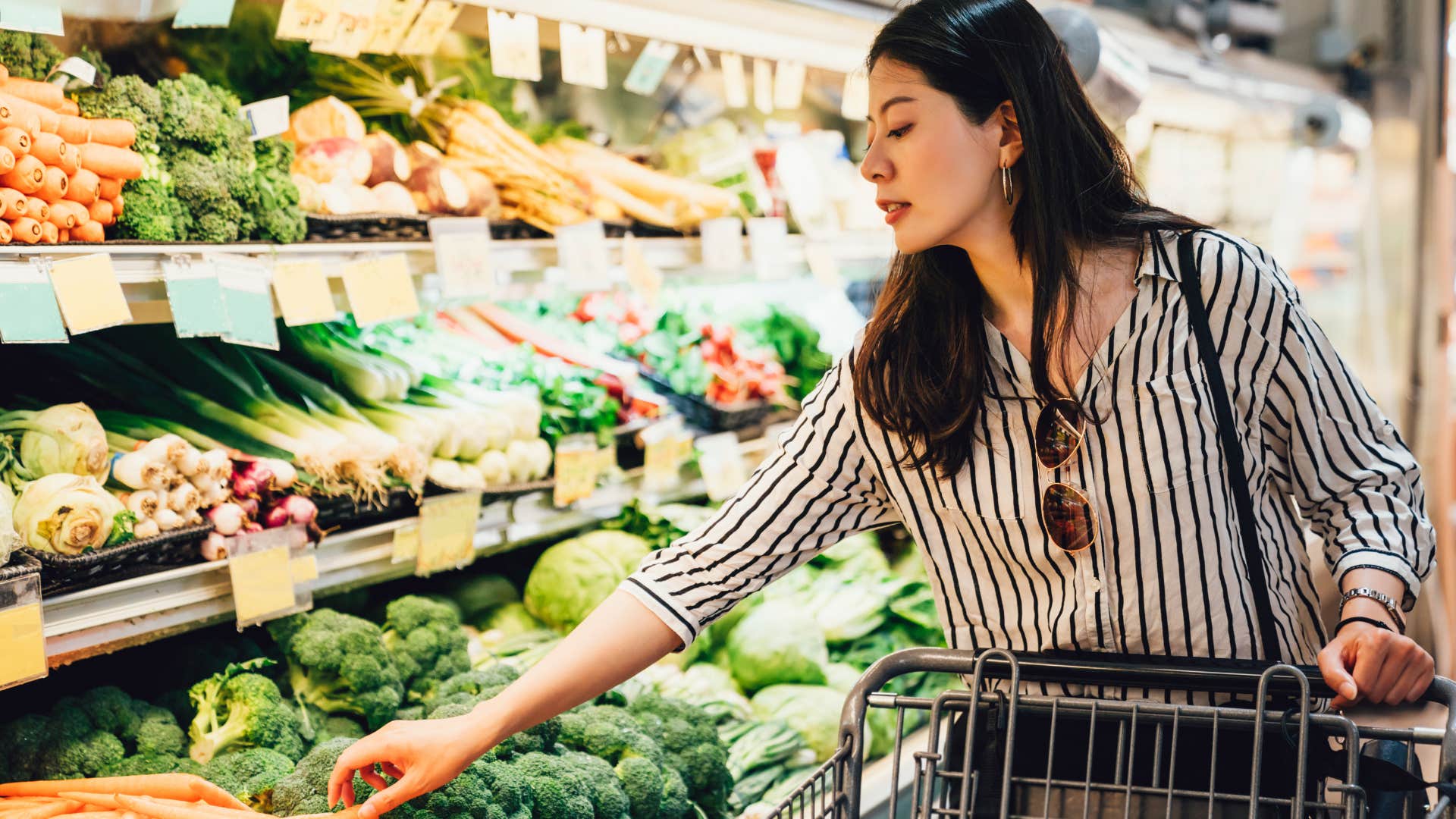
According to data from the U.S. Department of Agriculture, it’s not just basic grocery staples and essentials that are becoming increasingly inaccessible for middle class families, as the prices for fresh produce, supplements, and various meats have also increased massively. Their research reveals that upper middle class families, with annual incomes closer to $100K, are paying nearly 3% more than poorer households for the same food items — with grocery stores, farmer’s markets, and produce stands in higher income neighborhoods charging higher prices.
The data shared in point number one in this article also suggests that fresh foods experienced some of the highest rising costs compared to other items, with stark increases for both fruit and meats.
5. Breakfast cereal
 ucchie79 | Shutterstock
While the USDA insists that breakfast cereal is an affordable breakfast option, too often these are highly processed and loaded with refined sugar. In addition, the price of many breakfast cereals has risen dramatically in recent years, increasing 6% from 2025-2026 Especially for families with multiple children eating different cereals, relying on the convenience of a quick breakfast in the morning, many have had to to switch up their daily routines to account for the rising costs.
Considering that nearly 10 million Americans struggle with food insecurity (which is up from the last report,) it’s impossible to ignore how more issues of financial insecurity are seeping into middle class households’ daily lives. Even worse, the Trump administration cancelled the 2025 report that would have updated how many families struggled to feed their children.
6. Coffee and other caffeinated drinks
 JLco Julia Amaral | Shutterstock
While coffee may seem like a luxury, it's far from that. According to a report by PBS, "Second only to oil, coffee is the most valuable legally traded commodity in the world."
Along with fast food, many chain coffee shops like Starbucks and Dunkin’ Donuts have significantly raised their prices to combat the continually rising costs of coffee beans, making a to-go coffee or energy drink a luxury for many middle class families.
Tea, a product whose tariffs once sparked an America revolution, is also getting more expensive, especially after 2025 tariffs jacked up prices. While those tariffs have largely been rolled back (as of November 2025), the ripple effect still has tea prices high.
While coffee may not seem like a necessity to those who don’t drink it, for many families, it’s an everyday luxury that makes navigating the day easier for many. It has been an essential part of most families' diet for a hundred years or more.
7. Fast food
 Ground Picture | Shutterstock
Once an everyday staple for families seeking convenience and a bit of extra time, fast food has become relatively inaccessible for middle class families. According to data from the Federal Reserve Bank of St. Louis's Consumer Price Index, the cost of eating at fast food restaurants rose by over 83% since 2014. Typically affordable fast food spots like McDonald’s have nearly doubled in price, while the lower tier like Starbucks and Subway only rose 39%.
Not only do these families, typically working multiple jobs or long hours, have to plan out extra time to cook or prepare their meals, they have to give up a little daily luxury that has been shown to add some joy for children in households struggling economically. In addition, for many families, feeding kids fast food is seen as the most affordable, practical option.
8. Streaming services
 PR Image Factory | Shutterstock
Especially now that streaming services are cracking down on password sharing and usage in multiple households, the accessibility of a monthly streaming service has become a luxury in many middle class families. According to Variety, Americans pay, on average, $69 each month on streaming services. That amounts to a 13% year-over-year increase.
Despite 83% of American households footing the bill for that monthly subscription, and the average person spending more than three hours a day streaming digital media, many middle class families can’t afford it anymore, especially as rising costs in other areas like food and housing become inaccessible. Wherever families can cut costs, they’re trying to, taking away from little daily luxuries like fast food or watching Netflix in order to make ends meet.
According to Variety, "Despite streaming providers’ efforts to minimize churn, 39% of consumers have canceled at least one paid SVOD service in the last six months, a rate that has remained relatively stable in recent years. This figure jumps to over 50% for Gen Zs and millennials."
9. Preventative healthcare
 Chay_Tee | Shutterstock
From daily medications and prescriptions to physical therapy and a healthy diet, many middle class households are forgoing preventative care due to financial struggles. Even for households with insurance that offers more coverage for preventative care following The Affordable Care Act, many still struggle to foot deductibles, lose hours on their paycheck, and make time to drive to doctor visits, pharmacies, and rehabilitation centers amid their busy schedules.
As for people without healthcare insurance, usually working contract or service jobs, they’re even less likely to receive both preventative and reactionary care, according to data from KFF, as they face more cost barriers than their insured counterparts.
10. Multiple vehicles
 Kleber Cordeiro | Shutterstock
As reported on NPR, cars are essential in most of America, but fewer people can afford them now. Many experts, from mechanics to financial pros, suggest that vehicle expenses today may also sabotage many people’s chances of maintaining their wealth, given high gas prices, inaccessible repair fees, and huge monthly car payments. They even suggest Americans need at least a household salary of $100K to be able to afford one car, let alone multiple.
The middle class continues shrinking and the ultra-wealthy continue getting wealthier, with the majority of households making under $100K annually. That means on time constraints and general daily convenience become more problematic, managing car payments and maintenance causes many to take on more debt simply to afford the essentials.
11. Student loan payments and in-state college tuition
 Miljan Zivkovic | Shutterstock.com
According to NPR, "Millions of student loan borrowers aren't repaying their loans, and defaults are up" Seeing this as less of a choice and more of a necessity, a hearty 50% of student loan borrowers feel financially unstable right now, not even able to afford basic necessities like gas, groceries, or their rent.
Although many young adults and middle class families were sold the traditional dream of getting a college degree, landing a stable job, and securing their comfortable financial status, many are now struggling with an unfulfilled promise, grappling with money stress that greatly affects their emotional, mental, and physical wellbeing, with many not even able to land a job that will cover their basic bills.
"The average cost of college has more than doubled in the 21st century," according to the Education Data Initiative. The EDI also shares this startling data: "The average annual cost of tuition at a public college* is 40 times what it was in 1963; after adjusting for inflation, tuition has increased 312.4%."
Traditionally, middle class families chose to send their college-bound kids to state schools, where tuition could be as little as one-quarter to one-eighth the price of a comparable private college. These days, however, even state schools are often more expensive than most middle class families can afford and, as Bloomberg reports, top US colleges are too expensive even for people making $300,000 a year.
Zayda Slabbekoorn is a staff writer with a bachelor’s degree in social relations & policy and gender studies who focuses on psychology, relationships, self-help, and human interest stories.
