
11 Odd Behaviors You'll Notice In Someone Who Had A Rough Childhood
 PinkCoffee Studio | Shutterstock
 From relationships to attachment styles, communication skills, and personal self-worth, our childhood experiences and trauma often affect our adult lives in both subtle and all-consuming ways. While we always have the power to address and heal from these traumas, no matter how old we are, they can sometimes linger in subconscious beliefs and attitudes we don’t even realize we carry.
However, there are many odd behaviors you’ll notice in someone who had a rough childhood, from a tendency to over-apologize to being avoidant around conflict. They’re the survival instincts, fight or flight responses, and self-soothing behaviors that adults still lean on to heal their inner child and cope with the fears that their parents or childhood situations provoked.
Here are 11 odd behaviors you’ll notice in someone who had a rough childhood
1. They over-apologize for everything
 Gorgev | Shutterstock
According to clinical psychologist Daniel S. Lobel, many children with rough childhood experiences learned to apologize for everything to protect their parents’ emotions and their own safety. For many, this tendency follows them into adulthood — their people-pleasing behaviors are a survival mechanism that helps to self-soothe in tense, emotional, and stressful situations.
While it might feel like a victimless crime, apologizing too much — especially for things that don’t require an apology or accountability — can often strain relationships and place an emotional burden on other people to reassure.
Don’t be so hard on yourself if this sounds like you. You deserve to be met with grace and respect, even if your parents didn’t give you a chance to expect that or set boundaries in your favor.
2. They cling to their independence
 PeopleImages | Shutterstock
Even if self-reliance and a sense of independence are healthy for most people, some people, still battling experiences with unmet needs or a lack of control from their childhood, use their autonomy as a coping mechanism. They don’t want to rely on others for personal security, and often unknowingly push people away to protect their independence.
For kids and children who were parentified into independence “adults” at a young age, their independence comes naturally. But if it’s always coming at the expense of healthy relationships and the connection that brings joy to their lives, at what cost?
3. They make ‘mature’ decisions
 fizkes | Shutterstock
Many parentified children, expected to adopt overly mature, inappropriate roles from a young age, are stuck in this kind of obligation as adults. Whether they’re teenagers, young adults, or working professionals, making “mature” decisions and focusing only on responsibilities at all times are odd behaviors that you’ll notice in someone who had a rough childhood.
They hold themselves to unrealistic standards, largely because their parents did from a young age, and burn themselves out trying to “do” everything without space for rest or fun. It’s a survival instinct that’s essential to heal from, so these adults can open themselves up to an easier, more fulfilling way of life.
4. They struggle to trust openly
 Rawpixel.com | Shutterstock
When the people who were supposed to be the most loving and supportive in your life — your parents — sabotage your well-being and cultivate unsafe environments for you in your most vulnerable state, of course being distrusting of people comes as a second nature.
Whether it’s bosses at work or friends, expecting people to be untrustworthy is one of the odd attitudes you’ll notice in someone who had a rough childhood later in life. You were taken advantage of and sabotaged from a young age, but there’s one bright side: you’re resilient today. The hardship and discomfort you were forced into gave you the skills to be more resilient on all levels.
So, even if opening yourself up to being hurt as an adult feels scary and sometimes impossible, remember that you have resilience and control today. You can set boundaries, walk away, and express yourself without being condemned by a parent. You decide the rules and regulations.
5. They detach from their emotions
 Trzykropy | Shutterstock
When you’ve spent your entire childhood dealing with big, complex emotions without a safe space or supportive people to guide you through them, as adults, detachment might feel like a coping skill. Especially if your parents encouraged you to suppress your emotions to show up or protect the peace at home, you’ve grown accustomed to pushing everything down.
However, this kind of emotional numbness and suppression can have equally consequential effects on long-term health, relationships, and well-being, according to a study from the Journal of Psychosomatic Research.
6. They expect the worst
 Andrii Iemelianenko | Shutterstock
According to clinical psychologist Fabiana Franco, people who had a rough childhood or dealt with trauma have trained their brains to anticipate constant danger, keeping them stuck in a state of fight or flight, whether they realize it or not. They’re always expecting the worst and trying to prepare themselves to deal with catastrophe, in ways that often amplify their daily anxiety and worry.
Even if it’s driven by a desire to be in control and prepared, imagining the worst-case scenario often keeps adults struggling with their childhood trauma from appreciating the joys of uncertainty in daily life.
7. They avoid rest
 BaLL LunLa | Shutterstock
Many kids who were parentified from a young age always had a million responsibilities and obligations on their plates. They were guilted by parents for taking a break or resting when they felt tired, so it’s no surprise that these complex emotions follow them into adulthood.
They’re constantly moving, overworking themselves, and maintaining an overscheduled life, partially to cope with a fear of guilt and also to “prove” their worth. They feel guilty when they need to take a break and often push themselves closer to burnout with every day that passes without the rest they need to thrive.
8. They avoid conflict and arguments
 Dikushin Dmitry | Shutterstock
According to a study from Frontiers in Psychology, emotional trauma often predicts avoidant behaviors in adults later in life. When arguments or being “in trouble” as a kid brought up a lot of fear, as adults, it can feel like second nature to run at any sign of conflict, whether that’s at work or in personal relationships.
For many adults with childhood trauma, it can be a subconscious urge — they run away before they even understand what’s prompting their feelings of anxiety. They’re used to self-soothing these complex emotions with avoidance, because they did as kids, so addressing the complexities of hard conversations feels impossible.
9. They deflect compliments and praise
 Chay_Tee | Shutterstock
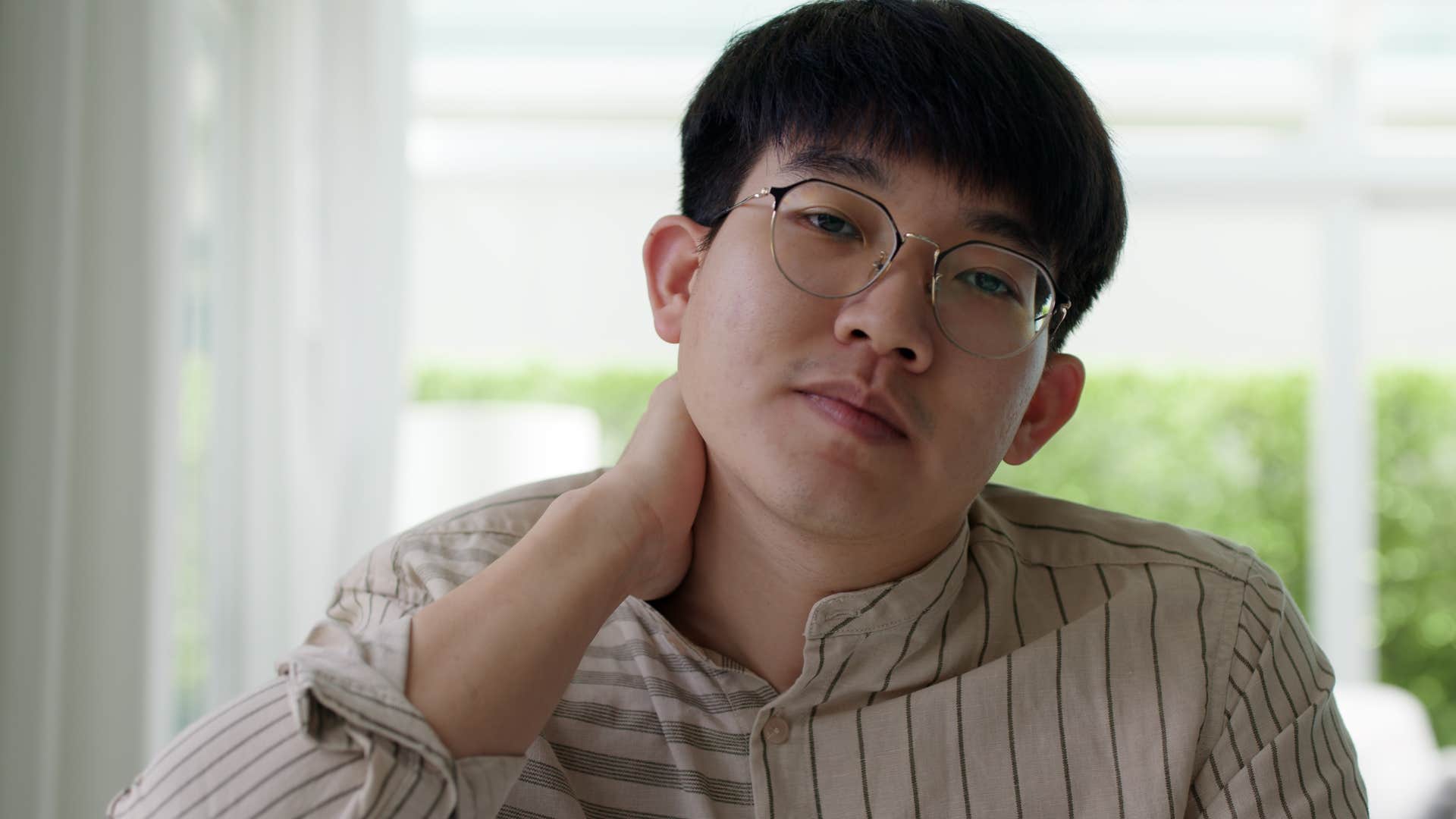
Oftentimes, adults who dealt with childhood trauma have lower self-esteem today. So, it’s not necessarily surprising that accepting praise and compliments is something that’s uncomfortable for someone who had a rough childhood. It brings out a kind of self-consciousness that’s only ever been tied to fear and anxiety, even if the compliment was made with positive intent.
Especially if someone is still struggling to accept themselves for who they are, speaking negatively to themselves on the inside, praise and compliments can feel invalidating. They don’t match up with the negative beliefs they’re telling themselves internally, which feels disorienting.
10. They struggle to compromise
 PeopleImages | Shutterstock
Many people who had a rough childhood growing up are now ultra-protective of their daily routines, needs, and emotions because, as children, they didn’t have any kind of power or control. They want to feel “in control” of their lives, even if that manifests as overprotectiveness in their relationships or routines as adults.
While it can feel uncomfortable to reflect on these kinds of controlling behaviors, especially how they continue to harm an adult’s life today, trauma specialist Jamie Cannon argues that reflection is another avenue to taking back personal power. The more you understand how your childhood trauma affects your adult behaviors and attitudes today, the more empowered, healthy, and happy you’ll feel.
11. Their boundaries are ‘all or nothing’
 sebra | Shutterstock
Many children who grew up with untrustworthy parents or in unsafe living conditions were forced to survive by any means. Their dependence on parents for security wasn’t a choice — it was something they had to learn how to navigate, even at the expense of their own well-being.
That’s why boundaries for many adults with unresolved trauma are complex and difficult, according to trauma therapist Richard Brouillette. Later in life, they have to learn how to “choose” the behavior and people they’re willing to tolerate, whereas when they were a child, that “choice” was made for them.
That’s why boundaries being “all” — pushing away all relationships and vulnerability — or “nothing” is quite common for people who had a rough childhood. They didn’t have parents who empowered them to express themselves or advocate for themselves, but instead to people-please for others to survive.
Zayda Slabbekoorn is a senior editorial strategist with a bachelor’s degree in social relations & policy and gender studies who focuses on psychology, relationships, self-help, and human interest stories.
