
People Who Grew Up In Chaotic Homes Often Call Themselves Empaths For These 11 Reasons
 Progressman | Shutterstock
 People who were raised in a home full of instability or chaos often find themselves with a variety of unique traits. Some of them can be challenging, but many are positive. Often, people who grew up in chaotic homes call themselves empaths due to how sensitive they are to the feelings or moods of other people.
Technically, an empath is "a person who has an unusually strong ability to feel other people's emotional or mental states," which makes them extra skilled at reading other people's moods. Unfortunately, empaths who grew up in chaotic homes may be vulnerable to feeling those moods, too.
People who grew up in chaotic homes often call themselves empaths for these 11 reasons
1. You absorb other people's emotions
 Prostock-studio | Shutterstock
"Due to heightened sensitivities to emotional and physical energy, it's a very common occurrence for empaths to take on the emotions of others and not even realize it," empath and author Christel Broederlow explains. "This can cause difficulty to distinguish what emotions belong to oneself or another."
She notes that strengthening your self-awareness and maintaining boundaries can provide a sense of emotional control and "the ability to determine whose emotions are whose, [which] will help the empath not get caught up in the outside emotions."
"Being an empath may seem like a burden. Your emotions can run high and cause anxiety and moodiness but all of those feelings can be used to provide you with greater insights into life," Broederlow concluded. As an empath, protecting your inner peace is essential to taking care of yourself first.
2. You're hyper-vigilant
 fizkes | Shutterstock
As a child, you learned to navigate your chaotic home by trying to predict your family's emotional state. You paid close attention to non-verbal cues, like if your dad's shoulders were tense or if your mom was sighing more than usual. These little indicators let you know whether or not they were in an emotionally stable place.
Living in a hyper-vigilant state can easily overlap with empathy because you can quickly parse out someone's emotions, even if their words don't match. This is a useful skill, but unfortunately, your heightened emotional awareness often makes it hard to relax or decompress.
Childhood trauma therapist Patrick Teahan explains that being raised in a chaotic family system deeply affects people long after they've left their childhood homes. He shares that kids from chaotic homes often become adults who are "emotionally in transit," meaning that they have a hard time recognizing and attending to their own feelings.
Because of this, people who grew up in chaotic homes often call themselves empaths. They feel deeply connected to other people's emotions, and there's good reason for it.
3. You try to fix people
 bbernard | Shutterstock
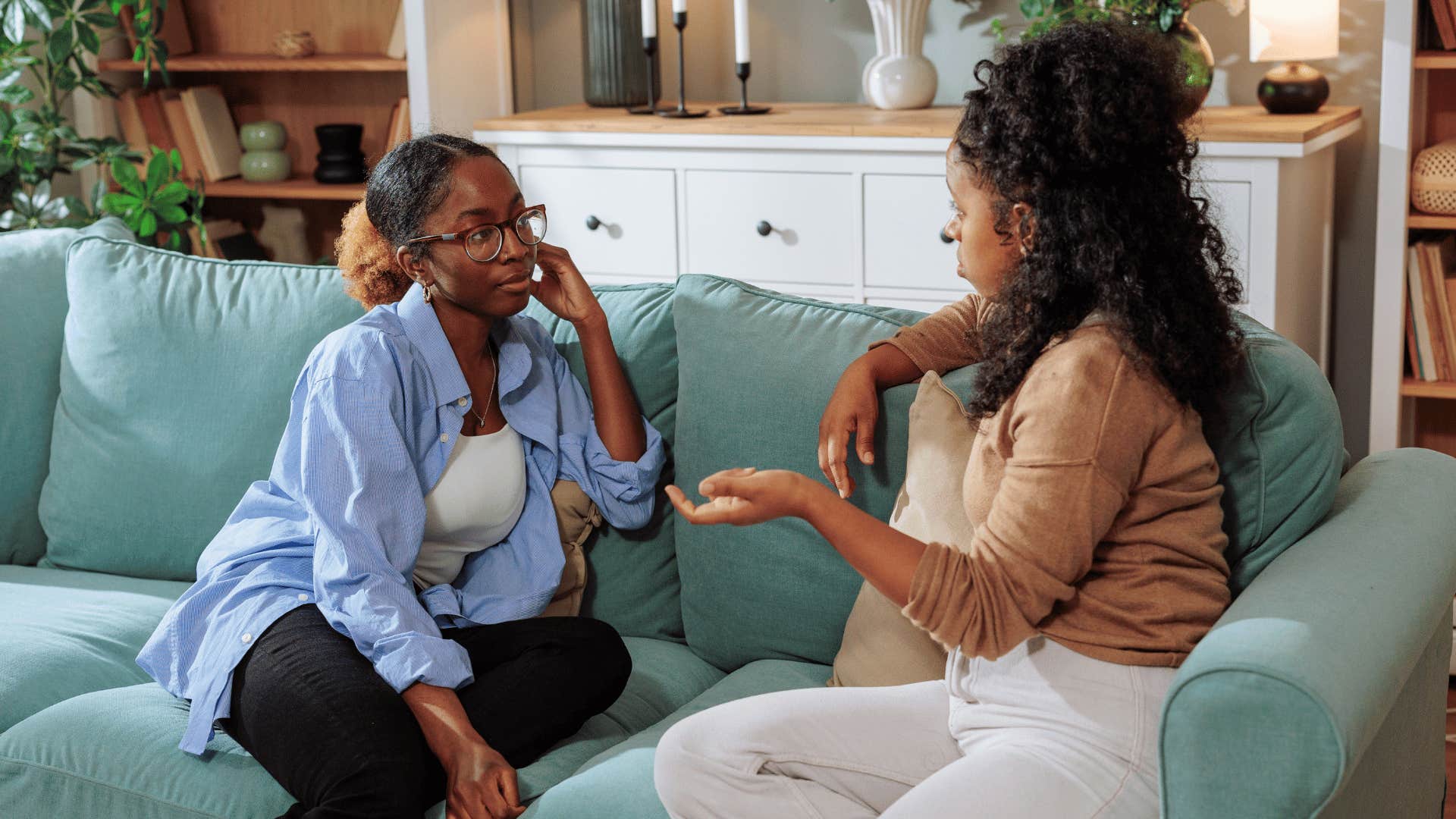
If you grew up in a chaotic home, you probably feel responsible for maintaining a sense of peace. You believe that fixing other people's brokenness is your job, and once you fix them, they'll be able to give you the love you crave.
But no matter how much of an empath you are, you can't be responsible for anyone's feelings but your own. You cannot love them enough to get them to treat you right or to be what the childhood version of you needed.
In a fascinating interview, clinical psychologist Dr. Ramani Durvasula asked Teahan, "What do you consider to be the definitive symptom of childhood trauma?"
"It's about trying to get a difficult person to be good to us," he replied.
Empaths may fall into this trap, thinking they need to try to solve this difficult person like they tried to solve the chaos in their childhood home.
4. You need a lot of time alone
 mojo cp | Shutterstock
If you need a lot of time to yourself, you likely became an empath after growing up in a chaotic home. You tend to feel emotionally drained in crowded places, since you're taking on the emotions of people around you. As a result, you require extensive solitude to reset and rebalance yourself.
Therapist Charlie Huntington, M.A. notes that there are different forms of empathy that impact people in different ways. Someone who has cognitive empathy understands other people's emotional states, yet there's a sense of distance. Someone who has affective empathy lets other people's emotions become their own emotions.
Being an affective empath can feel overwhelming, which is why you need to take time and space to be alone. Recalibrating your emotional state is hugely important for your well-being, so that you can navigate any overloaded emotions of your own.
5. You neglect your own needs
 LightField Studios | Shutterstock
Putting your practical and emotional needs on the back burner in order to take care of other people is a sign you became an empath as a result of your chaotic home. It's also a sign of having people-pleasing tendencies, which can ultimately lead to resentment and burnout.
As licensed clinical social worker Terry Gaspard explains, "Individuals develop a pattern of putting other people's needs before their own due to dysfunction in their family of origin." While breaking the pattern of self-neglect isn't easy, it is possible. Gaspard first advised people-pleasers to "Examine your childhood experiences and how you may have ignored your own needs to seek approval from others."
On a practical level, learning to say "no" and setting boundaries around caregiving is part of freeing yourself from people-pleasing habits. On an emotional level, Gaspard shared that believing in your own worth is essential to caring for yourself. "Believe in yourself and work on self-acceptance," she said. "You are worthy of love and all life has to offer."
6. You have heightened intuition
 PeopleImages | Shutterstock
Because you have heightened intuition, your initial instincts about other people tend to be correct. As someone who grew up in a chaotic home, you had to learn this skill.
Broederlow notes, "Empaths have a deep sense of understanding emotional significance that's unwavering and unquestionable. Their emotional knowledge comes with pinpoint accuracy in reading a person or situation. They are capable of reading others without obvious cues and can describe what's really going on beneath the surface."
She noted the positive aspects of this type of intuition, sharing that "Empaths [are] emotionally connected to others in a profound way. They are able to read the significance of complex emotions and are expert listeners." Yet it's also valuable for empaths to know where to draw the line and know when to tune others out, so they can tune into themselves.
7. Your sensitivity is in overdrive
 Africa Studio | Shutterstock
People who grew up in chaotic homes develop a sensitivity that operates in overtime. That's the main reason you call yourself an empath today: because you pick up on what people aren't expressing outright, meaning that you can read the subtle energy that people send out without even knowing it.
Your ability to sense, understand, and absorb other people's emotions can leave you feeling emotionally exhausted, which directly impacts how you care for yourself. This can be a common problem for empaths.
If you feel deeply fatigued or emotionally overwhelmed, it could be a sign that your senses are working in overdrive, and you need to take a step back to decompress. Empathy fatigue is a real thing, so remind yourself that you no longer have to live a chaotic life, even as an empath.
8. You have a tendency to overthink
 fizkes | Shutterstock
If you grew up in a chaotic home and feel like an empath, you likely have a tendency toward anxiety, which means you replay conversations, ruminate on the past, and over-analyze how other people feel. You might also project your anxieties into the future and imagine worst-case scenarios, which leave you feeling uneasy and destabilized in the present.
This skill served you well as a child, as you were able to use this skill to feel somewhat in control of a chaotic situation. But now you're an adult, in charge of your own life, and you can thank that adaptive child, as therapy icon Terrence real calls it, and move on.
Practicing mindfulness can help you stay grounded in the moment. Learning to let go of what you can't control allows you to be with yourself in a healthy way. Instead of worrying about what might happen, being mindful means you accept things as they are, which can let your busy mind rest.
9. You're conflict-avoidant
 Simona Pilolla 2 | Shutterstock
Being conflict-avoidant is a sign you became an empath after growing up in a chaotic home. If you had emotionally unstable parents who fought often or took moods out on you, the idea of confrontation might spike your stress and make you feel unsafe. Since you tend to take on people's emotions, even the idea of being in conflict with others often makes you feel agitated and even angry.
Avoiding conflict might mean that you step aside and don't stand up for yourself in emotionally-charged situations. Yet doing so won't solve the issues at hand, and your sense of resentment will only grow bigger over time. Remind yourself that you deserve to be treated with respect, even in conflict, and that expressing your needs doesn't make you a bad person, it just means you're human.
10. You struggle to let go of unhealthy relationships
 Cast Of Thousands | Shutterstock
If you have a hard time letting go of unhealthy relationships or removing yourself from situations that don't serve your best interests, this likely stems from your childhood in a chaotic home. As an empath, you probably see why the other person makes the hurtful or unhealthy choices and have empathy for them.
This is a wonderful quality to have, but it can backfire. You likely also have endless wells of hope that people can change, even when you're the one managing their emotions for them.
Intellectually, you probably realize that this other person (or your dynamic together) is unhealthy, but it's hard to take action. Not only is this based in the behavior habits from your childhood, it's also because of the complex relationship between different parts of yourself.
As Dr. Richard Schwartz, founder of the Internal Family Systems modality explained in an interview, "It is the nature of the mind to be subdivided into an indeterminate number of subpersonalities or parts... As we develop, our parts develop and form a complex system of interactions among themselves."
Being able to recognize and release unhealthy relationships isn't easy, yet it's a skill that you can cultivate over time. Recognize the parts of you that are hanging on, and allow the healthier parts of you to let that unhealthy relationship go.
11. You are a good judge of character
 Ahmetnkececi | Shutterstock
Empaths who grew up in chaotic homes are some of the best judges of character. Because of the hyper-vigilance you developed in your childhood home, you are aware of the ways in which good people behave vs. how bad people behave.
You can sense when someone is being dishonest, when they have malicious intentions and when they are in emotional pain. All of these things are the gifts of being an empath from a chaotic home, and if you listen to them, they can be an unbeatable guide.
This is, of course, easier said than done. Because of the fact that you had to become the "mood barometer" in the emotional climate of your chaotic home as a child, your instincts about people may be easily overridden by some other primal drives, especially the drive for love and acceptance.
For example, your instincts may tell you someone is lying but your internal "adaptive child" may urge you to ignore that or give them another chance. That's why it's so important to have compassion for yourself and the child you used to be, the one that did their very best to adapt to a chaotic home. Once you do that, you can start to heal and turn your empathy into a superpower.
Alexandra Blogier, MFA, is a staff writer who covers psychology, social issues, relationships, self-help topics, and human interest stories.
