
Steve Jobs Used This Method To Think Better — And Neuroscience Validates It
 Muhamad Kamaran | Unsplash
 Steve Jobs was known for his incredible creativity and outside-the-box thinking. He once said, “The best way to predict the future is to invent it.”
Most people credit Steve Jobs’ creativity to talent or intuition. But one thing appears again and again in his life: walking. As a neuroscientist who investigates the mechanisms behind creativity, I’m convinced that his walks played a considerable role in his creative process.
Walking was an integral part of Steve Jobs’ life
 Andrei Metelev / Shutterstock
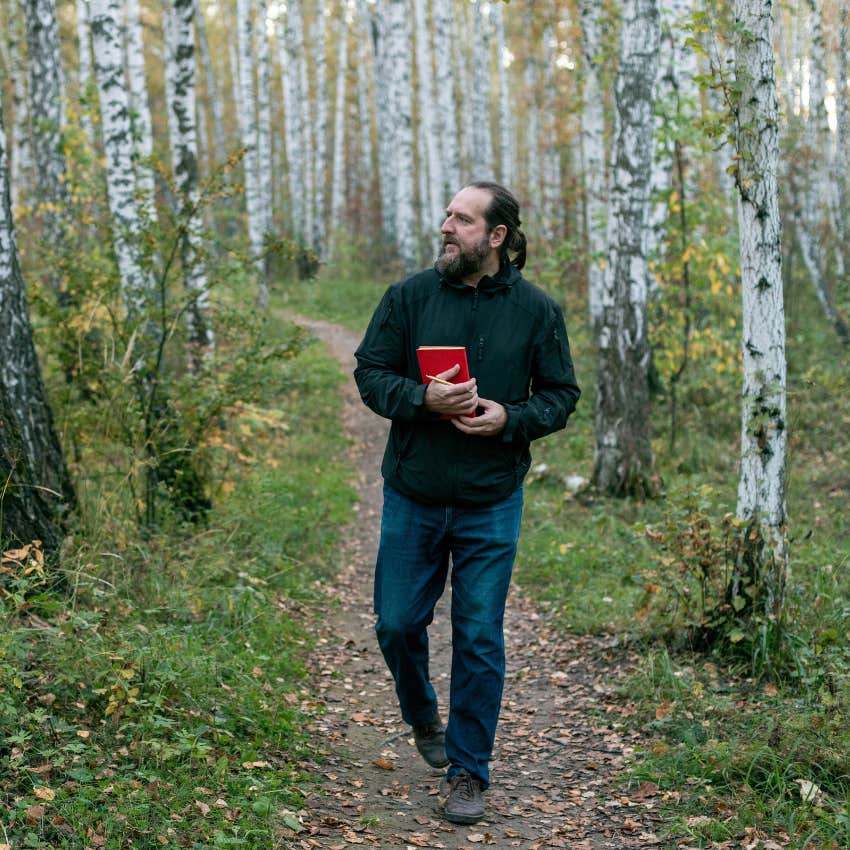
Jobs was known for the 10-minute rule: Whenever he was stuck on a problem for more than 10 minutes, he would leave his desk and go for a walk. His meetings were often walking meetings instead of sitting down with others to discuss ideas.
Modern research from psychology and neuroscience backs him up: walking isn’t just healthy; it boosts creativity, and walking with another person improves connection. Let’s break down the science behind both.
Walking boosts creativity
Modern neuroscience supports Steve Jobs’ strategy of going for a walk if the solution to a problem didn’t come to mind. Jobs intuitively optimally used his brain networks. Creative performance relies on three brain networks:
- Default mode network: It activates when you’re in a relaxed state, daydreaming, or your mind wanders. It helps you generate new ideas or create new connections between ideas.
- Executive network: It’s associated with ‘higher’ cognitive functions such as logical reasoning, planning, or decision-making, and requires a controlled, focused state of mind.
- Salience network: It helps you switch between the two other networks, so that only one of them dominates at a specific moment. It also has a filtering function, regulating what you become aware of and what gets filtered out before you even notice.
Coming back to Steve Jobs’ method and applying it to these networks, he first engaged his executive network by analyzing a problem for 10 minutes. This helped him understand the details and gather all the information he needed. It laid the groundwork for his creative process.
Then, he would go for a walk, so his salience network would downregulate his executive network and activate the default mode network, while also applying a looser filter to allow a free flow of ideas. Neuroscientists call this a ‘detached state’, ideal for spontaneous creative insights.
Walking promotes creative insight: In one study from Stanford University, participants asked to come up with unconventional uses for everyday objects generated more ideas while walking than while seated. The executive network comes into play again later, when the new ideas are evaluated.
So, without knowing the neuroscience behind his process, Steve Jobs did everything right to achieve peak creativity. He created products that were so revolutionary that people were unable to imagine them, or as he put it: “Some people say, ‘Give the customers what they want.’ But that’s not my approach. Our job is to figure out what they’re going to want before they do.”
Walking together increases the connection between people
Steve Jobs didn’t always walk alone, and he preferred walking meetings over sitting ones. “Taking a long walk was his (Jobs’) preferred way to have a serious conversation,” said Jobs’ biographer Walter Isaacson.
Apart from sparking creativity, walking with another person improves connection: In a study, pairs of people who didn’t know each other went on a walk together. The pairs not only synchronized their walking pace but also evaluated each other more favorably after the walk, even when they were not allowed to talk. Other pairs who just shared a space (sitting together in a room and silently working on a task) didn’t change their evaluations of each other.
So, walking together — not just sharing a space — was the key to liking each other more. Steve Jobs understood the power of walking together, not only for serious conversations and creative exchange with others, but also in silence.
Jony Ive, former chief design officer at Apple and one of Jobs’ closest friends, said: “Talking often gets in the way of listening and thinking. Perhaps that is why so much of our time together was spent quietly walking,”
Research consistently shows that people who move in sync with each other build stronger connections, even when they’re not talking. Frequent walks together, many of them in silence, might explain the amazing connection between Jobs and Ive.
Wrapping up the benefits of walking
Science shows that, without knowing the research on the topic, Steve Jobs intuitively did the right thing:
- He walked to unstuck himself.
- He walked to have conversations with people.
- He walked with others in silence.
His walks don’t fully explain his genius, but they contributed substantially to it. Many other great minds, such as Friedrich Nietzsche or Immanuel Kant, were also known for taking regular walks.
“All truly great thoughts are conceived by walking.” — Friedrich Nietzsche
So, next time you’re stuck on a problem, try taking a walk. I can’t promise you’ll become the next Steve Jobs, but it could help you come up with great ideas.
Patricia Schmidt is a Doctor of Psychology, Neuroscientist, and writer on Medium and other platforms. She mainly writes about Psychology and the brain, and she's also a ghostwriter for these topics.
