
Sorry, But No One's Fully Grown Kids Want To Hear These 12 Things From Their Parents
 BearFotos | Shutterstock
 The relationships we have with our parents are bound to change over time, especially when children, who are now adults, move out, enter into adulthood, and the parents are now left to reimagine their life in an empty house. It’s a transitional time for everyone, filled with complicated emotions and intense conversations. Social psychologist Susan Newman notes that, for many parents, "Constant involvement is a very hard habit to break."
But no matter how old their adult children get, no one's fully grown kids want to hear certain things from their parents. Even if their comments are coming from a place of love and support, sometimes the best thing parents can do is take a step back, supporting their children without providing unprompted advice or unnecessary criticism.
No one's fully grown kids want to hear these 12 things from their parents
1. ‘You owe us’
 fizkes | Shutterstock
Parental “enmeshment,” a term psychologist Dr. Margaret Rutherford characterizes as a toxic codependent relationship between parents and their children, partially explains the entitlement many parents feel over their kids' energy, space, and time into adulthood.
Unable to celebrate their children’s independence because of their own insecurities, these parents tend to demand loyalty from them, at the expense of a truly supportive relationship. As a result of phrases like this, many grown kids feel guilty for simply living their own lives and needing their own space.
2. ‘You don’t understand what it’s like’
 fizkes | Shutterstock
An innately dismissive way of communicating with their adult children, many parents rely on asserting their superiority to feed their own self-esteem with comments like "you don't understand." Adult children want to be loved and supported by their parents, but at the end of the day, they need to feel respected.
Grown kids don't want to hear their parents say anything like this, because they know their parents still view them as little children rather than adults who have their own lives. Comparing their experience to their parents is not only unfair, but incredibly harmful to the health of their relationship.
3. ‘You have it much easier than I did’
 ViDI Studio | Shutterstock
In toxic family dynamics, adult children often feel like they’re not heard or understood by their parents , even if they had healthy and supportive connections earlier in life. As the chaos of adulthood, from financial struggles to work, weighs on their family relationship, the way that parents respond to cultivate a supportive environment can be incredibly influential.
When a parent tries to dismiss their child’s concerns, under the guise of comparison, not only do their kids feel generally unsupported, they are less likely to seek out advice or vent to their parents in the future.
As family psychologist Jeffrey Bernstein explained, "Adult children may pull away due to dramatic, stand-out experiences, yet in many cases, this is not always the case. Sometimes, it is the accumulation of adult children experiencing subtle dismissals, chronic invalidation, or simply not feeling seen for years."
4. ‘You’re being selfish’
 Red Stock | Shutterstock
Especially for adults navigating a new job or a living on their own for the first time, taking personal time away from the chaos of work or relationships is extremely influential and necessary to build self-esteem and peace, according to psychologist Alex Klein. Having a deep understanding of themselves, building emotional intelligence, and finding their place in adulthood is essential for adult children, even if their parents perceive it to be “selfish.”
Comments like these can be representative of a larger generational divide, where younger generations of adults today are more concerned with maintaining a healthy work-life balance and self-care than their parents might have been at the same age.
Everyone is doing their best to protect their energy, space, and health, even if it’s misguided or misinterpreted from time to time. Adult children just want to feel respected and loved by their parents, and being called “selfish” for prioritizing their person time only deteriorates the trust and open communication healthy family relationships are founded on.
5. ‘You never make time for us’
 imtmphoto | Shutterstock
Despite relying on their parents' home to store most of their items, many adult children still feel burdened and anxious by worries about their parents after they move out. Even if they have plans to visit every now and then, it can feel difficult to leave them, especially if they’re a single parent or living in an empty house.
This kind of worry only amplifies as their parents grow older. However, some parents use this innate worry as a means to guilt-trip their children, arguing that they’re not spending enough time “at home,” and investing too much time into themselves, their futures, and their adult lives. It's just another experience that represents some parents’ entitlement to their kids’ time and space.
6. ‘When are you going to find a partner?’
 fizkes | Shutterstock
The pressures to find a partner or invest into a long-term relationship have evolved over time, but they’re clearly not completely gone, especially in parent-child relationships with older generations that still place a heavy emphasis on the sanctity of marriage, traditional family structures, and relationships.
According to counselor Dr. Rachel Glik, this pressure is often a large source of tension in parental relationships, contributing to rising rates of parental estrangement in younger generations of adult children. The last thing that fully grown kids want to hear from their parents, especially as they’re finding their footing in adulthood.
7. ‘Your siblings are all doing so well’
 DimaBerlin | Shutterstock
Comparison is the thief of joy and, unfortunately, for many younger generations, they live in a state of constant comparison on social media. They’re already stressed about proving for themselves in a new job, curating the perfect aesthetic in a new place, and making enough money to be comfortable. They don’t need another voice of criticism in their ears.
Even when it comes from a kind-hearted place of joy or support, adult children can perceive a phrase like this as an attack or criticism. It’s better for parents to celebrate their wins, provide advice when they need it, and be there as a listening ear when they need to vent, not compare their achievements as a misguided means of motivation.
8. ‘Welcome to adulthood’
 Dragana Gordic | Shutterstock
Parents of adult children moving out or entering the workforce for the first time have the power to be incredibly supportive and helpful during such a transitional time. Unfortunately, sometimes the wrong phrases can create distance and resentment.
When an adult child feels comfortable enough to express their struggles to their parents, they shouldn't dismiss their emotions with a rude phrase like this. What they're experiencing is new to them, whether it’s about financial trouble, a new job, or even a roommate. They need support, not a snarky attitude.
Parents should ask if they would like advice, support them where they can, and love them. Sometimes, they just need to feel comfort from their parents, rather than criticized or invalidated by unnecessary guilt and unprompted advice.
9. ‘Why would you choose to do that?’
 Prostock-studio | Shutterstock
Many parent-child relationships struggle into adulthood solely because of differing values. They live different lives, prioritize different things, and struggle to see eye-to-eye when it comes to various lifestyle choices. Parents often struggle to take a step back and be a support system rather than a teacher, harming their relationship and making their adult children feel criticized.
Unwarranted questioning and advice from parents ensures that their adult children’s emotions feel dismissed and invalidated. The key to a healthy relationship with adult children is simple: let them live their lives. If you’re concerned about them, find the right time to express that. If you wouldn’t make the same decision as them, keep it to yourself, unless they ask for your advice directly.
"While we may have spent years teaching and guiding them, the tables often turn as they grow into adulthood. Our adult children offer valuable lessons in embracing change, understanding diversity, prioritizing mental health, and living authentically. By learning from their experiences and perspectives, we strengthen our bond with them and enrich our lives profoundly and meaningfully," Bernstein pointed out.
10. ‘We’re so lonely without you’
 fizkes | Shutterstock
Parents who guilt-trip their adult children into spending time with them aren't sparking quality interactions; rather, it’s only introducing additional stress and anxiety into their lives, according to licensed marriage and family therapist Sarah Epstein.
Often coming from a place of fear of being replaced or missing out on their children’s lives, these parents only experience a worsened emotional state by shaming their kids for not spending time with them, sparking resentment on both sides of the aisle.
11. ‘We raised you better than this’
 fizkes | Shutterstock
According to Bernstein, parents often feel guilty when their adult children are struggling, and can make decisions and express unhealthy actions as a means to cope. Phrases like this may feel motivating to a parent, but it's something fully grown kids never want to hear from them. It feels incredibly isolating and dismissive.
Chances are, if an adult child is struggling, they’re battling their own internal turmoil and shame. They don’t need to also feel guilty or embarrassed in every interaction with their parents. The best way to empower adult kids as a parent is to continue supporting them and to set healthy boundaries to ensure nobody is carrying unnecessary emotional burdens.
12. ‘Are you sure you can handle being on your own’
 Chay_Tee | Shutterstock
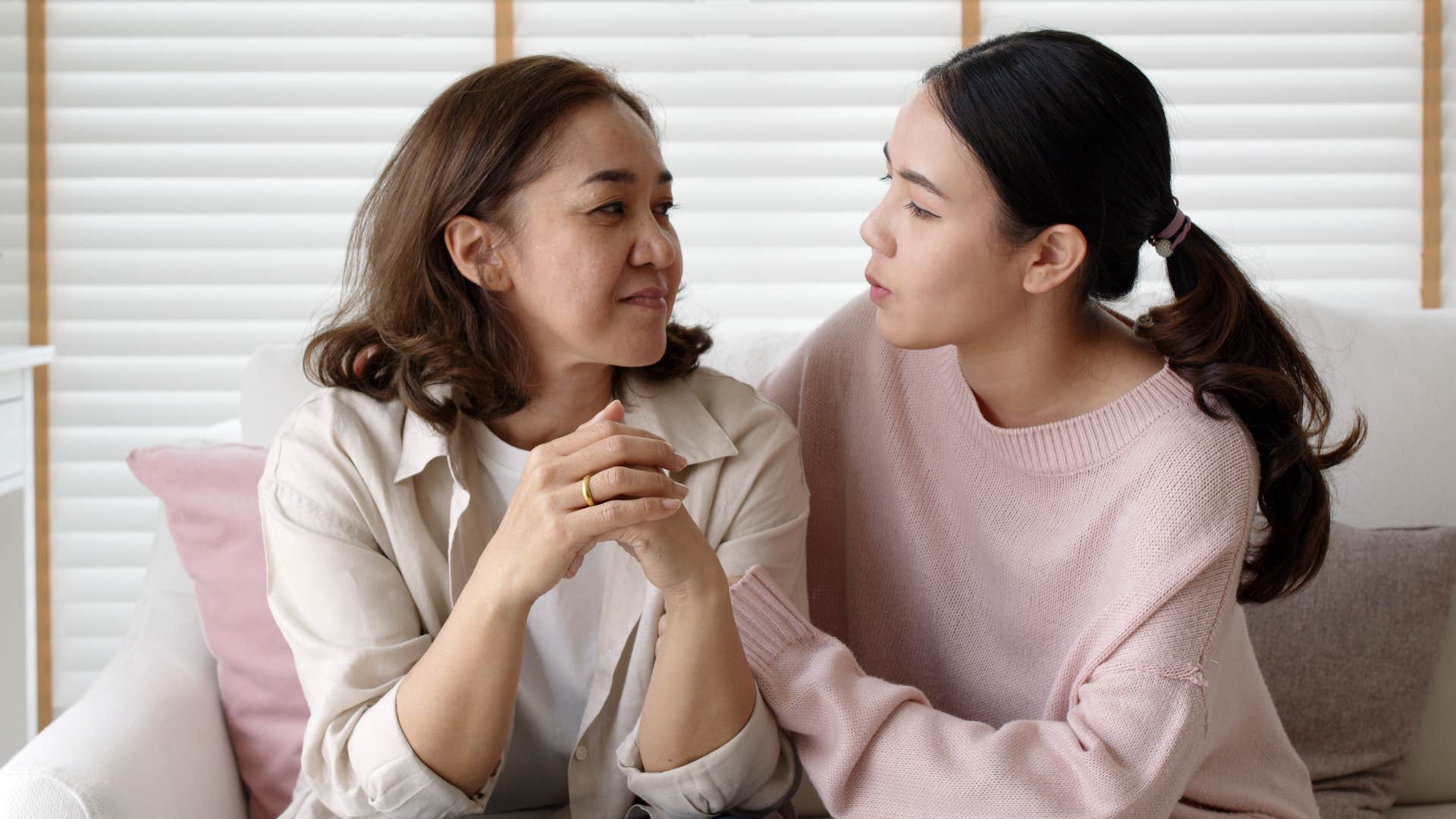
Many parents struggle in adult relationships with their children because they still view them as young kids, incapable of making their own decisions or being fully independent. Misguidedly informed by this experiential gap, parents use comments like this to self-assure themselves, but only leave their adult kids feeling unheard or misunderstood.
As an adult, they can make their own decisions and look out for themselves. They have a more well-rounded idea of what they need, their personal goals, and the life they’re hoping to achieve than their parents who still view them a child needing guidance.
Zayda Slabbekoorn is a senior editorial strategist with a bachelor's degree in social relations & policy and gender studies who focuses on psychology, relationships, self-help, and human interest stories.
