
New Study Shows ChatGPT Is Making Us All Dumber
 Peopleimages.com - YuriArcurs | Shutterstock
 In many ways, my mom and dad defied the parenting stereotypes of the 80s and 90s: My dad was a musician. My mom was a music therapist. They both worked, cooked, cleaned, and raised us. They encouraged me to be a writer (not a doctor or a lawyer), because writing has always been my passion.
But when it came to telling stories about his childhood, my dad was the quintessential Baby Boomer. He’d start every one with, “Back in my day…” I heard those words every single time I opened Wikipedia to start a school paper.
“Back in my day, I had to physically go to the library, get books off the shelves, and flip through them looking for information. If the library was closed and I had a report due the next day, I got a zero.”
I’d roll my eyes and tell him that easier accessibility to information was a good thing, not a bad one. Now, given the exponential growth of AI and large language models (LLMs), I’m not sure I believe that anymore.
A new study shows ChatGPT is making us all dumber
 Viralyft / Unsplash
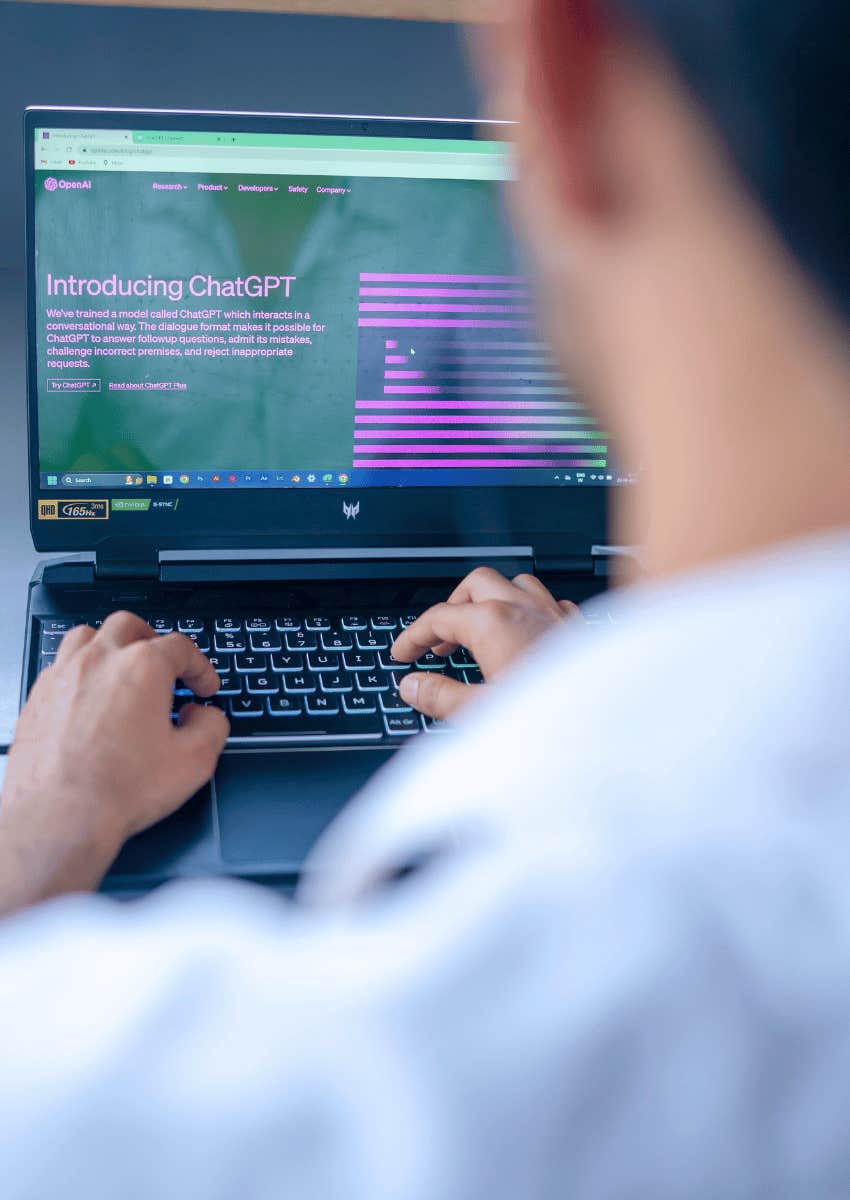
In June of 2025, researchers at the MIT Media Lab divided 54 participants (ages 18 to 39) into three groups. The researchers had everyone in the experiment write a series of essays, but the available research tools differed by group:
- Group one was told to use ChatGPT as their sole source of information.
- Group two was told to use only Google, no AI allowed.
- Group three was forbidden from using anything other than their brains.
The researchers then fitted each participant with a headset that recorded electroencephalogram signals (EEGs), which indicate electrical activity in the brain. Researchers analyzed activity across 32 different brain regions.
Guess what they found? Those who used ChatGPT to write showed significantly less activity in brain regions associated with critical thinking, memory, concentration, and creativity.
But wait, it gets worse
As the essay-writing sessions went on, ChatGPT users grew more dependent on the tool, and by the fourth session, when everyone was required to write an essay using only their brains, ChatGPT users “consistently underperformed” compared to other participants.
They scored less on all levels (neural, linguistic, and essay quality), and 83.3% of them could not remember a single quote from the essay they’d just written.
At the end of the experiment, English teachers evaluated the essays and said that those written by ChatGPT “stood out” — though not for good reasons. They had “a close to perfect use of language and structure,” yet they “simultaneously [failed] to give personal insights or clear statements.”
Also, because LLMs tend to hallucinate, references and citations were often inaccurate or entirely made-up.
In other words, the AI-written essays didn’t contain any grammatical errors, but they also didn’t contain any intrigue, insights, value or humanity. The teachers described these essays as “soulless,” lacking “individuality and creativity.”
Why do we write?
 Micah & Sammie Chaffin / Unsplash+
As humans, we’ve been recording our stories since prehistoric times. Over 45,000 years ago, we painted our thoughts on cave walls, proving the seemingly primal need to transfer knowledge, foster our identities, and connect to one another.
Around 3000 BC, the Sumerians invented cuneiform, our first written language. From there, humans wrote the Epic of Gilgamesh, and then Greek tragedies, and then Shakespearean sonnets. Now, we have The Great Gatsby, To Kill a Mockingbird, Jane Eyre, and The Lord of the Rings.
What do all of these stories have in common? They are the artifacts of hearts, souls, and minds trying to make sense of their own existence. They all express our deeply human need to connect to something bigger than ourselves.
At first glance, AI writing may seem human, and that’s because it was trained on centuries of real people’s writing. But dig a little deeper, and you’ll find that it’s missing something. It’s missing a soul.
Research shows that human writing can heal us
James Pennebaker, PhD, is a professor of psychology at the University of Texas. In his research, he found that expressive writing (also known as therapeutic journaling) can improve mood, reduce stress, and heal trauma.
For four consecutive days, you spend 15 to 20 minutes writing. You focus on an event that was particularly stressful or traumatic for you. You do not stop to think, edit, or worry about spelling or grammar. You definitely don’t stop to consult ChatGPT.
Scientific studies found that participants who practiced expressive writing experienced a significant reduction in anxiety, feelings of greater psychological well-being, improved memory, and fewer visits to the doctor — and these benefits lasted for months, if not years.
But reading has the potential to heal us, too. Research finds that children from high-trauma, low-support households are better able to process emotions when they read books. Avid adult readers experience less stress, improved sleep, greater empathy, and longer lives.
I highly doubt that AI-generated writing can replicate those benefits. Now, don’t get me wrong:
I’m not morally opposed to using AI as a tool
I use it myself when I need help brainstorming, outlining, or pinpointing a particular word. I also used it to help me plant a thriving vegetable garden. Like Wikipedia and the books in my father’s childhood library, it’s a solid jumping-off point — a springboard to make the process easier and more efficient.
But ChatGPT could not replace the feeling of the soil between my fingers, or the taste of a garden-ripe tomato as it burst in my mouth. Once the planning was done, I had to do the hard work on my own. AI is also not currently a replacement for human writing, and I hope it never becomes one.
When I silence my phone, close out of all unnecessary tabs, and write without help, input, or distractions, I reach a state of flow. My inner critic shuts up. My mind settles. My creativity ignites. My humanity returns.
I feel as though the words are channeled through me, inspired by something much larger than myself. Not a large language model, but something primal. Natural. Spiritual. You simply don’t get that experience when you outsource your heart, mind, and soul to a robot.
Maria Cassano is a writer, editor, and journalist whose work has appeared on NBC, Bustle, CNN, The Daily Beast, Food & Wine, and Allure, among others. She's in the process of publishing her memoir/
