
Gen-Z And Baby Boomers Have Totally Different Ideas Of What It Takes To Actually Run A Classroom
 Sandra Dans | Canva
Gen-Xers and baby boomers are now the grandparents of today's Gen Z and Gen Alpha kids, and given how nostalgic they tend to be, they'd probably be sad to see how different classrooms are today.
With the dramatic changes to classroom and school-wide tech, Gen Z and their boomer grandparents have dramatically different ideas of what's necessary in a classroom.
11 items baby boomers think are essential to run a classroom, but Gen Z has pretty much never seen:
1. Chalkboards and chalk
 AJR_photo | Shutterstock
Ask any Gen-Xer or baby boomer about a definitive part of going to school and they’ll recall the sensory experience of using a chalkboard. There was the sharp, squeaking sound that chalk made as you wrote out math problems on the board. There were the feelings of dread and anxiety as you walked past rows of desks to stand there, chalk in hand, trying to come up with the right answer.
And who could forget the sound and smell of their teacher clapping two rectangular erasers together to clean them, filling the air with chalk dust? If you got in trouble, you probably had to stay back and wash the board and clean the erasers quiet often!
By the time millennials were in high school, chalkboards had been replaced by whiteboards: gleaming, blank panels, waiting for some student to grab a marker and draw something inappropriate on them before wiping the image away with the sleeve of their shirt. After whiteboards came smartboards, which provide multimedia presentations and interactive lessons.
Gen-Z and Gen-Alpha were born into a fully digital age and don't feel any need to have a chalkboard or chalk. While their parents and grandparents cannot imagine a classroom without it, they can't imagine why anyone would want it!
2. Overhead projectors
 SeventyFour | Shutterstock
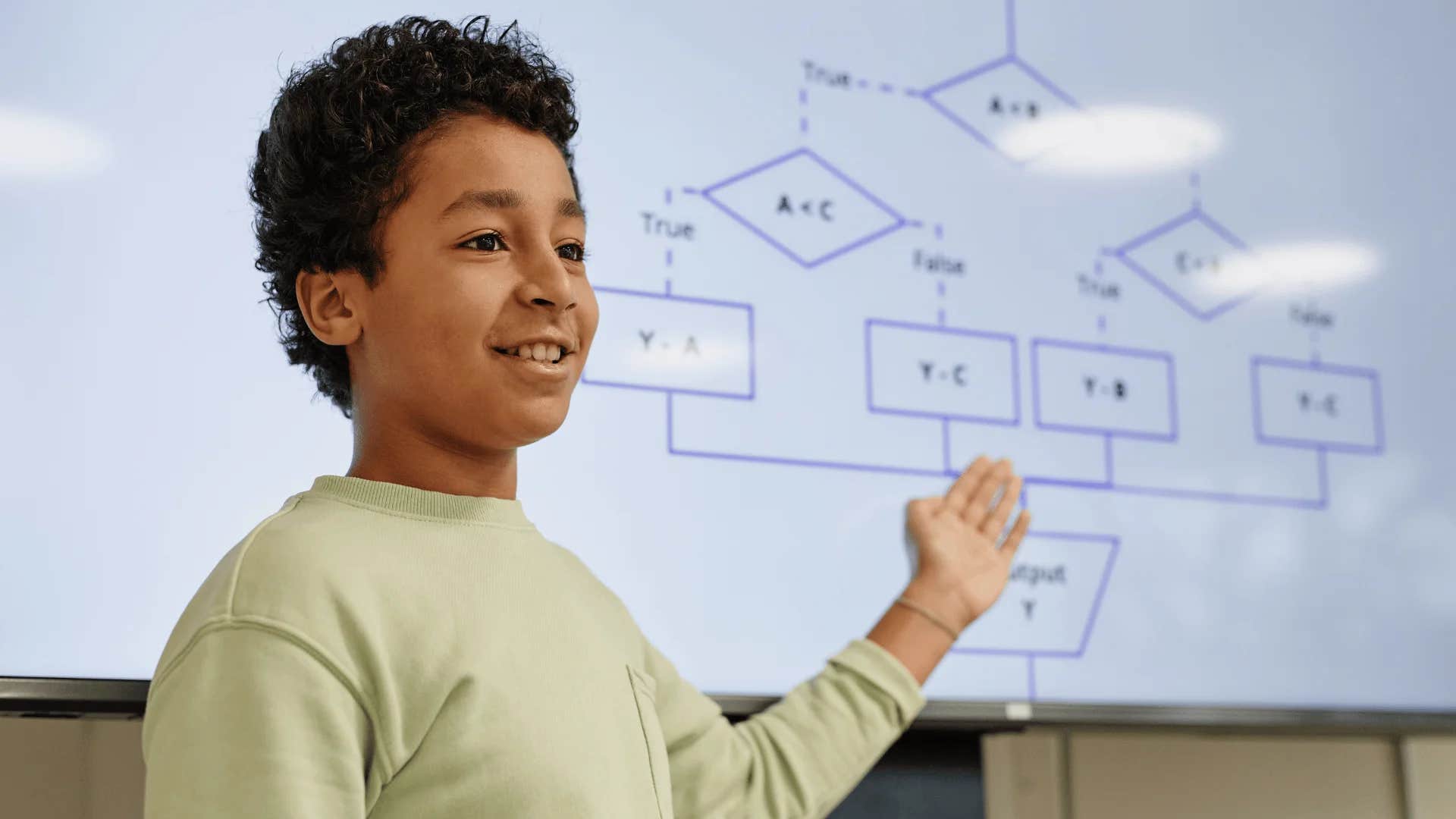
While some parts of going to school don’t change, like big yellow school buses and trying to fit in with the popular kids, other things have gone the way of wooly mammoths and dinosaurs. Overhead projectors are one of those things, as the invention of smartboards made them obsolete.
What's fascinating is that overhead projectors didn't start in the classroom. They were originally most often used for mission briefings during World War II. With the invention of a projectable transparent film, the overhead projector made its way into classrooms as a teaching tool.
While those boxy, heavy machines originated with the Silent Generation, they were anything but quiet. Overhead projectors made a constant, humming noise. They blew out hot air through a vent that could easily blast you in the face if you weren’t careful. Much like a solar eclipse, staring directly into the light of an overhead projector could blind you, even if only for a moment.
Smartboards are simple digital representations, but they have their down-sides, too. When the act up, you need IT (not just a new bulb or to make sure it's plugged in), the colors can be incorrectly represented and a few other small factors. For boomers, they'd rather just run the classroom with a projector than deal with the drama of yet another computerized tool.
3. Manual pencil sharpeners
 Urbanscape | Shutterstock
Another essential feature of classrooms that no longer exists is the manual pencil sharpener that all classrooms used to have mounted near the door. These wall-mounted beauties had a rotating ring of different-sized holes, meant for different-sized pencils. It took some serious work to turn the tiny handle, but cranking it was a satisfying way to get to the end result.
Manual pencil sharpeners allowed for one of the greatest activities a student could participate in: getting up from your desk a thousand times in one period to sharpen your pencil. For a wiggly kid (or an ADHD teen!) the opportunity to move from your desk and crank crank crank that handle was a huge relief. The teacher inevitably told you to stop getting up, but it was always worth it to try.
Manual pencil sharpeners were replaced by electric pencil sharpeners, which still gave students the option to complete the classroom’s most satisfactory chore: emptying the pencil shavings into the trash. I can remember the smell of the little wood shavings even now.
Yet even the presence of electric pencil sharpeners has declined these days, as they’re not really needed in digital classrooms. Unless you're in a math class, older kids today do everything on a tablet or ChromeBook. To baby boomers and Gen X, this is a tragedy.
4. Card catalogs at the library
 Litvinov | Shutterstock
Another thing that has disappeared since Gen-X and boomers were in school are library card catalogs. Those hulking, wooden cabinets played a central role in school libraries, as students pulled out each drawer and rifled through cards to find the shelving information for whatever book they wanted to read.
In America, the card catalog system started after the Civil War. Charles Cutter, the librarian at the Harvard University Library, discovered that it was easier to use cards than a handwritten paper catalog. Melvil Dewey, who was the chief librarian of Columbia University Libraries, invented the one and only Dewey Decimal Classification to shelve books according to 10 categories.
The card catalog of the olden days has been replaced by a digital system, making it even easier to find books, without the danger of paper cuts. While the stronghold of nostalgia might make Gen-X and Millennials wax poetic about card catalogs, digital systems are a much more streamlined and faster approach.
5. Paper attendance registers
 StudioRomantic | Shutterstock
Paper attendance registers are yet another thing that has disappeared from classrooms since boomers were in school, replaced by an electronic system.
Gen Z's parents and grandparents got the full Ferris Bueller experience, sitting in a silent classroom while their teacher called out every students’ name in a monotone voice, until that student shouted out "here!", something they simply cannot imagine enduring. The teachers, meanwhile, marked an X or check mark next to each name and then sent the attendance slip to the main office in the hands of a student.
For baby boomers, the honor of being able to deliver the attendance slip to the envelope on the outside of the door or all the way to the office was a dream, as any opportunity to stand up and help was treasured. They're sad that kids today don't have the opportunity, since attendance is taken and submitted with just a little click of a button.
6. Dodgeball during gym class
 BearFotos | Shutterstock
Playing dodgeball in gym class is an activity that has disappeared since Gen-X was in school, and similar rough games were part of PE classes for baby boomers.
For decades, slamming red rubber balls at other kids’ bodies was a time-honored tradition in the American education system, which is probably a metaphor for something if anyone cared to dig deep enough into the socio-emotional undertones of dodgeball to find out.
For some students, dodgeball was their time to shine. For others, the very idea of playing dodgeball struck fear into their hearts. Yet by 2004, certain states banned the game. In Massachusetts, Maryland, Maine, New York, Virginia, Texas, and Utah, dodgeball became a thing of the past. School districts cited the physical dangers of the game, as well as the psychological toll it took on students. Dodgeball was deemed “legalized bullying,” which led to its disappearance in many schools.
7. Well-worn encyclopedias in the library
 mentatdgt | Shutterstock
It's likely impossible for a baby boomer to imagine school encyclopedias going all but untouched, but today's generation has almost no reason to find the right book for the word they need to look up, since they can just use a computer.
When they were assigned a research project, students pored over those thick, leather-bound books, searching for credible information to back up their statements, jotting notes (including the citations, like publish date and author!) into paper notebooks with pencils. By the 90s, students started using CD-ROM encyclopedias, a cutting edge technology at the time. The act of slipping that silver disc into a slot on the family computer is something kids did with great frequency, but is also almost totally gone from classrooms.
Gen-Z and Gen-Alpha can find the literal world’s worth of information in seconds flat online, which is an entirely different academic experience from taking a heavy encyclopedia off the library shelf, turning page after page, and handwriting notes onto paper. But boomers think they're missing out. Flipping through the encyclopedia required a little effort, but you often found other topics to read about while you were doing it.
8. Pay phones at school
 Marian Fil | Shutterstock
Another thing that has truly gone the way of the Dodo is the presence of pay phones in the hallways or right outside the front door of schools. If Gen X or boomer students needed to reach their parents during the day, they stood at a payphone, put a dime into the slot, and pressed actual buttons, which were somehow always sticky.
They would read the graffiti scrawled across the metal box, written with Sharpies, as they waited for the person they were calling to pick up.
Pay phones became obsolete once smart phones staked their claim in almost everyone’s life. Communication became instantaneous. Even making actual calls mostly disappeared, since texting is a more immediate way to get in touch with people. While students were once intimately acquainted with using pay phones, now they pretty much all have cell phones and pay phones have disappeared.
9. Physical maps and globes
 Nestor Rizhniak | Shutterstock
Back in the day, every classroom had a series of maps that teachers pulled down during geography lessons. Classrooms also had at least one globe, and depending on what year it was, likely had countries like the U.S.S.R on it, that no longer exist.
By the time Gen Z arrived physical maps were replaced by digital interactive maps. The switch from paper maps to digital maps on a screen is another example of technology’s rapid advancement, which changed the way kids learn forever.
For teachers and school admin today, no longer needing to worry about out-of-dates maps is a relief. But for boomers and Gen X, there was a thrill to watching the various maps being pulled down, and something special about running their fingers across the surface of a globe, imagining how far you'd have to fly in order to arrive somewhere.
10. Dressing in uniforms for PE and showering after
 Krakenimages.com | Shutterstock
Most of people who grew up in the 60s through the 80s remembers the school-assigned uniforms that they were required to wear for gym class: rough cotton t-shirts emblazoned with the school’s name, ill-fitting shorts, and athletic socks. The pain and embarrassment of wearing a gym uniform was only outweighed by the pain and embarrassment of changing the locker room. The combination of raging hormones, tender emotions, and comparing your body to everyone else’s isn’t easy to forget.
That formative experience of wearing the same gym outfit as everyone else, as though you were in a cult led by jocks, is something students don’t have to worry about anymore. Most students in this day and age are allowed to bring their gym clothes from home, which can go a long way in helping them feel more comfortable in an inherently uncomfortable situation.
What is most shocking to parents of Gen Z is the fact that the kids almost never take a shower after PE. It was determined a bad use of time, and while some schools still offer kids the option to shower if needed after gym class, most kids simply don't do it, as it doesn't seem appropriate.
11. Handwritten notes between students
 Jacob Lund | Shutterstock
Passing notes in class could easily be described as the most important middle and high school pastime ever, yet that activity has pretty much disappeared. There was nothing as exciting as scribbling down an urgent message onto paper, folding it a hundred times, and stealthily sending it down the rows of desks.
What joy, to watch your note pass from sweaty palm to sweaty palm. What exhilaration, when it arrived at its intended destination, and what crushing despair when the teacher caught you passing notes. Oh, how everyone’s heart pounded as the teacher read the contraband note aloud: “Do you like me? Check one, yes, no, maybe.”
Decades have passed, and the modern world has essentially no need for passing notes. Today’s students send texts. They share Snapchats and TikToks, and while they might not be allowed to have their phones out in class, they don’t run the risk of their teacher intercepting a note.
Technology and society are always changing. The unavoidable push into the future means that things become outdated and get erased from the cultural lexicon. Yet their memory lives on, since nostalgia is something that will never disappear.
Alexandra Blogier is a writer on YourTango's news and entertainment team. She covers social issues, pop culture analysis and all things to do with the entertainment industry.
