
11 Obvious Signs A Man Never Felt Securely Loved As A Little Boy
 Sabphoto | Shutterstock
 For most adults, regardless of gender, childhood experiences and the relationships they share with their parents greatly impact their routines and connections later in life, at least according to a 2024 study. From the parental warmth and emotional support they’re offered by parents to the routines and rituals that existed in their households, the kinds of experiences kids have during their most impressionable years make a real difference in their adult lives.
However, especially for young boys, often subjected to misguided gender norms and stereotypes of “masculinity,” these childhood experiences can lead to an adulthood of emotional restrictiveness, poor emotional regulation skills, and insecure relationship attachments. They’ve been socialized to avoid vulnerability, leading to a million obvious signs a man never felt securely loved as a little boy.
Here are 11 obvious signs a man never felt securely loved as a little boy
1. He tests loyalty in relationships
 Zoran Jesic | Shutterstock
Men who were never securely loved by their parents as little boys often frame relationships through the lens of disappointment, guilt, and loneliness. They expect the relationship they shared with their parents to repeat itself in other romantic and professional contexts in adulthood, so it’s not surprising that they’re careful with their trust and control.
Whether it’s playing emotional games or “testing” someone’s loyalty in a relationship, they offer routes for people to leave and abandon them before letting their emotional guards down. They’re so used to being disappointed that they come to expect it, even if it means self-sabotaging connections that could potentially blossom into something secure and beautiful.
2. He deflects compliments and praise
 Chay_Tee | Shutterstock
Many people who regularly avoid praise from others and deflect compliments are grappling with low self-esteem. Whether it’s rooted in unresolved childhood trauma or not being met with affection from parents, these men often deflect praise and appreciation because they actively conflict with the negative self-talk they often hold themselves to, according to psychologist Guy Winch.
If they’re telling themselves they’re not good enough or worthy of love, and someone else is saying the opposite of that, it can feel entirely disorienting and invalidating.
3. He refuses to ask for help
 PeopleImages | Shutterstock
While asking for help is uncomfortable for most people, being comfortable and regulated enough with your emotions allows you to benefit from the bonding and learning opportunities that come from doing it often, at least according to a Stanford study.
However, many men who had unmet needs in childhood and were pressured by their parents to overlook their own needs in favor of theirs now demonize their own needs. They refuse to ask people for help because they view it as a “character flaw” or an admission that they’re “failing” in some way, when in reality, it’s actually a sign of confidence and strength.
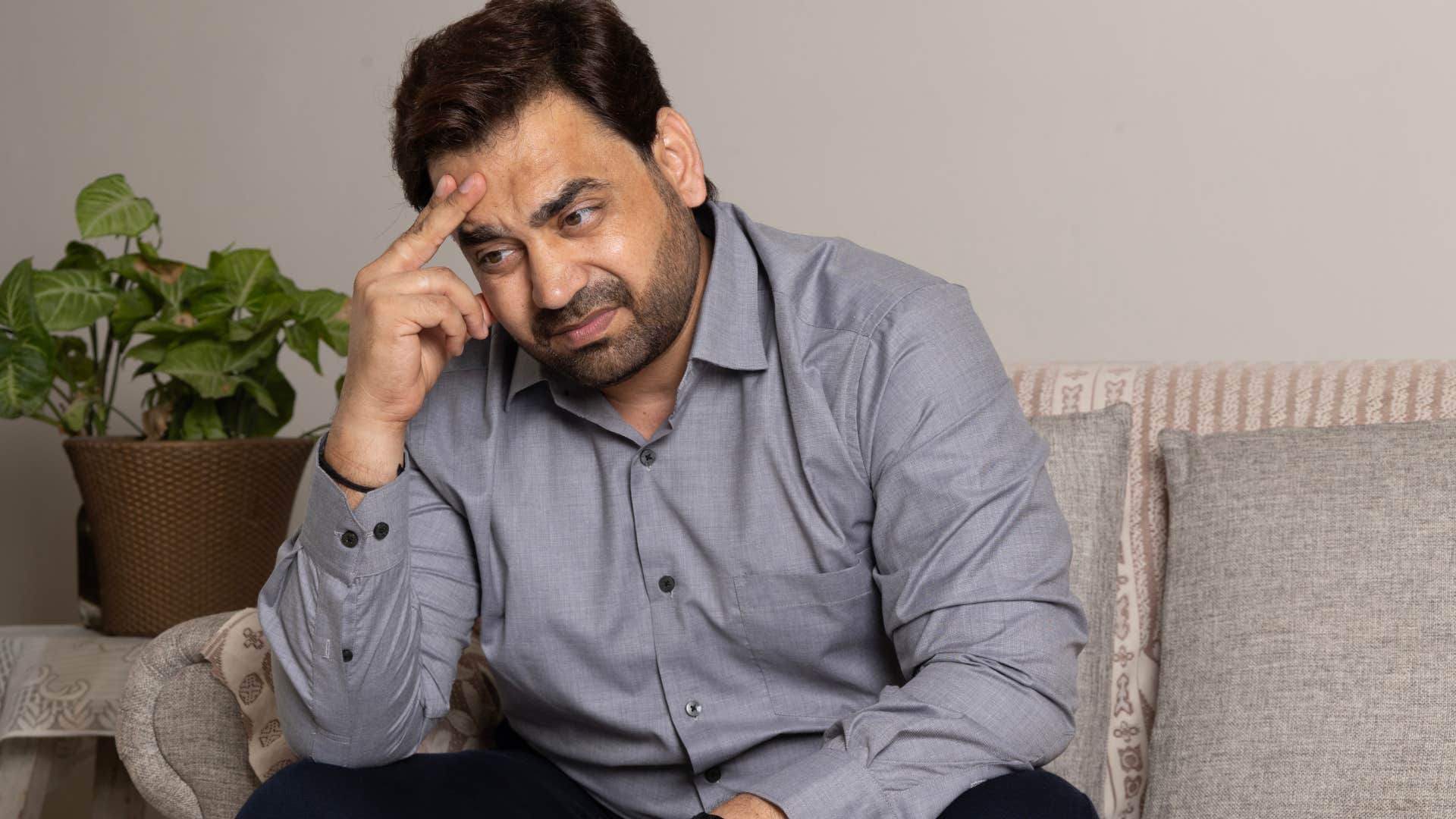
4. He suppresses his complex emotions
 Master of Stocks | Shutterstock
Even in homes where men were taught to “cope” with emotions with things like avoidance or control, they often still fall into adult spirals of suppressing complex emotions or overemphasizing specific ones, like anger.
As adults, men are more likely to “externalize” their problems and emotions with misguided coping mechanisms like indulging in vices and leveraging aggressive behaviors, especially if they’ve been socialized from a young age into believing their emotions aren’t worthy of support or positive attention.
While it might seem harmless to build into hyper-independence and protect their sense of control by suppressing emotions, in the long run, they sabotage their connections and chip away at their sense of self-esteem.
5. He’s hyper-independent
 insta_photos | Shutterstock
Hyper-independence is often a response to trauma for adult children, at least according to relationship coach Annie Tanasugarn. For kids who felt little control over their lives or who felt unacknowledged, disappointed, and consistently dismissed by their parents, hyper-independence in adulthood is a means of clinging to their new autonomy and control.
Of course, some level of self-reliance and independence is necessary in adulthood, but if these men are isolating themselves, self-sabotaging healthy relationships, and refusing feedback for the sake of control, it can transform into loneliness quickly.
6. He struggles to accept feedback
 Zmaster | Shutterstock
Struggling to accept feedback often comes back to a foundation of insecurity. If someone’s struggling with self-esteem or frames their self-worth around praise and reassurance from others, being met with constructive criticism and feedback can feel like a personal attack.
Especially for men who never felt securely loved as little boys, living with parents who made them prove themselves worthy of love and affection, it’s not surprising that they struggle to accept feedback and get defensive when someone points out where they can grow.
7. He runs from ‘labels’ and commitment in relationships
 Zamrznuti tonovi | Shutterstock
Men who self-sabotage relationships when things are going well or run from labels and commitments in their connections often fear abandonment and rejection. Their avoidant tendencies and emotional walls are defense mechanisms to cope with these fears.
As a study from the journal Healthcare explains, parental mistreatment and emotional coldness often encourage young children to adopt guilt and shame, which can lead to these misguided coping mechanisms that harm their well-being and relationships for life.
These men struggle to trust other people, especially in vulnerable ways, because they feel foundationally “unlovable” due to childhood experiences. Their parents made them feel ashamed for asking for what they needed or guilty for expressing their needs, so in relationships, they expect similar things.
8. He minimizes his own needs and emotions
 Dragana Gordic | Shutterstock
So many men have been taught to “tough it out” or “man up” in the face of complex emotions like shame and sadness, leading to cycles of emotional suppression, irritability, and isolation that are hard to unwind themselves from. However, true strength comes from recognizing trauma, opening up to trusted peers, and validating personal emotions without immediately shutting down and shoving them away.
Men who never felt securely loved as little boys avoid vulnerability and emotionally “stonewall” their partners when things get difficult, because they never had a space to practice accepting and expressing themselves without judgment.
9. He avoids conflict and arguments
 MAYA LAB | Shutterstock
Psychologist Jonice Webb suggests that unmet needs and emotionally absent parents often cultivate emotionally immature adult men. They may have good intentions, but when it comes to inherently emotional experiences like resolving conflicts with a partner or making space for their emotions in conversations, they struggle to accept that they’re worthy of support and attention.
Shutting down around conflict and running away from hard conversations are obvious signs that a man never felt securely loved as a little boy. He worries about losing control or even being abandoned, because his vulnerability has always been framed as a “weakness” or something to hide.
10. He ‘overreacts’ to small triggers
 MAYA LAB | Shutterstock
Men are often pressured to suppress their emotions, with the exception of anger, in their relationships and adult lives from a young age. These norms misconstrue anger with a form of control, making it “acceptable” in contrast to truly healthy forms of vulnerability and openness.
However, simply suppressing emotions often causes emotional outbursts over small triggers and arguments in daily life as well. The more you push feelings away, the more at risk these men are for experiencing emotional outbursts, because these feelings don’t simply go away because they’re ignored.
These tendencies are rooted in instant comfort and may provide a feeling of respite for men who have been taught to minimize and dismiss their feelings in childhood. But in the end, it only creates more emotional reactivity and distress.
11. He clings to ‘protector’ and ‘provider’ roles
 fizkes | Shutterstock
While old-fashioned gender roles encouraged men to be the “protectors” and “providers” for their partners and families, they can oftentimes lead to resentment, pressure, and burnout if they’re not also present in relationships with warmth, support, and balance. According to psychotherapist Avrum Weiss, men socialized into these roles often take on a big responsibility for their wives’ happiness.
Especially for men who never felt securely loved as a little boy unless they had something to offer in exchange for conditional warmth and affection, these kinds of self-perceived “failures” can make them shut down emotionally to protect themselves from fears of rejection and abandonment.
Zayda Slabbekoorn is a senior editorial strategist with a bachelor’s degree in social relations & policy and gender studies who focuses on psychology, relationships, self-help, and human interest stories.
