
People Raised By Narcissistic Parents Often Heard 11 Casual Phrases Without Realizing How Manipulative They Were
 Anna Alexes | Pexels
 There are two types of parents in this world: those who do their best to do what is right for their children and those who use manipulative tactics to keep their kids under control. Distinguishing between the two can be difficult, as narcissists are often quite charming, but there are some specifically manipulative phrases narcissistic parents say to keep their kids weak and dependent that will quickly give them away.
People raised by narcissistic parents often hear these manipulative phrases growing up:
1. 'I know what's best for you'
 BearFotos | Shutterstock
Narcissistic parents' main objective is to control their kids by pointing out their perceived incompetence. As a result, a manipulative phrase narcissistic parents say to keep their kids weak and dependent is, "I know what's best for you." Sure, when children are younger and defenseless, parents need to take the reins and guide them. However, as kids grow up, their need for independence becomes increasingly important.
Whether narcissistic parents want to admit it or not, children must fail in order to learn from their mistakes and develop as a person. According to the National Poll on Children's Health, independence makes kids more resilient and better at problem-solving. Despite this fact, many narcissistic parents don't know how to let go of their controlling tendencies. As marriage and family therapist Dan Neuharth, Ph.D., MFT, perfectly explained, "They have a knack for knocking others down a peg, even their own kids."
2. 'You're being way too emotional'
 fizkes | Shutterstock
Everyone gets emotional at times, and deep down, most narcissistic parents know that children are bound to be emotional at times. Since their brains aren't fully developed until age 25 or later, emotionally healthy parents understand that lashing out or crying when confused or overwhelmed is normal for children. Unfortunately, narcissists don't want to put up with the emotions of their children, causing them to condemn their emotions instead. According to psychotherapist Elinor Greenberg, Ph.D., "People with untreated NPD lack emotional empathy."
3. 'After everything I've done, this is how you repay me?'
 Motorition Films | Shutterstock
When parents bring a child into this world, they must commit to the fact that their children are individual beings and may not always follow the road they so carefully planned for them. From deciding not to go to college to disregarding their parents' choices for them, children will grow into adults with their own opinions, whether narcissistic parents like it or not. Understandably, any parent can feel a bit peeved when their child is ungrateful. After birthing a child, raising a child, and investing in their education and environment, it's a slap in the face to feel as if they're disregarding their parent's hard work. But there's a clear difference between a narcissist and a regular parent.
Narcissists will say this phrase to their children over any small thing: Did their child express their emotions or disagree with their narcissistic parent? Expect a narcissistic parent to use this phrase against them to get them to fall in line. According to licensed marriage and family therapist Dan Neuharth, Ph.D., MFT, when a narcissist does something for someone, it often comes with strings attached.
4. 'You'd fail without me'
 Brian A Jackson | Shutterstock
When failure knocks on their kid's door, parents must guide them through those emotions while also letting them pick themselves back up. Even so, narcissistic parents don't care if they damage their kid's ability to believe in themselves. As long as their child depends on them, then who cares what they say at the end of the day, right?
However, parents shouldn't take damaged self-esteem lightly. According to the American Psychological Association, "Low self-esteem or lack of confidence leaves students doubting their ability to succeed, making them hesitant to engage in learning or take appropriate academic growth risks." So, while narcissistic parents might think that they know best, demeaning their children through the use of this manipulative phrase only hinders their success later on.
5. 'You're just like so and so'
 Prostock-studio | Shutterstock
Narcissistic parents are so obsessed with their idea of perfection that they'll constantly draw comparisons and demean their children. This is probably why so many of them say to keep their kids, "You're just like so-and-so." Comparing your children to other kids can crush a child's self-esteem. According to a study published in 2025, comparison impacts children's self-esteem, whether it's uttered directly or indirectly. While narcissists will continue to do what they do, parents who truly love their children should be wary of comparisons. Even if they had the best intentions, comparisons can be crushing to their children's mental health and, by extension, their sense of self.
6. 'I'm hard on you because I love you'
 Thaninee Chuensomchit | Shutterstock
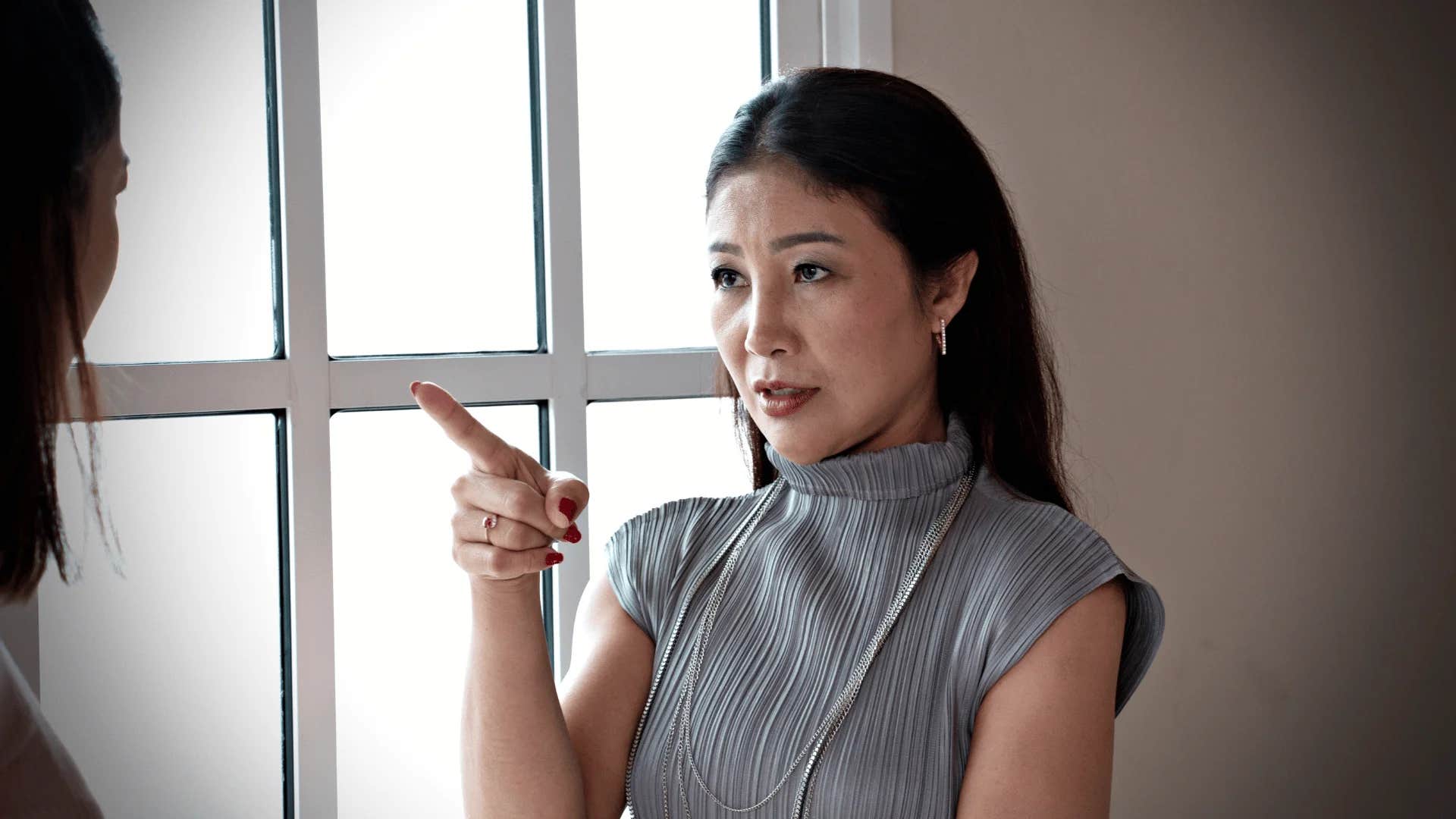
The next manipulative phrase narcissistic parents say is, "I'm hard on you because I love you." Sometimes, showing a bit of tough love is necessary. When children are out of line and need a rude awakening, parents should step in and guide them. Still, this phrase can easily weaken kids if parents aren't careful.
For example, a narcissistic parent using this phrase to condemn their child's looks will only teach their children that accepting criticism under the guise of love is perfectly acceptable. This is dangerous, as children who become adults might enter into toxic relationships where abusers justify their abusive or controlling behavior by claiming that they're doing it out of love.
7. 'You'll regret cutting me off'
 DimaBerlin | Shutterstock
At some point, a kid grows up and becomes a young adult with a choice: do they continue a relationship with toxic parents, or do they leave? For many kids, the answer might be simple, depending on how they were raised. Kids raised in a loving home likely won't think twice about keeping their parents in their lives.
However, kids who grew up with narcissistic parents might hesitate to maintain a relationship with them. After all, their toxic behavior and condescending words have likely left a huge impact on this child, causing irreversible damage in the process. Narcissistic parents often refuse to take responsibility for their actions. "Instead, they blame their children for the harm, or a nearby party, insisting that, if they had acted differently, they would never have been hurt," said mental health professional Jamie Cannon, MS, LPC. And if their children still decide to go through with cutting their parents off? Expect a narcissist to constantly throw this phrase back in their face.
8. 'Nobody will ever love you like me'
 fizkes | Shutterstock
As kids grow older, they'll slowly be introduced to new people. Family and friends will become important figures in their lives, shaping the person they become. As parents, it can be difficult to let your kids explore and meet new people. Parental fear of the unknown likely makes parents want to hold their children a little closer.
Still, most healthy parents understand a child's need to form their own social circles, whereas on the opposite end, narcissistic parents have a hard time letting go. They're so used to being the only one in their child's life that a narcissist might feel threatened by being viewed as second best.
9. 'If it wasn't for me, you wouldn't be where you are'
 AstroStar | Shutterstock
It's unfortunate, but narcissists don't actually want their children to feel good about themselves. Known for stealing the spotlight, narcissists love to rob their kids of their own accomplishments by pointing out the fact that "If it wasn't for me, you wouldn't be where you are." On the surface, there's a slight truth to this. Yes, parents do give their kids opportunities to network or get the best education. And while all of this may be true, it is also true that kids put in the work to use those opportunities well.
Whether that means studying for hours on end to earn good grades or volunteering to make their college admissions essay stronger, this effort comes from the kids, not the parents. Knowing this, kids should never feel ashamed of their successes. They should know that throughout life, they'll continue to be successful, not just because of their parents, but through their own determination and hard work, too.
10. 'This wouldn't have happened if you'd have just listened to me'
 fizkes | Shutterstock
If there's one thing a narcissistic parent loves to do, it's to rub people's flaws in their faces. Most people forget this, but being narcissistic means having an excessive amount of admiration for oneself. So, when someone disturbs their perfect image of themselves by pushing against the grain, narcissists want nothing more than to prove them wrong. With this manipulative phrase, not only does a narcissistic parent feel reaffirmed in their own superiority, but they also have another way to make their kids more dependent on them.
11. 'I can't trust you to make your own decisions'
 fast-stock | Shutterstock
Finally, the last manipulative phrase narcissistic parents say to keep their kids weak is, "I can't trust you to make your own decisions." Children will make their own decisions, whether parents want them to or not. Some of these decisions might be great, and some are questionable, to say the least. Yet, through making these choices, kids grow into capable adults who feel empowered to take charge of their own lives.
Narcissistic parents rob their kids of this security when they constantly reinforce the idea that their kids aren't good enough to make choices for themselves. That's why it's important for kids who become adults to separate themselves and explore their independence. As much as a parent might complain, exploring their own freedom will only make it much easier to let go of the toxic, narcissistic parent who is constantly holding them back from their own destiny.
Marielisa Reyes is a writer with a bachelor's degree in psychology who covers self-help, relationships, career, family, and astrology topics.
