
I’m A Neuroscientist: People Who Consistently Do 3 Exercises Tend To Age Much Better Over Time
 RDNE Stock project | Canva
 As a neuroscientist in my early 40s, aging is a topic that matters to me. I want to stay fit for the decades to come, both physically and mentally, and I know I need to take care of myself to age better.
My strategy involves different angles, starting with mindset: I embrace aging, and I’m aware that aging doesn’t automatically mean cognitive decline. Of course, I also practice the classical exercises: strength training, cardio, and stretching.
But this article focuses on other exercises I include in my daily routine. They might be rather unexpected or unknown, but they could make a big difference in how you age. Plus, they take only a few minutes each day and don’t cost you any money.
People who consistently do these 3 exercises tend to age much better over time:
1. Standing on one leg
Why it’s important: Being able to stand on one leg is related to balance. Balance is crucial for movement coordination and to prevent falls, which become more common with increasing age.
What the science says: Balance declines over the lifespan. According to a study, balance is preserved into the late 30s and then begins to decline. The decline is slow at first, but then accelerates:
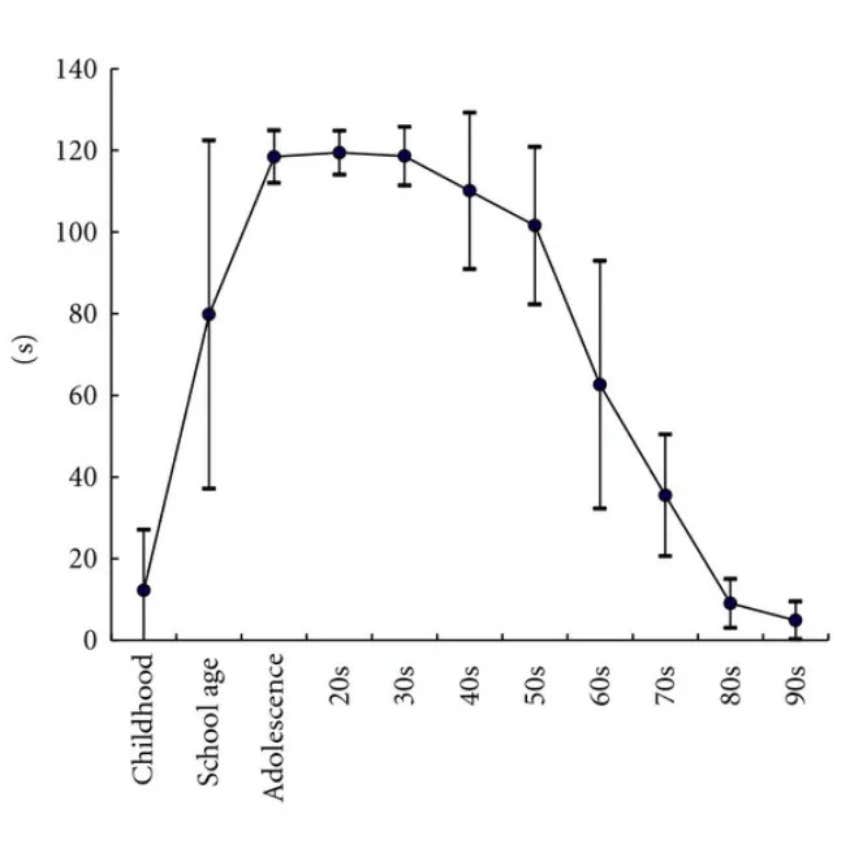 Source: Morioka et al., 2012.
Another study showed that the inability to stand on one leg for at least 10 seconds was associated with higher all-cause mortality in subsequent years. This pattern remained even after correcting for age, gender, BMI, and various health risks.
The good news is that you can train your balance skills just like you can train your muscles: A study with 360 participants aged 70–80 years showed that 2 minutes/day of standing on each leg (while brushing their teeth) for one year significantly improved balance.
Practical recommendation: Practice standing on one leg for 2 min per leg daily (you can split this up into two 1-minute sessions per leg). That doesn’t mean you must remain stable on one leg for 2 minutes; instead, try to stay on one leg for as long as you can and reinitiate the practice as many times as you need during those 2 minutes.
To avoid falls and increase your safety, stay near a stable support (wall, desk, etc.). For stability, it helps to focus your eyes on a fixed point during the practice. Once you’re more advanced, you can practice closing your eyes for a few seconds. This is a lot more difficult than with eyes open, so if it feels hard, that’s normal!
Another “upgrade” of the balance task is doing some simultaneous cognitive exercise (e.g., counting backwards by 3s or 7s from a random number while standing on one leg). Combining the balance task with a cognitive challenge is even more beneficial than the balance task alone.
2. Eye exercises
Why it’s important: Near vision declines with age. Eye problems aren’t just uncomfortable; they affect your everyday functioning and well-being.
What the science says: As we age, the lens and its supporting tissues become stiffer, making it harder to change the lens shape for near objects. The result of this process is called presbyopia — the phenomenon that your vision for near objects declines and you have to hold them farther away to see them better.
That’s why even people who didn’t use glasses in their younger years need corrective measures at some point in midlife.
There’s limited but promising evidence that eye exercises can improve some aspects of the visual process and the subjective satisfaction with near vision, even though they cannot fully reverse age-related changes. In other words, you might still need glasses or another corrective measure at some point, but you’re not just a victim of worsening eyesight. You can actively do something about it.
Practical recommendation: One training method implies quick switches between near and far visual targets.
How to do it:
- Hold a near target (e.g., a pen or your finger) at a 30–40 cm distance from your eyes.
- Identify another target that is over 5 meters away (across the room or out a window).
- Now switch your visual focus quickly between the near and far targets.
- Do this 20 times in one set.
- Start with 1 set/day and increase the number weekly until you can do 4 sets/day.
- For safety reasons, do this exercise in a seated position.
Another exercise is “pencil pushups”.
How to do it:
- Hold a pen at arm’s length and focus your eyes on it
- Slowly move it closer to your eyes until it gets blurry or you see a double image
- Hold it at the closest point where you can still see a clear image of the pen and remain there for 5 seconds.
- Do this 15 times in one set.
- Start with 1 set/day and increase the number weekly until you can do 4 sets/day.
- For safety reasons, do this exercise in a seated position.
Warning: If you have eye pain, double vision, or sudden vision changes, talk to an eye care professional instead.
3. Smelling different odors
Why it’s important: Olfactory function (the ability to smell) declines with increasing age. It is linked to cognitive function, general well-being, and mental health.
What the science says: Most people over 65 have some form of olfactory impairment, ranging from mild impairment to complete loss of smell (anosmia). These impairments are associated with cognitive decline and even dementia. Not everybody with impaired olfactory function will experience cognitive decline or dementia, but it’s associated with an increased likelihood of suffering from them later.
While olfactory damage may not be completely reversible, the system has some regenerative capacity. That’s why olfactory training makes sense. It not only improves the ability to smell but may also protect cognitive function and overall well-being.
Practical recommendation: A common protocol involves smelling 4 different odors twice a day for 10 seconds per odor while focusing on the olfactory experience. The original protocol included rose, eucalyptus, lemon, and cloves, but feel free to replace them with other smells you like.
These 3 exercises are beyond the scope of what you might think of when you hear the word “exercise”, but there are good reasons to practice them. Plus, they’re free and require just a few minutes every day, but could translate into huge benefits later.
Patricia Schmidt is a Doctor of Psychology, Neuroscientist, and writer on Medium and other platforms. She mainly writes about Psychology and the brain, and she's also a ghostwriter for these topics.
