
Kids With Pretty Much Zero Empathy For Others Usually Hear 9 Phrases At Home On A Regular Basis
 dr.Barmely | Shutterstock
 Kids with no empathy didn't become that way randomly. Almost nobody randomly starts thinking, "I'm not going to care about anyone's feelings." Certainly not children. Like everything in life, it comes down to childhood and what happened in the home.
Parents often don't realize it in the moment, but those throwaway phrases that are said at home, sometimes even when you're joking, matter more than you think. In fact, how parents respond to thier kids' and other people's feelings can affect their child's use of empathy. Phrases like these, below, are often some of the culprits.
Phrases at home that kids with zero empathy hear on a regular basis
1. 'Just worry about yourself'
 AstroStar | Shutterstock
Many kids who grew up hearing their parents say to only worry about themselves slowly began to care less about those around them. They were taught to be individualistic, and even if the parents meant this in a good way (like minding your own business), without the added nuance, the message can be taken to an extreme. As a result, they have a harder time relating to other people's emotions.
A study in Frontiers in Psychology explains that "empathy is such an essential component of healthy human social interactions that absence of it may lead to severe social and cognitive dysfunctions." That's why it's a key lesson for kids starting from when they're young all the way into adulthood.
If a child repeatedly shows a lack of empathy or remorse, it's likely not just something they'll grow out of. It's best to reach out to a school social worker or a therapist for advice, as kids lacking empathy often end up with serious issues down the line.
2. 'You'll get over it'
 LightField Studios | Shutterstock
This can be said warmly or in a way that freezes kids out. Reassuring a child that they'll heal and grow and eventually get over a slight is OK, as long as it's not done in a way to shut the kid down or dismiss their issues.
In the moment, a child's problems probably feel insignificant even to the best parents. So what if their best friend hangs out with other classmates? So what if you didn't like the way your uncle spoke to you? You'll get over it.
But just because it feels insignificant doesn't mean parents should treat it as such. Remember: a parent is the role model in a child's life. That means modeling empathy for your child, not just telling them to stop talking about it.
Even worse? Sometimes the feelings they have in response to something are strong instincts or good judgment, and shutting those down can have serious consequences.
3. 'Quit complaining'
 Pressmaster | Shutterstock
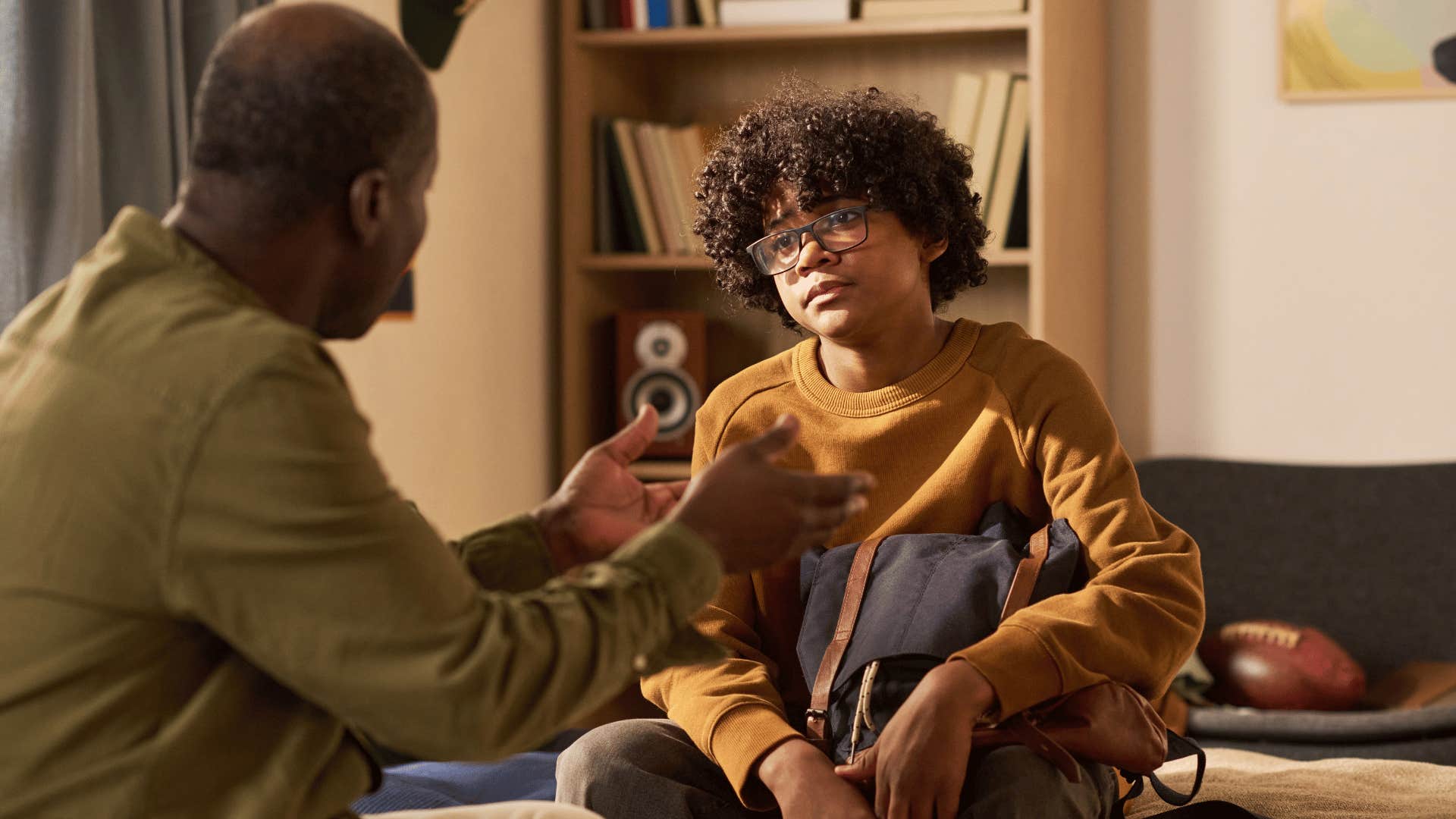
After a long day of work, the last thing a parent wants to hear is their child whining. They don't want to be that person, but a child's problems feel minuscule compared to paying bills. Like, yes, it sucks that their child has homework to do.
Unfortunately, dismissing a child's complaints cannot be done with sweeping generalizations without modeling a total lack of empathy for that child. When the kid doesn't see how to respond to someone's complaints in a healthy way, they won't know how to show empathy toward others' negative or uncomfortable feelings.
Yes, in the moment, these parents probably think they're teaching their child a valuable lesson. But true empathy develops when parents talk about feelings.
So, even if it's annoying, a parent needs to slow down, have a conversation about the problem, and then set limits on how often and how the child can talk about the issue without it becoming self-defeating negativity, which is one of the big problems with complaining in the first place.
4. 'You need to toughen up'
 New Africa | Shutterstock
Most parents grew up hearing "you need to toughen up" whenever they cried or complained. Parents thought they were doing a good thing for their kids saying it, but it often minimized their pain and taught them to minimize the pain of others.
Often, kids who heard this were reminded that others had it worse. That's probably why they repeat the same cycle. They want their kids resilient and strong. However, by saying, "You need to toughen up," you're doing the exact opposite.
Emotional suppression leads to poorer health outcomes. A child is less empathetic the more they hold their emotions in. That's why every parent should encourage dialogue. Even if their problems are small, it's better to air them out than allow them to fester.
5. 'I don't have time for this'
 DimaBerlin | Shutterstock
Most parents only have so many hours in the day and feel emotionally pressed constantly. Their sleep schedule is already broken. Their work hours are already inconsistent. The last thing they need is a sniffling child coming to them about every minor inconvenience.
While it's understandable why they're overwhelmed, saying "I don't have time for this" damages their child's emotional well-being. They are told that they are not important to their parents and that they must push away their feelings, and thus they extend that out to others.
Children want to feel important to their parents. It's human nature to want to feel seen. That's why saying this phrase is damaging. Unconsciously, they're teaching their child that their feelings don't matter. Children internalize that and become less empathetic.
So, if they're truly strapped for time, a better response is, "Honey, I'm a little busy at the moment, but why don't we revisit this tomorrow?" As long as the parent does make time later, it's a lesson in boundaries and respect that doesn't teach narcissism or lack of empathy.
6. 'You're fine'
 fizkes | Shutterstock
Do children overreact? Absolutely. As much as parents love their kids, children can be dramatic. Especially when they're young, they aren't the most emotionally regulated, but that is developmentally normal.
But just because they can overreact doesn't mean they do it all the time or that something is wrong with them. That's why it's unhelpful to tell a child "you're fine" when a parent could, instead, recognize the child's feelings and then reassure them with words like "you're safe" or "I know it's hard, but you are tough and will get through this" or "let's take a deep breath together and figure this out". These phrases teach resilience instead of dismissal and repression.
As Children's Hospital of Philadelphia advises, "Validate her feelings, but remove the attention from crying. Focus instead on redirecting her behavior towards the goal, and ignore additional outbursts."
That way, parents aren't just ensuring their children have empathy. They're connecting with their child, too, and teaching emotional regulation.
7. 'Life isn't fair'
 New Africa | Shutterstock
Parents aren't wrong for saying "life isn't fair." Sometimes, it really isn't. We all face moments when we're overlooked or treated unfairly. But that doesn't mean "life isn't fair" should be our go-to response to struggles and emotional pain. If parents want their kids to have empathy, they've got to model it first.
They can't just roll their eyes and tell their children to get over stuff. Even if they're exhausted, parents have a duty to teach their child how to respond to disappointments and process their emotions. That way, their child can go out into the world and do the same for others.
8. 'Figure it out yourself'
 Deborah Lee Rossiter | Shutterstock
Nobody wants to raise a child who is overly dependent on others. Kids need to learn how to stand on their own two feet and solve problems. The problem is, human beings are wired for connection and community, and children are even more in need of those things when facing problems.
Figuring things out yourself is a skill, one that is ironically taught by parents guiding their kids through the process of discovering independence.
Parents don't need to be harsh to get the message across that independence is a good thing. It isn't just unhelpful. In the long run, it teaches children to have less empathy for themselves and others. After all, they never saw someone gently set boundaries or urge someone else to solve a problem, so how would they know how to do that?
9. 'Stop making a big deal out of everything'
 New Africa | Shutterstock
Sure, children can make a big deal out of things and it can be annoying and even emotionally taxing for parents. But even when their child is being dramatic, saying, "stop making a big deal out of everything," isn't helpful. Unless parents want their child to lack empathy, they need to deal with their emotions head-on.
This doesn't mean every emotional outburst deserves a ten-minute conversation. Instead, parents can focus on positive behavior and teach their children self-soothing techniques. Over time, this teaches a child how to manage their own emotions.
But, remember, kids are new to the planet. Things like social rejection and heartbreak often feel like the end of the world because the child is new to the experience. They don't have the wisdom yet to know that these feelings are challenging, but soon will pass.
When kids seem to have zero empathy for others, it's often a sign that they were treated without empathy by their parents and other caregivers. Fortunately, they can learn how to empathize with others, even as adults.
So, if you relate to these kids or have made these mistakes as a parent, don't give up hope. Empathy can be challenging, but it's so worth the effort.
Marielisa Reyes is a writer with a bachelor's degree in psychology who covers self-help, relationships, career, family, and astrology topics.
