
Why It Feels Like The Years Go By So Much Faster The Older You Get, According To Scientists
 cottonbro studio | Pexels
 As soon as you reach a certain age, you'll definitely notice it: Time seems to go by faster and faster the older you get. The exact age that starts happening may be something of a mystery, but the phenomenon itself certainly isn't. Suddenly, it's as if you blink and an entire year is gone.
So what's going on here? Do we enter some kind of wrinkle in the time-space continuum after we reach a certain age? Not exactly, but scientists have found that there very likely is something to this, and the newest scientific discovery came in a most unlikely way: By making people watch an old Alfred Hitchcock show.
Time really does go by faster the older you get, according to scientists.
Most of us can remember how time felt like an eternity when we were kids. Christmas break and summer break gloriously felt like eons and eons, whereas in adulthood, it seems like we go from Memorial Day weekend to Labor Day weekend in approximately 15 minutes.
Scientists theorize that this is likely due in part to regular age-related changes in the brain. One scientist, professor and author, Adrian Bejan, explains that it is simply a function of the fact that when we're young, our brains are trained to take in as much new information as possible. When we're older, our brains do the opposite. We've already learned a ton of stuff, so it affects our perception of time.
Time seems to go by much faster when you're older because of a lack of new experiences.
Ultimately, scientists theorize that this all comes down to new experiences: The more new experiences a person has, the slower time seems to move.
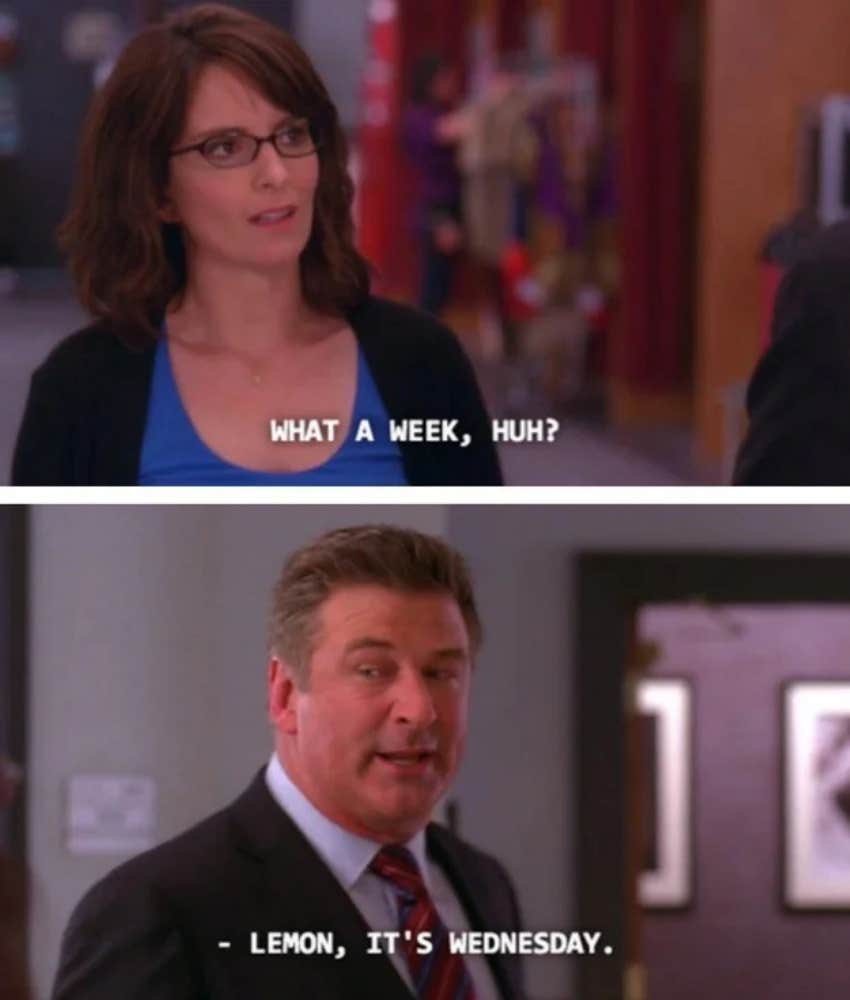
This is why, for example, a month full of constantly shocking news headlines results in everyone joking that the past month was "the longest year" of our lives, like that old joke on "30 Rock" where Liz Lemon says, "What a week, huh?" and Jack Donaghy says, "Lemon, it's Wednesday."
 Reddit | Canva Pro
But we also process time in two different ways: linearly, in our external lives of calendars and clocks, and mathematically in our internal systems. That means that a 5-year-old and a 50-year-old have totally different perceptions of time, because a year is 20% of a 5-year-old's life but only 2% of a 50-year-old's.
"People are often amazed at how much they remember from days that seemed to last forever in their youth,” Bejan wrote in his book on this subject, "Time and Beauty." “It’s not that their experiences were much deeper or more meaningful; it’s just that they were being processed in rapid fire.”
A new experiment involving Alfred Hitchcock clips helps explain this phenomenon.
So what's actually happening in the brain to produce this altered time perception? Last year, researchers at Cambridge University conducted a study of the results of an earlier experiment that measured brain activity using MRI scans of subjects aged 18-88 watching an old episode of "Alfred Hitchcock Presents" called "Bang! You're Dead."
That particular episode had been shown to elicit the most consistent responses in viewers' brains, and when Cambridge analyzed the MRI scans, they noticed a distinct pattern: Older viewers' brains shifted to new activity states far less frequently, but for much longer durations than younger subjects.
The pattern was consistent across every age, suggesting that "longer [and, therefore, fewer] neural states within the same period may contribute to older adults experiencing time as passing more quickly," according to the researchers.
Which takes us back to that "30 Rock" joke about it only being Wednesday, and a long-known neuroscience concept called age-related neural dedifferentiation, in which neural function becomes less specific overall as we age.
So how can you slow down time? Scientists say taking up new hobbies, listening to new music, or even just taking a different route to the store each time can help our brains process more "new" events and have us feeling like a kid again, at least where the passage of time is concerned.
John Sundholm is a writer, editor, and video personality with 20 years of experience in media and entertainment. He covers culture, mental health, and human interest topics.
