
People Who Prefer To Travel Solo & Answer To Nobody Often Do So For 5 Understandable Reasons
 martin-dm | Canva
When it comes to travel, it seems to mean different things to those who fly solo. Recently, women's wellness coach Mya McCarthy had a thought-provoking take on solo travelers. "I truly don't think I have ever met someone while traveling that was not […] the black sheep of their family or community."
She went on to explain that people with a passion for travel, and especially those who fly solo, tend to be "running" from something, not in the unhealthy sense the word usually conjures, but "running from what they've known because they believe and they know that there's more out there."
As a dyed-in-the-wool solo traveler myself, I was struck by this take because it is essentially the words I've been searching for. I am the black sheep of my family and community, and that is indeed exactly why I've sought out travel: to better understand myself and the people and places I come from.
McCarthy went on to say that travelers "don't feel any restrictions to stay the same," and I couldn't have said it better myself. And it turns out, there's something to this take. Psychologists say that jetting off solo is almost always about not just exploring a new location, but exploring oneself.
People who prefer to travel solo and answer to nobody often do so for these understandable reasons:
1. They want control over their trip
At first blush, this sounds a bit too controlling to fit into this very philosophical view of travel, but it's less about a Type A need to rule every detail with an iron fist and more about ensuring they get out of the trip what they're looking for, which is more about personal growth than notching another passport stamp.
If you've ever traveled with someone whose approach was misaligned with yours, you know how much it can disrupt the experience. I'm a person who likes to amble and wander and see where the day takes me; one of my best friends gets antsy if there's more than 15 minutes of downtime and likes to go, go, go. We've just agreed to never travel together, lest one of us not make it home alive!
2. Solo travelers tend to be more reflective and value solitude
One of the key motivators for solo travelers was a thirst for self-reflection and self-discovery. It's hard to build that into an itinerary when you're traveling with others, and it's not easy to get solitude, which many solo travelers crave.
For many people, especially those who are more introverted and many who are neurodivergent, solitude is how they recharge. I'm one of these people myself, and while traveling with others is fun in other ways, it always leaves me just a tiny bit disappointed I wasn't able to have that alone time, just me and the city or hiking trail or whatever the case may be, experiencing it one-on-one.
3. They have a desire for transformation and personal growth
 Dragana Gordic | Shutterstock
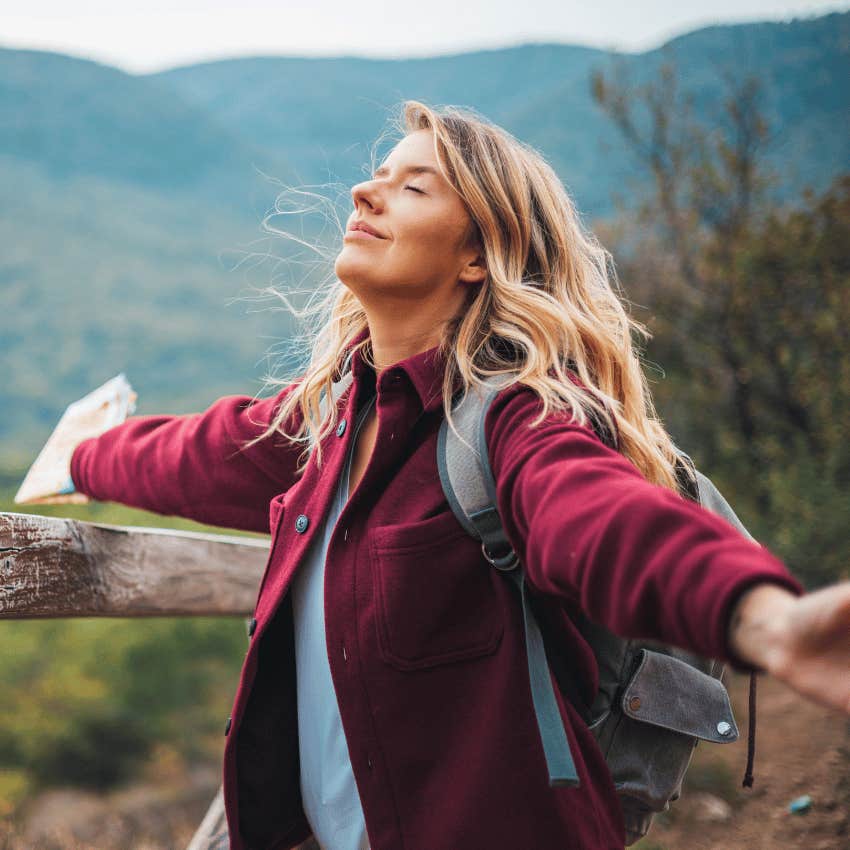
For solo travelers, a trip is often about something even deeper than connecting with yourself. It can feel like a form of recovery, and scientists say this impact is in fact very real. Psychologist and avid traveler Dr. Jenna Kirtley has written that studies have shown that travel helps lower stress, increase emotional well-being, and can even aid in recovery from depression.
Call it the "Eat, Pray, Love" effect, and I've experienced it myself. When I took a solo trip to Paris shortly after a catastrophic trauma in my life, it helped me round a corner that three years of therapy hadn't quite done the trick on.
Not that the therapy didn't help. It saved my life, in fact. But there was something almost confrontational about the way that trip made me realize that while I had been drowning in darkness, the world had kept right on spinning, and there was still wonder and awe to be had. It spun my life in a different direction that I'm not sure would have been possible otherwise.
4. They have a love of freedom and flexibility
This all goes back to what McCarthy said: When traveling solo, you can wander, explore, and experience with no rules, no schedules, and nobody else's needs to take into account, and that's often how you're able to get to those "black sheep" moments of no longer being the same.
In my experience, the best travel moments I've had were just things I stumbled upon, like a random Roman amphitheater in the middle of Paris, a tiny cafe in the literal middle of nowhere along a hiking trail in England, and a panel of ancient petroglyphs on a rock in Utah.
The kinds of things you're likely to miss if you're chatting with a travel partner or trying to get to the next place on an itinerary. Traveling solo keeps you engaged in the present and gives you the latitude to stop and bask in it for as long as you like.
5. People like this want to meet new people and try new things
One of the key ways traveling solo broadens your horizons is that you tend to encounter people you otherwise wouldn't. Even if you're an introvert like I am, you'll find people engaging you, either because they're traveling solo too, or because they're intrigued by you doing so and want to hear all about it.
I'm a shy sort, but even I have had this experience again and again: Hearing the life story of a grizzled Waffle House waitress over the five different kinds of grits she brought me when I said I'd never tried them; a huge campfire breakfast in the Sierras with a Wisconsin family of six who noticed me camping alone; a midnight swim in the Colorado River with a group of hilarious drunk girls from Georgia whose hammock I helped fix; even a random restaurant encounter in France that briefly turned into a VERY long-distance relationship (that reputation for romance they have is not just a stereotype).
Planning and itineraries have their place, and flying solo by the seat of your pants definitely isn't for everyone. But if it's something transformative you're after, a trip by yourself is the quickest ticket to something new and cathartic. And that's the best souvenir there is.
John Sundholm is a writer, editor, and video personality with 20 years of experience in media and entertainment. He covers culture, mental health, and human interest topics.
