
CEO Warns Employers Not To Hire Anyone Who Mentions This One Thing During An Interview
 MAYA LAB / Shutterstock
 Scott Kuru, who is listed on LinkedIn as the Founder and CEO of Freedom Property Investors, recently shared his opinion about whether companies should hire workers who admit that they want their employer to support a healthy balance between their professional and personal lives.
In an age of burnout and workers desperately seeking to move away from our current live-to-work culture in order to find enjoyment in their lives, Kuru is pushing back against workers' wants. His attitude certainly fits our employer market, where workers are at the mercy of their bosses' whims because the job market is so bad.
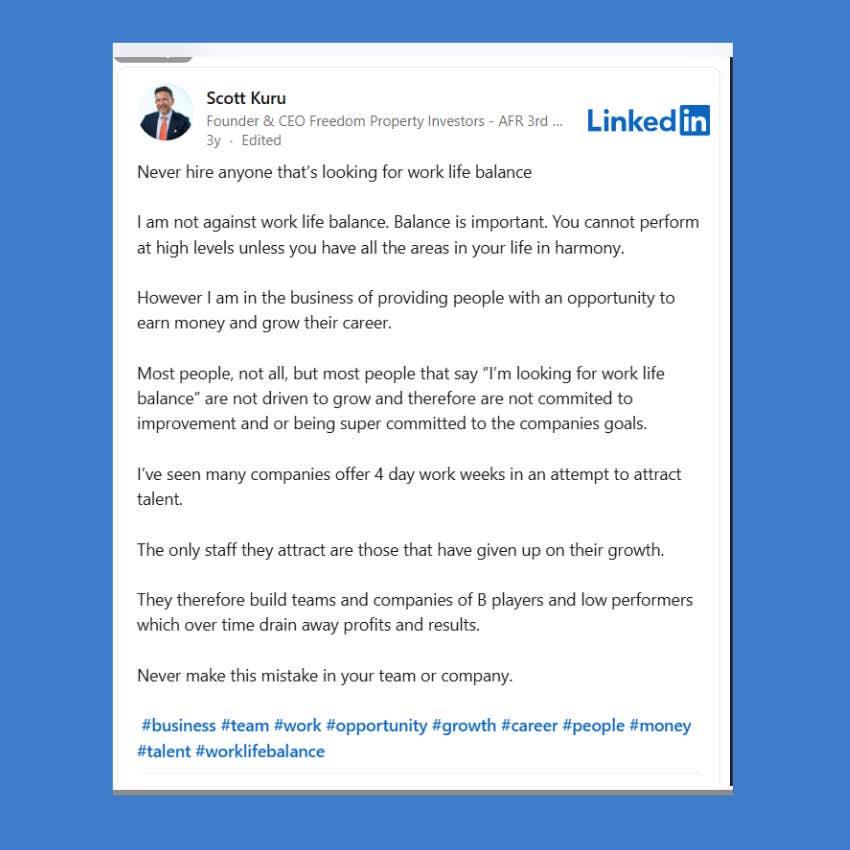
A CEO wrote a LinkedIn post telling employers not to hire anyone who mentions work-life balance in an interview.
Kuru started his post with a strong stance, stating, “Never hire anyone who’s looking for work-life balance.” He went on to clarify that he is not entirely against it and agrees that all aspects of a person’s life must be in harmony for them to reach their full potential.
 LinkedIn
The CEO further explained that his goal was to provide people with a chance to earn a living as they grow in their careers, and that is when his post took on a tone that many disagreed with. He argued that most people who say they need work-life balance are not actually looking to grow in their careers.
Kuru also believes that they are not committed to their own advancement, nor those of the company they are seeking to work for. He added, “I’ve seen many companies offer 4-day work weeks in an attempt to attract talent. The only staff they attract are those that have given up on their growth.”
As expected, his controversial commentary did what he likely wanted it to do — attract dissenters left and right.
The first person who commented seemed to be beside herself with disdain for the leader’s point of view. She commented, “Well, you definitely poked the bear! The well-being bear! Defining work-life balance in a virtual world has different meaning today! I do not agree with this statement! How do we think we got to 1 in 2 Americans burned out?”
“Burnout now has an ICD-10 code, a confirmed disease state with huge healthcare costs to employers and employees. It is time to reframe our approach to how we treat employees in the workplace. The downstream is going to be ugly two to three years from now!” the commenter added.
The floodgates were open, and professionals from every corner of LinkedIn chimed in to let Kuru know that his approach was tone deaf and disheartening. And rightfully so, since by now, most leaders know that people perform better when there is a work-life balance.
Studies prove the CEO's assumptions about work-life balance are incorrect.
A December 2020 study found that 76% of workers were experiencing burnout due to excessive hours and demands, resulting in a lack of downtime. And let’s not forget the Great Resignation, when 41% or 2 in 5 employees walked away from their jobs or their entire careers in search of more flexible working arrangements.
 PeopleImages | Shutterstock
Work-life balance is more than just a catchphrase. When it is healthy, it improves employee engagement, lowers the cost of healthcare for employers, and results in better performance. Employees who live a balanced life work 21% harder, making them much more efficient than those who are overworked.
Lastly, Kuru seemed to believe that a 4-day workweek equates to less productivity, but the opposite is true. When working hours are reduced, workers are naturally happier, and the employer benefits from increased individual productivity and fewer mistakes, leading to lower costs.
Of course, there are challenges to shortening hours for employees. Leadership has to figure out how to become more efficient and get the work done on reduced schedules. Costs can also increase if employees receive the same salary for fewer hours, but most employers understand that the benefits of engaged employees far outweigh the risks of burnout. Kuru’s post and the inferences he made seem to indicate an inability to read the virtual room. How it impacts his company’s image remains to be seen.
NyRee Ausler is a writer from Seattle, Washington, and author of seven books. She covers lifestyle, entertainment, and news, as well as navigating the workplace and social issues.
