
70s & 80s Kids Didn’t Need Phones To Do 6 Basic Things Young People Can’t Do On Their Own Today
 melissamn | Shutterstock
 If you grew up in the '70s or '80s, chances are, if phones disappeared tomorrow, you'd be able to thrive because you learned the basics early on.
You learned how to solve problems on your own, and if you still couldn't figure it out, you knew how to look things up in the card catalog at the library. That's not to say younger generations aren't smart or capable. They just grew up with different tools and resources than kids back in the day. As a result, certain everyday skills that were once totally ordinary are now nearly obsolete.
Young people never learned these basic things that kids from the 1970s and 1980s could do without a phone:
1. Find their way to a destination they've never been before
 MISTER DIN | Shutterstock
Long before smartphones and GPS, getting somewhere meant paying close attention to where you were going. Learning to read paper maps and even stopping to ask for directions were just a part of the journey.
Today, most people pull out their phones for even the shortest drive or walk if it's somewhere they haven't been before. GPS is convenient, but it's also become easy to rely on technology instead of developing a natural sense of direction.
2. Memorize important phone numbers
Before every phone number was stored in your contacts, you had to memorize the numbers for the people you called regularly. Gen Xers and millennials knew all the important numbers, and chances are, if you asked them today, they could probably still recite their best friend's number from elementary school. Important phone numbers had to be permanently stored in the brain because there was simply no other backup.
Most people rarely dial a number manually in the modern day, so there's not much reason to memorize one anymore. This basic skill, which used to be necessary, has definitely become a thing of the past.
3. Make plans without constant communication
Making plans with someone used to be incredibly simple. If you told your friends to meet at 7:00 at the mall or the movie theater, everyone showed up. There were no last-minute texts, no location sharing, and no back-and-forth on deciding where to go.
Smartphones have made coordinating plans easier than ever, but they also created an expectation of constant updates. Today, plans don't happen without a steady stream of messages or calls. Back then, however, you just had to trust that everyone would be there.
4. Look up information without the internet
 Rizky Ade Johnathan | Shutterstock
Kids today will never know what it was like to do a research paper before the internet. Schools used to have library classes just to teach kids how to find reference materials by using microfiche and card catalogs. Finding information took a lot more effort, but it also taught people how to research and be patient.
Kids now know that any fact is just a quick internet search away. But because information is so readily available, fewer people have experience digging for answers on their own. This was just an everyday skill that came in handy before search engines existed.
5. Fix small, everyday problems
Not every little issue always required replacing something or calling in an expert. When something broke, it was normal to try to fix it first. Many learned basic repair skills by watching their parents or figuring things out through trial and error.
These days, it's less time-consuming to watch a tutorial or pay someone else to handle the repair. There's nothing wrong with that, but it also means that most kids miss out on the opportunity to build their confidence by solving small problems on their own. For kids who grew up decades ago, changing the chain on their bike was something they could just do without help.
6. Entertain themselves without a screen
 Lyudmila2509 | Shutterstock
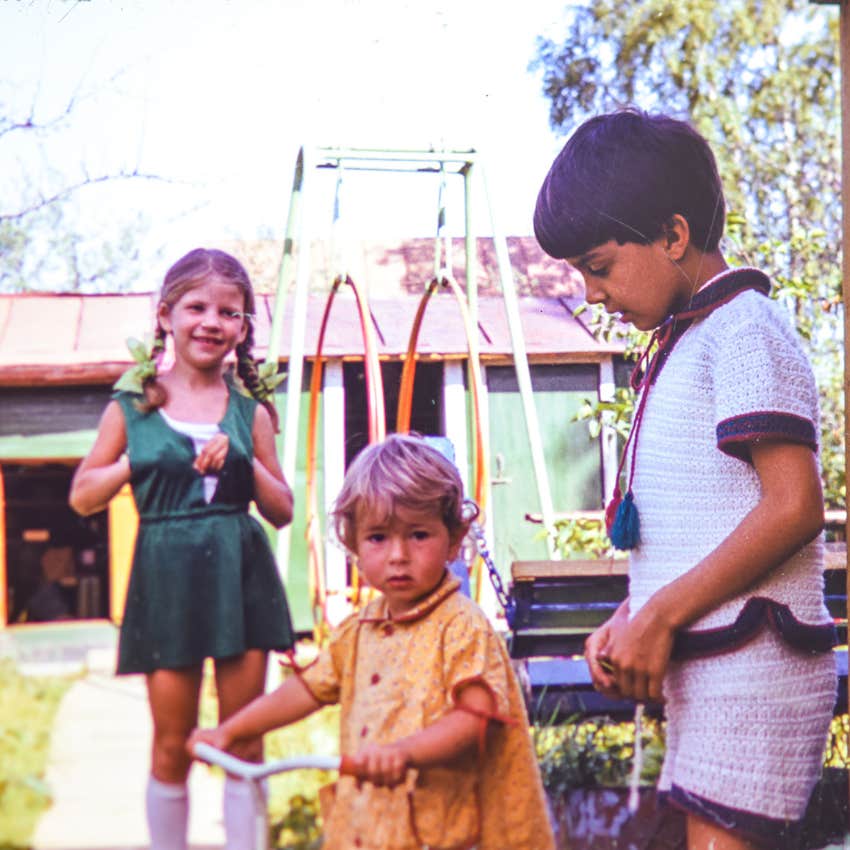
Before smartphones and tablets, you couldn't just doomscroll boredom away. '70s and '80s kids would spend hours using their imagination to make up games with elaborate rules. If no one was home to hang out, you found some other way to pass the time. Boredom was a gateway to imagination.
Today's younger generations have access to more entertainment than ever before, all at the tap of a finger. That convenience has plenty of benefits, but it also means there are fewer moments to let creativity and play shape development. Entertaining yourself used to be a big part of growing up, and a place where many of the best memories were made.
Kayla Asbach is a writer with a bachelor's degree from the University of Central Florida. She covers relationships, psychology, self-help, pop culture, and human interest topics.
