
People Who Feel Utterly Drained By Work Meetings Usually Say 7 Phrases Pretty Much Daily
 Elena Nichizhenova | Shutterstock
 People who prefer to work on their own and get drained by meetings usually express how they feel in the phrases they use with their co-workers.
These workers aren't just grumpy. Statistics show that most meetings are actually ineffective. Talking in circles and interrupting productive workflow seems counterintuitive, yet these constant disruptions are still scheduled.
Phrases people who are drained by work meetings seem to say daily:
1. ‘Can we take this offline?’
 we.bond.creations | Shutterstock.com
Virtual meetings are just as draining as in-person ones. When someone’s using any excuse they can to take a conversation offline and get out of a Zoom, there’s a good chance they’re already fed up.
Collaboration is important for some projects, but it needs to be balanced, or else no one can meet their deadlines. The perpetual joke about a meeting that could have been an email is layered in truth especially for employees who spend most of their days trying to squeeze in actual quiet time to get things done.
2. ‘Let’s stick to the agenda’
When you’re switching between different tasks at your desk and trying to manage a million different deadlines, it can take a toll on your mental well-being and productivity.
The same is true for meetings at work. People drained by office conversations struggle with jumping from small talk to productive problem-solving. They can’t keep up with switching topics constantly, and often use phrases like this to protect their well-being and reduce fatigue in an already stressful environment.
3. ‘I just need some time to think’
Introverts who need quiet alone time to process can easily become fatigued by back-to-back meetings. They not only need to set boundaries to ensure they can actually get their work done, but they also often feel exhausted by the need to simply chit-chat with co-workers.
Even if it happens subconsciously, reading social cues and actively listening in meetings can take a toll. Feeling wiped out by a meeting can make getting back into a project almost impossible.
4. ‘I feel like I have no time’
 PeopleImages | Shutterstock
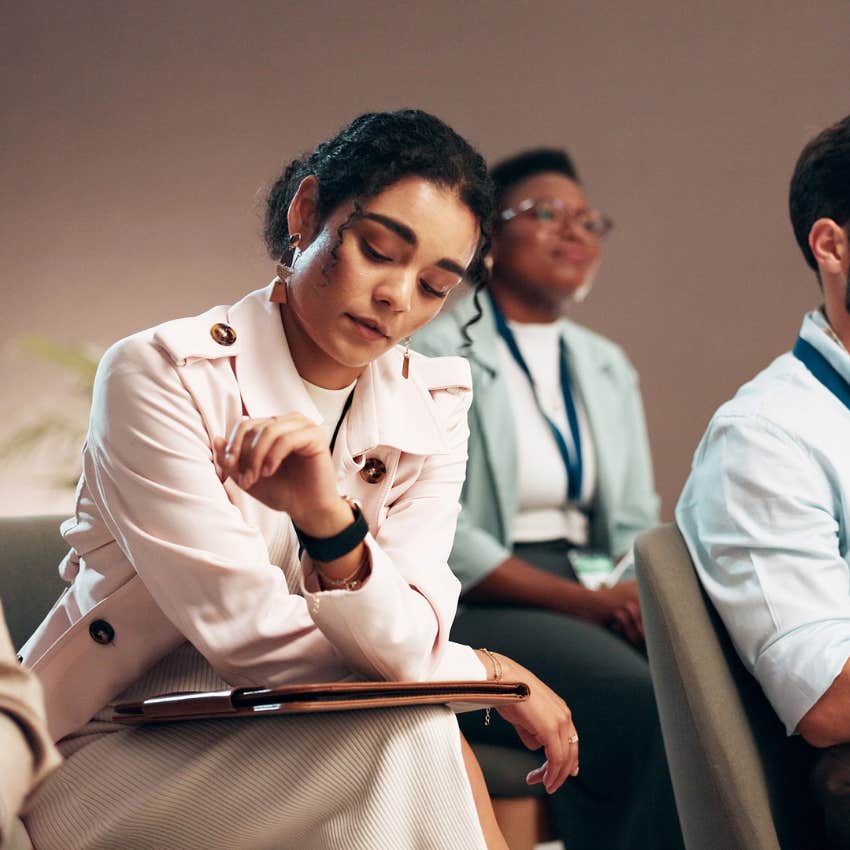
When someone spends all their time at work in meetings, experts refer to it as meeting overload. They’re spending so much time talking about the work they have to do with other colleagues that they inevitably have no time to actually do it.
They’re drained after work meetings because of all the interaction and small talk, but then they’re forced to work more than they should because they can't get anything done by quitting time.
5. ‘Sorry, can you repeat that?’
A tired brain doesn't function at its best. Basic tasks like concentrating on someone speaking or focusing during a meeting can feel impossible.
“Sorry, can you repeat that?” might seem harmless, and sometimes, a little frustrating, in the moment, but it could be a warning sign that someone’s dealing with a lot more than distractions.
6. ‘Who is owning this?’
While confusion about who’s taking the lead on a project or roles within the workplace can be draining in their own right, someone constantly asking “Who’s owning this?” may also be trying to protect their own boundaries.
This is especially true if they already have a million things on their mind, and unnecessary meetings are pulling focus. Making sure they’re not adding another task to an already full plate is at the top of their list. They need to make sure someone takes ownership, so they’re not left worrying behind the scenes after the meeting about what they have to do.
7. ‘I can’t look at myself anymore’
 MAYA LAB | Shutterstock.com
Especially in virtual meetings, when workers are forced to stare at themselves all day in a window on their computer, having a million meetings a day can be draining. Not only do they deal with all that wasted time, but they also have to manage any self-consciousness that comes up.
According to a study published in Clinical Psychological Science, staring at ourselves during virtual meetings can seriously affect our mood. It’s no surprise that some people are utterly drained after their calls, because they’re also forced to manage insecurities.
Zayda Slabbekoorn is a senior editorial strategist with a bachelor’s degree in social relations & policy and gender studies who focuses on psychology, relationships, self-help, and human interest stories.
