
As A Professional Editor, These 6 Writing Habits Instantly Make Someone Sound Smarter And More Credible
 JLco - Julia Amaral | Canva
 Over 63 million Americans write as a hobby, but I’m one of the few who gets paid to do it. For the last decade, I’ve made my living as a writer, editor, and journalist for publications such as Bustle, CNN, NBC, The Daily Beast, and Food & Wine, and the site you're reading right now.
This experience (combined with a BA in English that I’m still paying off) taught me a few things about quality writing. So let’s dive in.
The six writing habits instantly make someone sound smarter and more credible, according to a professional editor:
1. Cut out any unnecessary words
Our college courses did us dirty. Professors encouraged students to hit minimum word counts, so we threw in as much filler as possible — but quality writing is clear and concise. That’s why most literary agents will instantly reject manuscripts that are over the recommended word count for their genre.
In his book Editor-Proof Your Writing, veteran editor Don McNair has an entire section dedicated to taking words out:
The more words you eliminate without changing meaning and sacrificing detail, the clearer and more powerful your writing will be. [… The] words we want to chase away do specific, bad things to our writing. Examples? They weaken verbs. They introduce author intrusions. […] They create redundancies.”
- Do you have two words that mean the same thing? (She was a stunning,̶ ̶b̶e̶a̶u̶t̶i̶f̶u̶l̶ woman.) Take one out.
- Can the reader tell who’s speaking without the dialogue tag? (“Are you sure you want to do that?” I̶ ̶r̶e̶s̶p̶o̶n̶d̶e̶d̶̶.) Delete it.
- Are actions already implied by other actions? (He t̶u̶r̶n̶e̶d̶ ̶h̶i̶s̶ ̶h̶e̶a̶d̶,̶ ̶l̶o̶o̶k̶e̶d̶ ̶a̶t̶ ̶m̶e̶,̶ ̶a̶n̶d̶ ̶ beamed at me.) Cut them.
2. Choose strong verbs instead of weak verbs and adverbs
 Getty Images / Unsplash+
Similarly, some writers try to strengthen a weak verb by combining it with an adverb. Instead, choose a strong verb from the get-go.
- I ran quickly out the door = I sprinted out the door.
- She cried softly = She whimpered.
- He thought deeply about the idea = He pondered the idea.
- They ate it greedily = They devoured it.
The same rule applies to adjectives and nouns: A big house is a mansion. A tall building is a skyscraper. A heavy rain is a downpour. If you can find a stronger term that encapsulates the idea in fewer words, use it.
3. Use active voice whenever possible
An editor from a publishing house taught me this tip. It took me a while to grasp, but once I did, I saw passive voice everywhere.
What’s the difference between active voice and passive voice? In active voice, the subject acts on the target: “The cat chased the mouse.” Here, the cat is the subject, and the mouse is the target.
In passive voice, the writer prioritizes the target of the action over the subject: “The mouse was chased by the cat.” The mouse isn’t the subject; it’s the target, but it still comes before the subject and the verb. The sentence now contains unnecessary words, like “was” and “by,” which makes it longer and weaker.
- The cake was eaten by the children = The children ate the cake.
- The speech was given by the president = The president gave the speech.
- The window was broken by the storm = The storm broke the window.
When identifying passive voice, keep an eye out for the phrase “there was.” People use it constantly to passively describe a scene — but if you think about it, it doesn’t make much sense. When a sentence starts with “there was,” who or what is the subject?
- There was a book on the table = A book lay on the table.
- There was a decision made by the board = The board made a decision.
- There was a letter found in the archives = The librarian found a letter in the archives.
4. Search your document for filler words and delete 99% of them
Some words in the English language serve virtually no purpose — and yet most of us use them all the time.
The word “just” is a great example. In 99% of cases, it’s unnecessary. It doesn’t change the meaning of the sentence, but we just throw it in anyway. (Not-so-fun fact: Women subconsciously use it more than men to soften their language so they seem polite and apologetic.)
- He just couldn’t believe the outcome = He couldn’t believe the outcome.
- I’m just checking in about those documents = I’m checking in about those documents.
- No matter how hard she practiced, she just couldn’t do it = No matter how hard she practiced, she couldn’t do it.
When I searched my first manuscript for the word “just,” I had used it over 300 times. Deleting most of them didn’t change the meaning of my sentences, but it did make my writing stronger. Other common filler words that rarely serve a purpose?
- That
- Really
- So
- Very
- Actually
- Of
Pro tip: If you press Ctrl + F on your keyboard, you can search most documents and web pages for specific words and phrases. Use this to find and delete filler words.
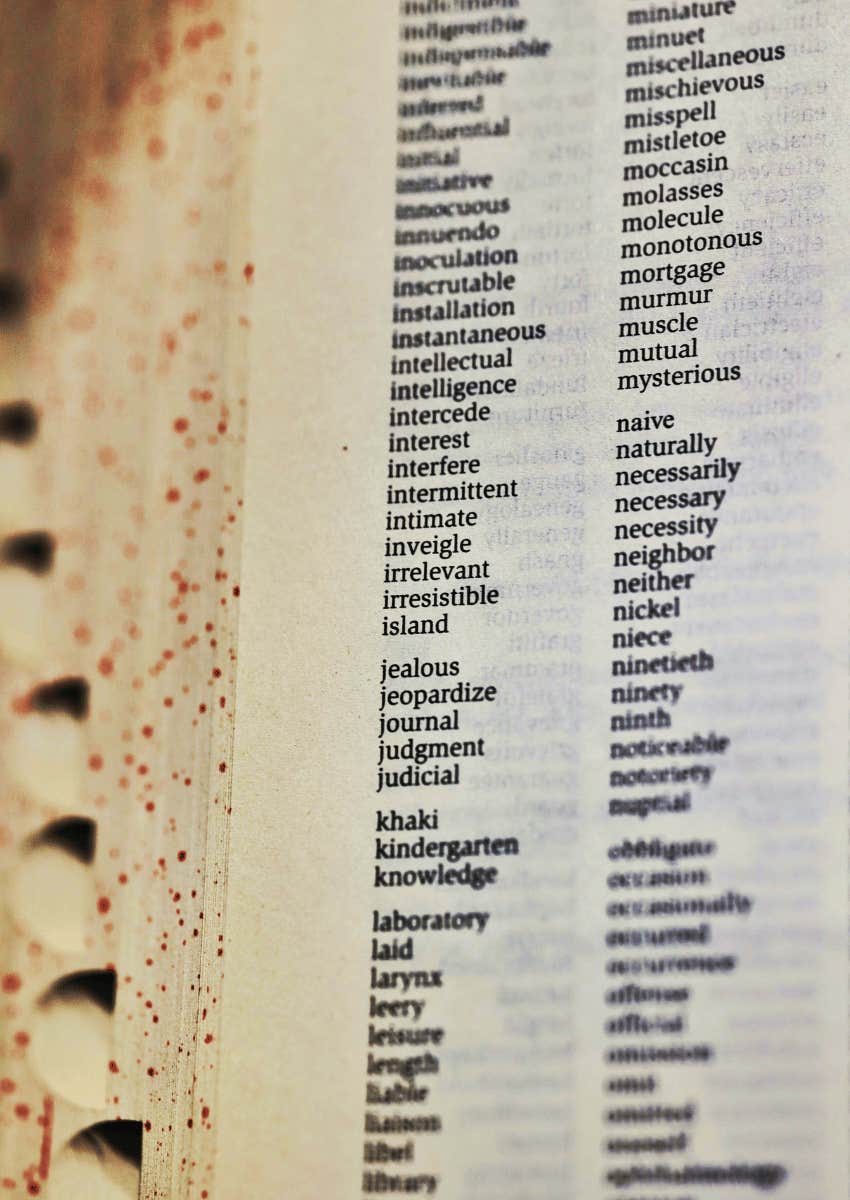
5. Ditch your thesaurus and opt for clarity
 Joshua Hoehne / Unsplash
Novice writers beef up sentences with as much flowery language as possible. Professional writers know that writing is a form of communication, and communication should be straightforward.
No one thinks you’re smart because you use words like “pontificate” and “ostensibly.” Instead, they probably think you’re an asshole.
Unless you’re writing a legal document or trying to impress the guy who does your taxes, ditch your thesaurus and use clear, powerful language. Take your time to find the right word, but don’t choose a word solely because it sounds impressive. In fact, writing long sentences with big words is the fastest way to lose your reader.
It doesn’t matter how impressive your writing sounds if the reader gives up before learning anything.
6. Read your work out loud — or have AI do it for you
Last but not least, read everything you write out loud. It’s the easiest way to catch mistakes — but it’s not only about grammar.
Like music, beautiful writing has a cadence to it. That’s why Shakespeare wrote in iambic pentameter, and Emily Dickinson used slant rhyme. When you read your work out loud, you’ll know if that cadence is there. On the other hand, when you’re tripping over your words, it’s time to make some edits.
If you don’t like reading aloud or you share a workspace with others, put on headphones and use the Read Aloud feature in Microsoft Word. (It sounds robotic, but it gets the job done.)
Alternatively, you can use AI text-to-speech software to read articles, web pages, and more. I use an extension called NaturalReader. It’s pricey and has a few glitches, but it sounds pretty darn realistic.
Happy editing, and remember: If the sentence makes sense without it, it’s j̶u̶s̶t̶ not worth the word count.
Maria Cassano is a writer, editor, and journalist whose work has appeared on NBC, Bustle, CNN, The Daily Beast, Food & Wine, and Allure, among others.
