
Why You Pace All Over The House Anytime You Are On The Phone, According To Psychology
 PeopleImages | Shutterstock
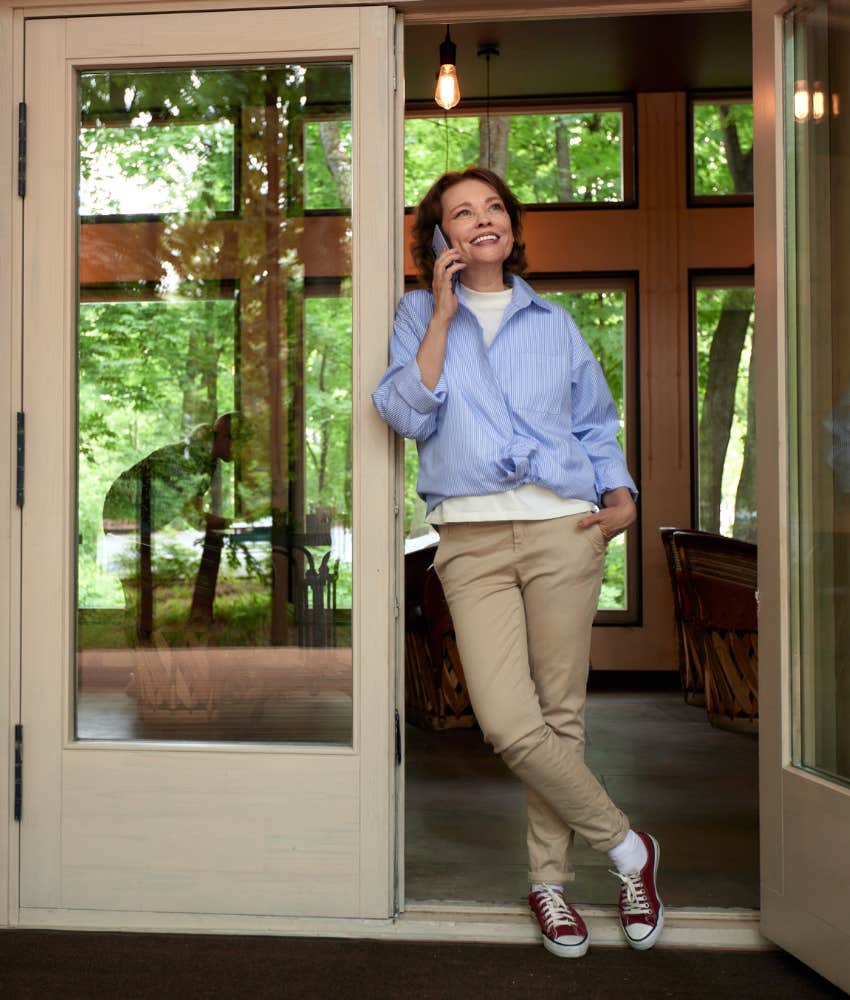
 Do you ever find yourself pacing around the house when talking on the phone? You probably don't even realize you're doing it, and suddenly your feet have taken you into an entirely different room while you've been gabbing with your bestie.
According to psychology, there's a very real reason some people are compelled to just move while on the phone, and it has everything to do with how your brain processes information. Believe it or not, there are plenty of people who stay rooted to one spot while on the phone, so if you're a pacer, you're actually unique!
You pace around the house while talking on the phone because your brain requires motion to process information without visual cues.
If you're a phone pacer, you've probably noticed that the compulsion to move doesn't happen when you're, say, having coffee with friends or at a face-to-face networking event.
This isn't just because it would be rude to walk circles around the coffee shop. It's because when you are having an in-person conversation, your brain is receiving visual cues from the person you are talking to, and that helps you process what they are saying. These visual cues convey emotion, and your brain responds to those emotions.
 Krakenimages.com | Shutterstock
Ken Fogel, Psy.D., of the Chicago School of Professional Psychology, told Men's Health, "When someone is present, you're not the only one holding onto these emotions. They're passed back and forth."
He added, "But on the phone, it's like you're juggling a hot potato and you can't pass it to anyone." That's where the pacing comes into play. It gives your brain an outlet for not only the visual cues you are sending, but the ones you aren't receiving from the person on the other end of the line.
People who pace while talking on the phone use movement to free up space in their brains to fully understand the conversation.
In a TikTok video, Kyle Cox, a content creator with a penchant for neuroscience, delved into the topic. He explained, much like Fogel, that the brain takes over while you are on the phone, making you walk and freeing up some mental space to process what you are hearing and help formulate your own response.
Cox noted, "Your brain needs physical movement to process real-time verbal conversation at full capacity," in what's called "motor recruitment.” Cox also acknowledged that there are people who do not need to walk around while on the phone, saying that they "process verbal information without motor recruitment."
Pacing while talking on the phone also helps us think by boosting creativity.
Our brains are pretty amazing. When we need to think, the brain automatically finds ways to avoid interference that might keep us from our goal. In the case of pacing on the phone, that goal is being actively engaged in the conversation.
Not every conversation is a gossip fest, however. Some conversations require more brain power, and pacing is even more important in these instances.
 Gerain0812 | Shutterstock
In fact, a 2014 study found a direct link between walking and creative thinking. The study essentially confirmed that some people need the almost mindless movement to give their brains space to process and ideate.
This isn't much different than people speaking with their hands while on the phone. You might ask yourself what the point would be if the person on the other end can see you, but according to an academic paper by Carolyn Y. Wei at the University of Washington, talking with your hands even when on the phone is a similar motion to pacing in that it benefits the person moving moreso than the person listening.
The things we do subconsciously can surprise us. The neural network underlying what we do, consciously and subconsciously, is definitely mysterious. Shedding some light on the actions we perform without much thought can give us a better sense of ourselves and our inner workings, showing that even minor things we do require serious brainpower.
Laura Lomas is a writer with a Master’s degree in English and Creative Writing who focuses on news, psychology, lifestyle, and human interest topics.
