
Women Married To Selfish Husbands Often Hear These 9 Casually Obnoxious Phrases
 HelgaQ | Shuttertsock
 Anyone who has ever been married will tell you how difficult it can be sometimes. A minor disagreement can easily turn into a major blow-up, and some of what couples say may stem from a moment of pent-up frustration. However, it is common to underestimate how obnoxious some of the things we say can be, especially if they come from a particularly selfish spouse.
Women married to selfish spouses often hear these obnoxious things:
1. 'That's not a big deal'
 PeopleImages.com - Yuri A | Shutterstock
Husbands sometimes minimize their partner's feelings or concerns by telling them they're not a big deal. Even if it doesn't seem like a big deal to him, that doesn't mean his partner's feelings don't matter. They have every right to feel frustrated that their husband forgot to take out the garbage despite being constantly reminded, or that they forgot to make them a dinner reservation for a celebration.
By saying it's not a big deal, husbands tell their partner that their emotions are insignificant, which can harm the relationship. According to psychotherapist Moshe Ratson, "Invalidation is particularly destructive in romantic relationships, where emotional safety and mutual respect are essential for long-term success."
Ratson referred to emotional invalidation as a silent killer of relationships, continuing, "When a partner's emotions are repeatedly invalidated, they may feel unimportant, invisible, or even unlovable. Over time, this breeds resentment and corrodes intimacy, setting the stage for relationship breakdown."
2. 'You're overreacting'
 Q88 | Shutterstock
"You're overreacting" is not only incredibly frustrating to hear, but it's also one of the phrases selfish husbands say without even realizing it. Husbands like this often focus on their partner's reaction instead of what they did to cause it. It's a classic way to avoid responsibility and deflect their partner's emotions.
This phrase centers a husband's perspective over his partner's, creating a power imbalance in the conversation and dismissing his partner's feelings. People are impacted by things differently; no one else can (or should) tell you how you should react.
Instead of critiquing their partner's reactions, husbands should try to understand why they reacted the way they did and how they can help. Telling their partner they're overreacting will only make things worse.
3. 'I work hard too, you know'
 wavebreakmedia | Shutterstock
This is often a phrase selfish husbands use to avoid helping their partners with household tasks, or in response to their partner saying how exhausted they are. It means, "I don't care how burnt out you are because, in my eyes, I work way harder than you."
Even if a husband works longer hours outside the home and has less opportunity for downtime than his partner, that doesn't mean his partner isn't also working hard. Hard work is more than physical labor; it's mental and emotional labor, too.
Much of women's work happens behind the scenes, often going unacknowledged and unnoticed. They may have washed and folded clothes or made lunches for the kids. They may have filled up the car their husband uses to get to the office with gas the night before. The mental load list is honestly endless.
Both partners can work hard in their own ways without turning it into a degrading competition. According to psychologist Mark Travers, PhD, "The persistent need to demonstrate one's worth or dominance can create an atmosphere of tension and mistrust, gradually corroding the foundation of mutual respect and understanding."
4. 'Why are you always so emotional?'
 Olena Yakobchuk | Shutterstock
Selfish husbands may try to turn their partner's vulnerability into a flaw. If they have an emotional reaction to something, their husbands may criticize them for being "too emotional." However, they fail to realize that everyone's emotional spectrum is different. What makes one person deeply upset may not bother another person so much.
Still, if their partner is particularly emotional about something, husbands should comfort them instead of criticizing them, and try to understand where they're coming from. As licensed couples counselor Kari Rusnak revealed, "Being vulnerable creates emotional intimacy and connection. Opening yourself to your partner shows and builds trust and helps them understand you on a deeper level."
5. 'You're just trying to start a fight'
 NDAB Creativity | Shutterstock
When their partner calls them out, selfish husbands often deflect their wrongdoings by claiming their partner is just trying to be difficult. If their partner even tries to explain how their actions or behaviors are hurting them, they try to make it their problem by accusing them of starting a fight.
By doing this, husbands only worsen their relationship because they shut down valid conversations before they even start. Having an honest conversation about issues arising in your marriage isn't necessarily about stirring conflict. In fact, addressing issues rather than avoiding them strengthens relationships.
"Communication is vital for healthy relationships. Being able to talk openly with the people in your life allows you to share, learn, respond, and forge lasting bonds," psychology educator Kendra Cherry shared. "More fights start (and get out of hand) when people refuse to talk about the underlying tensions in their relationships."
6. 'I never asked you to do that'
 simona pilolla 2 | Shutterstock
This is one of the more common phrases selfish husbands say without even realizing it, often saying it when their partner is simply asking for acknowledgment of the kind things they do selflessly.
Even if a husband may not have asked his partner to surprise him with his favorite dessert or move across the country with him to pursue his dream job, acknowledgment and appreciation go a long way. Sometimes, all their partner wants to hear is a simple "Thank you" or "I'm so lucky to have you" for doing things out of the kindness of their hearts, most of which they know will make their husband happy.
7. 'I deserve to relax when I get home'
 Streamlight Studios | Shutterstock
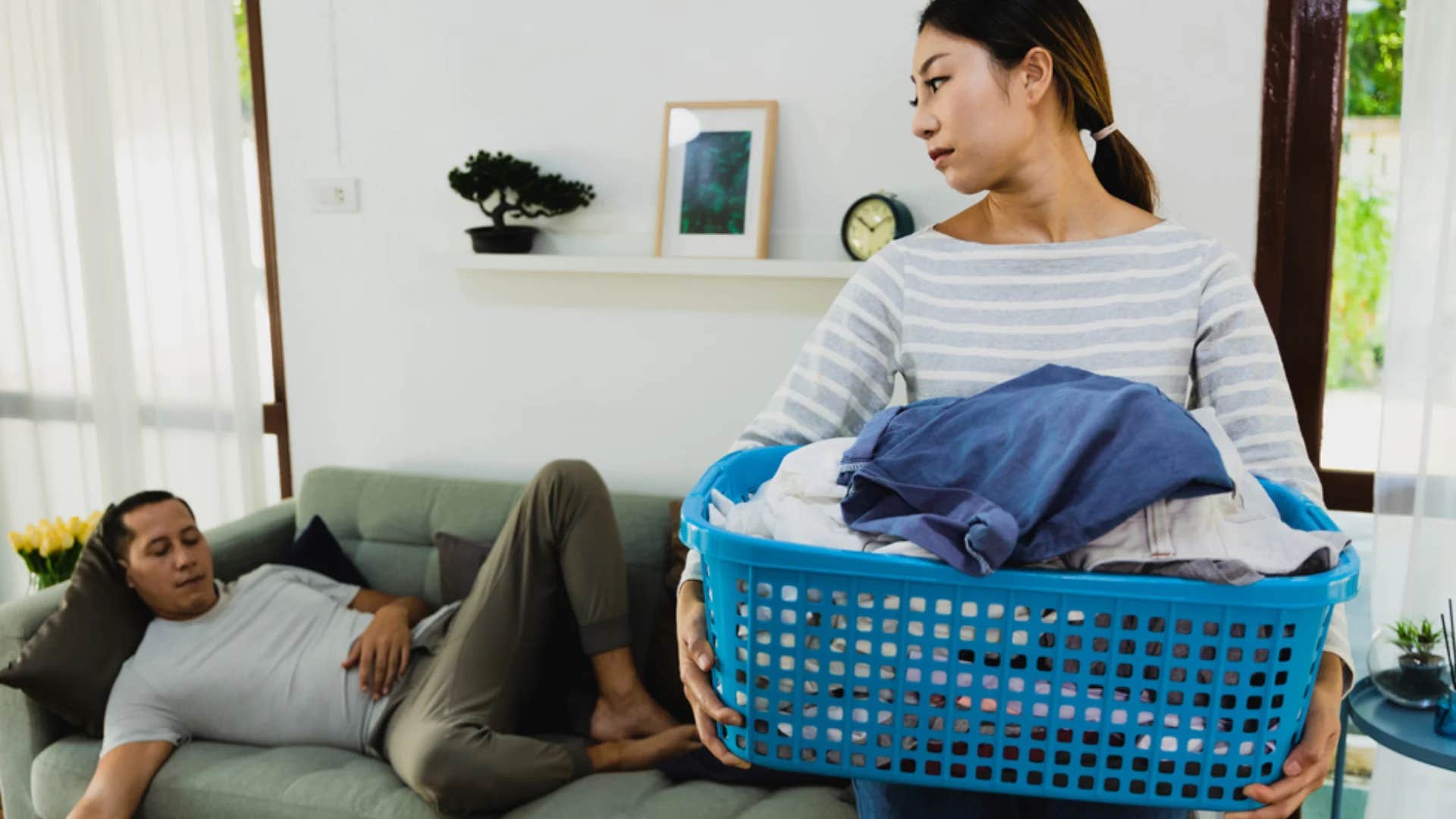
Selfish husbands often believe that they must always be working harder than their partners if they have a job outside of the home. Therefore, they shouldn't be expected to help out with the kids or chores in any way once they get home.
However, they fail to realize that even if their partners may not have left the house all day, it doesn't mean they weren't working hard. Assuming that their partners weren't also working hard all day and expecting them to continue doing everything around the house long after they get home is cruel and dismissive.
8. 'You're lucky I even help with that'
 NDAB Creativity | Shutterstock
Selfish husbands often try to frame the bare minimum as a favor. If they clean up their plate from the table or change their children's clothes, they remind their partners they're "lucky" to do what should already be expected of them.
This phrase implies that shared responsibilities, such as parenting and housework, are a favor and that any contribution to them is going above and beyond. In a marriage, teamwork should not be viewed as an honor. It is a simple expectation required for all relationships to work.
"Teamwork recognizes that it's you and me against the problem, whether that's money, kids, parents, time pressures, emotional or financial pressures," social worker and author Robert Taibbi shared. "Though we each have our own strengths and weaknesses, in the end, we work together equally to solve the problems that life throws at us."
9. 'You're not the same as you used to be'
 Just Life | Shutterstock
"You're not the same as you used to be" is one of the phrases selfish husbands say without even realizing it, and it translates to "You're not as easy to manipulate as you used to be, and I'm upset about it." Husbands often use this phrase when their partners begin to stand up for themselves.
Rather than asking why their partner's behavior has changed over time or how they can support this new version of them, selfish husbands imply that their partner's growth has been an inconvenience, and that they preferred it when they were more submissive. It also belittles their evolution, and implies that change is a bad thing.
When we marry someone, we won't be the same people we were when we started the relationship. Instead of weaponizing these inevitable changes, husbands can try to understand the new version of their partners and grow with them.
Megan Quinn is a staff writer with a bachelor's degree in English and a minor in Creative Writing. She covers news and lifestyle topics focused on workplace justice, personal relationships, parenting debates, and the human experience.
