
Why Scientists Say Our World Will Be Unrecognizable By 2075
 Veronica Perez Cortes / Shutterstock
 As the years pass, technological advancements grow exponentially. Since the 1960s, computer speeds have doubled every year-and-a-half to two years.
This rapid technological progress, though many believe is unsustainable, has raised concerns about an intelligence explosion among computer interfaces that would render humans extinct. The worries about the ever-growing machine intelligence have given rise to a potential risk to society known as "technological singularity."
What is the theory of technological singularity?
According to Britannica, technological singularity "would involve computer programs becoming so advanced that artificial intelligence transcends human intelligence, potentially erasing the boundary between humanity and computers."
 Andrey_Popov | Shutterstock
Sometimes referred to as "the singularity" to distinguish it from mathematics, simply put, singularities occur when computers become so smart that artificial intelligence (AI) would surpass human intelligence. This would render the human brain inferior and erase the boundaries between humans and technology.
John von Neumann, a well-known mathematician, computer scientist, physicist, and engineer, was the first to introduce the concept of "singularity" as it relates to technology in 1958 during a discussion with Stanislaw Ulam, a scientist who discovered the concept of cellular automaton.
That conversation centered around the acceleration of technology and how it would impact human life. It was proposed that if the field of artificial intelligence continued at its present pace, human affairs as we know them would cease to exist.
The concept of the singularity didn't become popularized until the early 90s.
It was in 1993 that Verner Vinge, a sci-fi author and professor, claimed in an article that people were creating a superintelligence that they could not contend with on a human level.
Vinge believed that this superhuman intelligence would result in a technological and social move similar to the space-time at the center of a black hole — a place where matter is reduced to an infinitely small point and time and space don’t truly exist anymore.
Over time, the idea of technological singularity has become much broader to include visions of apocalyptic changes, tempered by the idea of salvation through technology. Many studies have been conducted on technological singularity. Most of them seek to determine not if, but when, singularity will be achieved, and the vast majority predict it will occur sometime in the 21st century.
When would we hypothetically reach technological singularity?
There are several opinions out there about when technological singularity could be reached. Ray Kurzweil, an American author and futurist, predicted in his 2005 book, "The Singularity is Near," that it will happen by 2045.
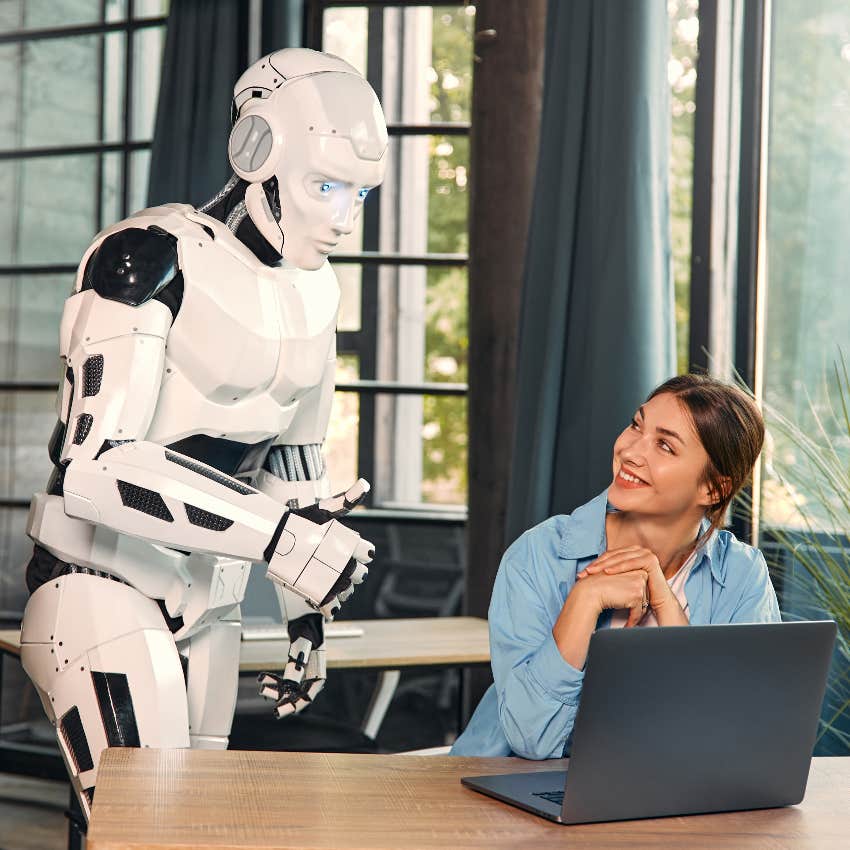 ORION PRODUCTION | Shutterstock
In a 2013 survey of 550 AI researchers, 10% thought it would happen by 2022, but were clearly wrong. Half of the study's participants thought 2040 was the year we would reach technological singularity. However, no one surveyed thought it would happen after 2075.
Not everyone is convinced it will happen at all. A 2019 survey of 32 AI experts showed that 21% did not believe that the singularity would ever occur. But the rest, similar to the 2013 poll, expect it to occur no later than 2075. There are some scientists, such as Stephen Hawking, who believe that if and when technological singularity does occur, it will be detrimental, leading to human extinction.
Many prominent technologists, like Paul Allen, believe the notion of artificial intelligence taking over is too far-fetched. This is based on the premise that as time goes by, the intelligence explosion we’ve witnessed will decelerate, as we’ve seen with other human technologies.
It's undeniable that AI has carved out a spot for itself in modern society, and we have to accept its new role regardless of what the future holds. It has some intriguing possibilities, which are worthwhile for further scientific exploration.
NyRee Ausler is a writer from Seattle, Washington, and author of seven books. She covers lifestyle, entertainment, and news, as well as navigating the workplace and social issues.
