
People Who Stay Calm In An Emergency Aren’t Naturally Fearless — They Rely On These 9 Mental Habits
 Celal Kesser | Canva Pro
 We've all been overexposed to fear lately. Daily reports of affordability, political fragmentation, and conflict in the Middle East all feed into our angst.
The emotional pushback on these abnormal circumstances is episodic. Sometimes this includes chronic anger and fear. Both these emotions occur because your amygdala, the fear center of the brain, interprets danger and sets the "fight or flight" response into motion.
When the associated adrenaline and cortisol flood the system, the brain changes. One of these changes is a sense of certainty that one is right. But true certainty is not possible at this point. Certainty will come, retrospectively, and then only with honest, unbiased assessment. In the meantime, how do you keep your sanity and humanity? The way you always have in emergencies: By staying calm, being courageous, and remaining resilient.
Staying calm will help you make better decisions. Without an influx of adrenaline, you can perceive the larger picture, both broader and further into the future. Once adrenaline has been released, your brain doesn't allow you to focus on anything other than the perceived threat. But people who stay calm in an emergency aren't naturally fearless; instead, they rely on these mental habits.
People who stay calm in an emergency rely on these 9 mental habits:
1. They use tactical breathing
When people are angry or anxious, they automatically breathe shallowly. This sends the message to the brain that there's danger in a feedback loop that increases anxiety. Deep breathing disrupts that loop. How to do tactical breathing:
- Take a breath to the count of four.
- Hold it for a count of four.
- Exhale to the count of four.
- Hold the empty state for a count of four.
Shallow breathing during stress signals danger to the brain, creating a feedback loop that keeps anxiety running. Slow, controlled breathing like the four-count method interrupts that cycle by activating the parasympathetic nervous system, which is the body's built-in calm-down response.
2. People who stay calm in an emergency challenge their thoughts
 Getty Images / Unsplash+
When you feed your amygdala alarming thoughts, you trigger the fight or flight response. So, be mindful of what you say to yourself. The human brain is elastic enough to rewire by intentionally changing one’s thoughts, thus changing one’s emotions.
Determine whether you're imagining worst-case scenarios, asking yourself leading "What if?" questions, blaming, or thinking of things you "should" have done. Mindfully focus on how your body is responding to the emotions of anger and fear. Instead of focusing on your thoughts, focus on your body's sensations.
Scan from the top of your head to your feet, noticing any unusual sensations, tightness, or tension. Once you locate the body-felt sense of your emotion, note the details. Is there pressure, pain, movement, tightness, heat, heaviness, etc.?
As you maintain focus on the body, the somatic sensations will pass. Embraced emotions can be processed; only rejected emotions become problematic long-term. Also, noticing the body makes you aware of the present, and the actual present is usually not as scary as the imagined future.
3. These people know how to take mental vacations
Visualize yourself being calm. Think of a time when you felt tranquil, perhaps at the beach. Use your five senses when you visualize. What do you see, hear, feel, smell, and taste? Take time in elaborating on details; that's where the beauty lies.
Visualization activates many of the same pathways as actually being in a calming environment, which is why picturing yourself at the beach can genuinely shift how your nervous system responds to stress. The more sensory detail you add, the more effective it tends to be.
4. Someone who stays calm in an emergency exercises often to release emotional energy
The fight or flight response is preparing you to move your body. So, moving your body is following through with the amygdala’s instructions.
In addition, exercise produces serotonin, a neurotransmitter that helps regulate mood and social behavior. Adrenaline production cannot coexist with serotonin production, so your body steps down into a more relaxed and calm state when you exercise.
Exercise is one of the most documented ways to lower cortisol and boost serotonin, which helps regulate mood and keep anxiety in check. Since adrenaline and serotonin production work against each other, moving your body is one of the fastest ways to bring your nervous system back down.
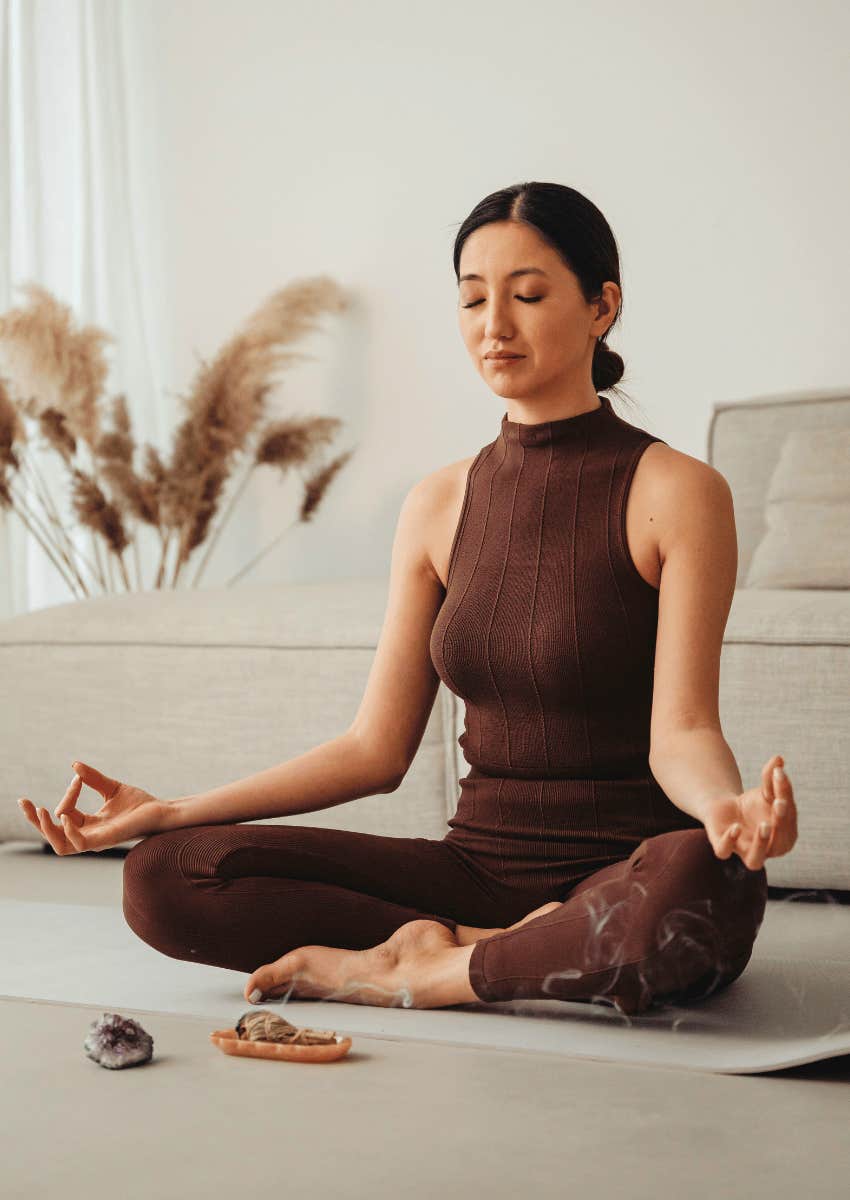
5. They usually meditate
 Karolina Grabowska / Unsplash+
Mindfulness meditation changes your brain, giving you expanded awareness of your emotional reactions. Mindfulness meditation gives you a front-row seat to your own reactions without getting swept away by them, and over time, that awareness creates real, measurable changes in how the brain processes stress.
According to research, regular practice has been shown to reduce anxiety symptoms, improve mood, and help people develop a stronger understanding of their own thought patterns.
6. People who stay calm in an emergency practice gratitude
If nothing else, thinking grateful thoughts directs attention away from fearful and angry thoughts. But it also changes your brain by producing more dopamine, a chemical messenger that enables you to feel pleasure and think clearly.
Gratitude triggers the brain's reward system, releasing dopamine and serotonin, the same chemicals associated with pleasure and emotional balance. As psychologist Dr. Ashley Smith explains for the Anxiety and Depression Association of America, gratitude can increase happiness and life satisfaction while decreasing anxiety, depression, and anger.
7. They go on a news diet fairly often
When you hear something scary on the news, adrenaline charges the brain, causing it to focus on the danger to the exclusion of everything else. You keep coming back for more because it feels like you must have the latest information to be safe.
But if you want to stay calm, once you've received the latest news, turn off electronics and do something enjoyable. If you must worry, practice "controlled" worrying. Set aside a designated time to worry. If worries come at other times of the day, set them aside to focus on during your worry time.
8. People who stay calm in an emergency use their values to determine what they need
 João Paulo de Souza Oliveira / Unsplash
As a human, you can override your fear with the value system you've developed over your lifetime. This includes values of understanding, compassion, fairness, gentleness, kindness, and caring.
Others have good reasons for what they believe, and it takes courage and compassion to face your fear and come to a working solution together.
We will get through this, though it would be great to do so with a minimum of collateral damage. So, be courageous and face your fears, whatever those may be. But do so humanely.
9. They use their fear to become stronger
Resilience can be taking something difficult and translating it into a strength. The way you perceive outward circumstances determines, in a large part, how your body responds. Your body reacts to threats by preparing to fight or flee, thus prioritizing its energy and functions.
When you perceive anything as a threat, digestion, reproductive, and growth hormone production are suspended, as is tissue repair. Your heart rate and blood pressure increase, providing your muscles with oxygen to work efficiently.
In the extreme, decision-making is impaired because the amygdala has hijacked your brain to keep you alive. Chronic activation of the fight or flight response can lead to health issues because it's harder for your body to fight off pathogens in this state.
When you see something as a challenge to be overcome, your heart rate becomes more regular, thus more efficient. Your blood vessels expand, providing your prefrontal cortex with more oxygen. Resilience also affects your immune system, making it more efficient in fighting off disease.
The good news is that you can build your resilience, and anyone can do it. According to the Connor-Davidson Resilience Scale, the following characteristics are attributes of resilience that can be developed or increased:
- The ability to adapt to change.
- Having close and secure relationships.
- Believing that sometimes fate or God can help.
- Believing that you can deal with whatever comes.
- Reminding yourself of past successes can give you confidence for a new challenge.
- Seeing the humorous side of things.
- Believing that coping with stress will strengthen you.
- Believing that you tend to bounce back after illness or hardship
- Believing that things happen for a reason, and ultimately for your benefit
- Putting in your best effort no matter what
- Believing you can achieve your goals
- Not giving up when things look hopeless.
- Knowing where to turn for help.
- Having the ability to focus and think clearly under pressure.
- Preferring to take the lead in problem-solving.
- Not being easily discouraged by failure.
- Thinking of yourself as a strong person.
- Making unpopular or difficult decisions.
- Being able to handle unpleasant feelings.
- Acting on your hunches.
- Feeling that you have a strong sense of purpose.
- Feeling in control of your life.
- Liking challenges.
- Working to attain your goals
- Taking pride in your achievements.
These resiliency attributes can be set up as cognitive and behavioral goals. Examine your thoughts and behaviors. Work on changes where needed. Get help in doing so if necessary.
Growing in resiliency is an empowering and self-fulfilling loop because having the resilience to recognize areas in which you do have control, which will increase resilience. Choosing to face life with resilience today is equipping yourself for future challenges.
Lauren Reiter is a licensed clinical social worker certified in Eye Movement Desensitization and Reprocessing therapy and practicing in Granbury, Texas.
