
This Is The Only Photo I Have Of My Dead Best Friend
 Shazard R. | Pexels
 At every birthday party, family reunion, or holiday dinner, the moment inevitably comes when someone whips out a camera and says, “Hey, everyone! Let’s take a picture!”
When I was six, it was my mother’s Canon film camera. At 10, it was the disposable plastic Fujifilms you bought in packs of four from CVS. At 14, it was someone’s T9 flip phone. (The photos looked like pixelated postage stamps, but having a camera in your pocket was a novelty.) Now, it’s the newest model of iPhone, complete with AI editing capabilities.
The make and model never mattered. I dreaded that moment then, and I dread it now. For one, as a girl with a slow thyroid and an undiagnosed dissociative disorder, I have never been particularly comfortable in my body.
For another, it rips you out of the moment and cements the memory in posed, synthetic happiness: “Hey, everyone! Let’s stop smiling and laughing and bonding so we can pretend to smile and laugh and bond.” In short, I hate pictures with a vehement passion.
I only have one photo of my dead best friend and me
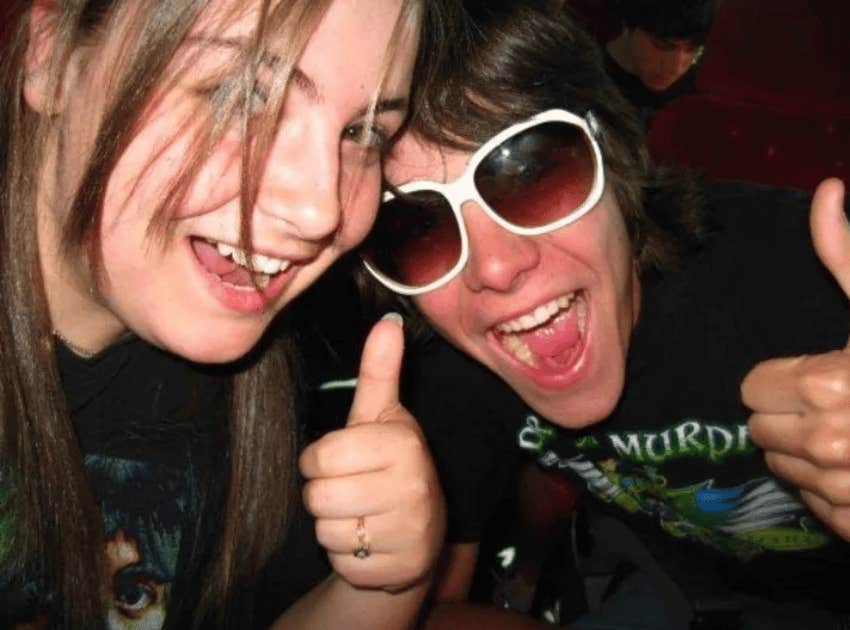 Photo from Author
I met Will in marching band when I was a sophomore in high school. He was a six-foot-two junior with shaggy hair and a killer smile, and against all odds, he somehow pulled off that dumb uniform, feathered hat and all.
First, we traded AOL Instant Messenger screen names and chatted online, communicating in archaic emojis and acronyms that mangled the English language. Then we started going to ska shows together in Manhattan. We’d sit side-by-side on the pleather seats of the Long Island Rail Road, the windows rattling and the brakes hissing as the train pulled into the city’s dark underground. At the venue, he’d crowd-surf me against my will and flail his lanky limbs to the rhythm of the horn section.
I took this photo on a school trip to Disney World. As Will and I waited in line for some ride at Epcot, I whipped out my powder-blue Canon digital camera and snapped a selfie of us. I was 16, and he was 17. I don’t know why I broke my rule. I guess it felt significant.
For years, our band teachers had dangled this trip over our heads like a Mickey-Mouse-shaped carrot: a reward for putting on a marching band uniform every weekend and honking out pep tunes as the football team fumbled plays and fell behind.
The Disney trip was the sole reason any of the students stuck with the band — but not me. Will was my reason. I’d take any excuse to see him, even if it meant sitting on tush-numbing metal bleachers for six hours on a Saturday morning.
I’d fallen in love with his smile. His magnetic pull. His chaotic-good energy. The surprising depth underneath his pranks and half-baked shenanigans. The way he made me feel seen and solid at a time when I felt like I could vanish into thin air, and no one would notice.
This photo shows him the way I remember him: wild and unbothered and infectiously golden. He’s flashing his signature thumbs-up. He’s wearing his favorite Dropkick Murphys T-shirt. He’s shamelessly sporting his sister’s sunglasses because he couldn’t find his own.
But that’s not how Will was at the end
The summer before he turned 21, Will went to Bonnaroo, a music festival in Tennessee, with his sister and some friends. He was already high on acid, and a stranger passed him a cup of water — or so he thought, so he drank it.
It was laced with PCP. The combination of drugs broke his brain. Doctors diagnosed him with acute schizophrenia, and they didn’t think it was going away. The next time I saw Will, he was not wild and unbothered and infectiously golden. He wouldn’t make eye contact. Couldn’t relax. Barely smiled. Didn’t laugh. Hadn’t eaten in days.
“I can’t trust them not to poison my food,” he told me.
I didn’t know who “they” were, but apparently, I wasn’t one of them. I made him two peanut butter and jelly sandwiches, and he ate them without hesitation.
We lay on a blanket in my childhood backyard, staring up at the stars as we had so many times before. This time, Will pointed out the satellites that were watching him. He told me about the voices that criticized his every move. The demons he saw on the road. The monsters that crawled through his television screen every night.
I reached across the blanket and grabbed his hand. I squeezed. He squeezed back.
“I’m glad you texted,” he said.
“Me too.”
That was the last time I ever saw him
 Timur Weber / Pexels
Will died by suicide on July 10, 2012. On one hand, I completely understood. I couldn’t handle my own thoughts and feelings, so I’d numbed myself into dissociation. If it were me, I never would’ve survived the hell of being relentlessly hunted by thoughts that weren’t my own; voices that clawed at my sanity; waking nightmares that other people couldn’t see.
On the other hand, nothing about this made sense. He was the brightest, most happy-go-lucky person I knew. Sunshine in human form — and in seconds, his light had gone out.
After his funeral, the Facebook posts flooded in. People who’d barely even known him posted about that one time in gym class, or that vapid inside joke, or the short conversation they’d had at a party once.
“None of you fucking get it,” I wanted to scream. “He was the only person who saw me. Who made me feel anything. Who showed me that I wasn’t a sociopath; that I still had the capacity to love. He was the only person who noticed when I was disappearing.”
But what proof did I have? What did I have to show for our friendship? How important could I really have been to him?
In my five years of knowing him, we had one single photo together — and in it, he was wearing women’s sunglasses.
After Will died, I stopped feeling anything
It was the nail in the coffin, no pun intended. From that point on, I blocked out everything: pain, fear, happiness, dreams, desire, empathy, connection, trust.
For almost a decade, I abandoned my body and lived entirely in my brain. That way, I could rationalize what happened; I could bend a chain of unfair, unthinkable tragedies into a neat little narrative that made them feel survivable.
Then, when I was 28 years old, a psychologist diagnosed me with depersonalization-derealization disorder, and the healing began.
We started an intensive therapy technique called Eye Movement Desensitization and Reprocessing, or EMDR. Using cognitive behavioral therapy alongside eye movements that tap into your brain’s amygdala (where trauma is stored), we reprocessed my memories so they were no longer painful enough to paralyze my nervous system.
It worked, and it worked fast.
Emotions flooded my body, and for days, I felt insane
 Ivan S / Pexels
For 72 hours after my first session, I floundered in the decades-old feelings, trying not to drown: The pressure of keeping my bipolar brother alive. The shame of my childhood sexual abuse. The panic of my mother’s kidney failure. The abandonment of my parents’ divorce.
And, finally, the heartbreak of losing Will — the moment that confirmed it all:
See? This is what happens when you put your guard down. This is what happens when you love someone. It’s too much pressure, shame, panic, and abandonment. If you never, ever let anyone in, you’ll never get hurt again.
But I was tired of living a life without love, so this time, I refused to dissociate.
I let the emotions surge. I felt them pool and swirl and darken and densen inside my body, and soon, like a wave on the shore, they crashed. They foamed up before settling down. Then they floated back out to sea.
I had finally let myself feel all of it, and guess what? I was still alive.
After two years of processing these emotions in EMDR, I met a man
The second he walked into that Starbucks, I noticed it: The same golden, glowing charisma that Will once had.
Yet this man was a little different. Yes, he glowed, but he was calmer. Less chaotic. Less impulsive. More grounded. He picked up where Will left off, helping me to feel seen and solid — but this time, he loved me the same way I loved him.
In an ironic turn of events, he’s a cameraman, and we’re still debating whether or not we’ll have a photographer at our wedding.
As for my one single photo with my dead best friend, I’m happy I have it, but I no longer wish I had taken more. For one, I now know what he meant to me, and I don’t need a Facebook post filled with posed memories to prove it.
For another, I finally realized: My hatred of pictures wasn’t the thing holding me back
When Will would throw a rager of a house party while his parents were gone for the night, we didn’t want any incriminating evidence — and honestly, we were too buzzed and caught up in the moment to bother.
When Will’s band would play a show, and I’d open for them on my acoustic guitar, the venues were too dark, too smoky, too loud, and too kinetic to fit inside a lens.
When we drove out to Montauk and spent the night drinking on the beach, the camera never would’ve captured the thousands of stars that looked like pinhole pricks in an inky-black canvas.
And when Will would drop by my house unannounced at midnight and stay until sunrise, we were too busy talking and laughing and living to remember the cellphones in our pockets.
Even before I knew it was temporary, I didn’t want to miss a second of his infectious, unfiltered glow — and a frame wouldn’t have done him justice, anyway.
Maria Cassano is a writer, editor, and journalist whose work has appeared on NBC, Bustle, CNN, The Daily Beast, Food & Wine, and Allure, among others. She's in the process of publishing her memoir.
