
Men Who Secretly Think They're Not Good Enough Say 8 Phrases To Bring Women Down A Notch
 Alex Gállego | Pexels
Men are often socialized into believing that the only acceptable kind of masculinity is rooted in self-confidence, according to psychotherapist Avrum Weiss.
That can foster emotional intelligence, but can also spiral into self-worth issues. These are the men who bring people down to feel better about themselves. They think they're not good enough, and they pressure the women in their lives to comfort their fragile egos.
Phrases men who don't think they're good enough say to bring women down
1. 'Is all of this not good enough for you?'
 Miljan Zivkovic | Shutterstock
Insecure men make people feel guilty about wanting more. The same men who have no personal goals or motivations project their own insecurities onto people who do.
They try to make them feel guilty instead of celebrating them and working on their jealousy issues. It's their way of attempting to manage their fears of loneliness and rejection.
"It is easy to project our reactions and fears onto situations when we feel insecure, especially ambiguity," psychologist Lynn Margolies adds. "But reading negative intent into something a person says or does because it made us feel bad is a false equivalency that typically leads to the wrong conclusion, usually a more painful one."
2. 'Nobody else would put up with this from you'
Phrases like this are a clear manipulation tactic from men who want to isolate their partners completely. They bring their self-trust and confidence down, trying to keep them stuck in the relationship to soothe their own fears.
When men are insecure, they need someone constantly reassuring their masculinity. For men clinging to traditional gender norms and relationship expectations, that means having an obedient woman who doesn't question their demands and never makes them feel inferior.
Rather than growing and changing unhealthy parts of himself, he will use this phrase to dull an ambitious woman down to an inferior partner.
3. 'You got really lucky there'
According to a 2025 study, men feel less masculine and more inadequate when their wives make a larger share of the household income. So, even if she's ambitious and successful, a man's insecurity takes the lead, and he finds a way to take it out on her.
Invalidating her success by chalking it up to sheer luck is how he finds control. It helps him feel better about his own failures and insecurities, but changes nothing.
And if he never changes, trying to bring other people down won't change anything about his situation. It will just make everyone and everything more miserable.
4. 'This is really not attractive to me'
Some men inherently tie ambition and superiority to masculinity because, in their heads, that's what they're trying to embody. So, when they're struggling with those traits and a woman in their life is thriving, their immediate response is guilt.
As a study published in the Journal of Personality and Social Psychology found, women are rarely threatened by their male partner's achievements. But many men feel much more inferior when their female partners succeed.
To him, these traits are masculine, and if insecurity is in the picture, you'll hear some version of this phrase. He's trying to weaponize his own attraction in the relationship to dim his partner's shine to make himself feel better.
While some women may shrink themselves, a self-assured woman knows her power and isn't afraid to make it known.
5. 'You never have time for me'
 BearFotos | Shutterstock
When someone has an anxious attachment style in a relationship, according to a 2019 study, relationship satisfaction goes down. But it often happens in small ways, like hearing "you never have time for me" while achieving something instead of being celebrated, like you'd expect from a partner with your best interests at heart.
These men are jealous about everything. They constantly need reassurance. They get defensive and reactive, while someone with a secure attachment style would be supportive and excited.
6. 'I actually did that same thing a few years ago'
Partners who subtly compete with each other are less happy. They're rarely celebrated for achieving something, because they're always subconsciously hoping they won't hurt the other person's feelings.
"At its core, one-upmanship is propelled by deep-seated insecurities prompting individuals to seek affirmation and validation through comparison," psychologist Mark Travers explains. "Despite initially seeming like harmless banter or playful rivalry, its underlying motivations can sow seeds of discord and resentment within relationships."
For ambitious women in relationships with insecure men, there's always a performance going on. They know if they brag about a goal or share a cool moment, they're going to be met with something like this that undermines their success.
7. 'You're so sensitive, it was just a joke'
Insecure men are experts at hiding their cruelty behind a joke or an excuse. They need to feel in control, and if they're called out and expected to be held accountable, that defeats the whole purpose of their manipulative game.
"Psychologically, ridicule is not simply about tearing another person down; it is about confirming one's own place in the social order," psychology professor RJ Starr explains. "The one who ridicules positions themselves as competent, confident, and socially fluent. For the rest of us watching, the one who is ridiculed becomes the mirror of what we fear we are: awkward, foolish, fragile. In this way, ridicule functions as a form of moral theater."
8. 'You're always off doing who knows what'
 Hryshchyshen Serhii | Shutterstock
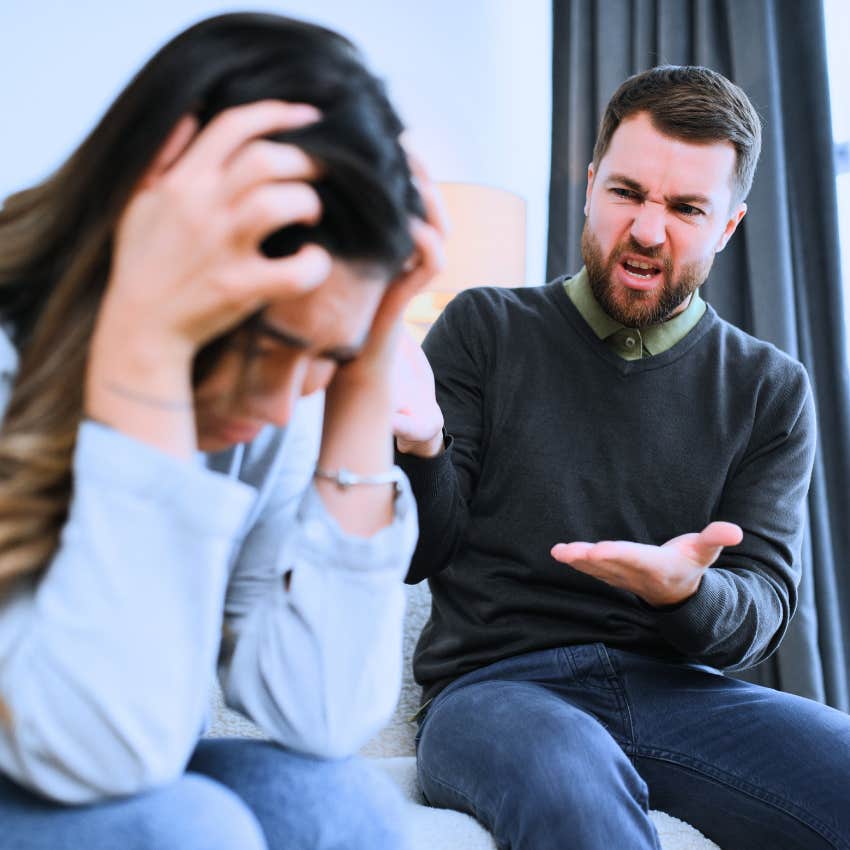
For jealous men, phrases like this come up all the time. They make little jabs and assumptions, trying to force their partners to over-explain themselves. Even if their wives or girlfriends are working hard, an insecure man will try to bring her down by suggesting she's being dishonest.
It's a form of control, because these men don't know how to control the inner turmoil driving their insecurity. "When people can't modulate their own anxieties and insecurities, one partner's options and priorities are sacrificed on the altar of the other's fears," psychologist David Schnarch says.
"You also fear that if your partner doesn't need you, because he or she can take care of himself/herself, then he or she wouldn't want you or choose you. This makes you fear your partner becoming more emotionally autonomous as much as you fear it in yourself."
Zayda Slabbekoorn is a senior editorial strategist with a bachelor's degree in social relations & policy and gender studies who focuses on psychology, relationships, self-help, and human interest stories.
