
5 Hard Things I Did This Year That Changed Me As A Human
 Valerii Honcharuk | Canva
 “That was a year.”
I’ve been saying a version of this at the end of every year for at least the last decade. Every year has been “a year for the books,” as they say, and usually not in a positive sense. Whether it’s all the crazy stuff going on “out there,” or all the crazy stuff going on in my own home, each successive 12-month cycle has contained more than enough crazy stuff to qualify as A Year.
Last year, 2025, was no exception. I could list the major news stories of 2025, and that would suffice. Truth be told, I was hardly paying attention to the major news stories because there was only so much crazy I could take.
This year, though, it was less about bemoaning the crazy and more about how I grew through it. It was less about how I reacted and more about how I proactively deconstructed it to get closer to living my truth.
I have seen various versions of year-end “ta-da” lists floating around Substack, and as is the case with nearly every online trend, I am late to the party. But better late than never. As someone with far too many concurrent to-do lists at any given time, I like the idea of celebrating accomplishments, of taking time to acknowledge what we’ve done, rather than all that remains to be done.
At the same time, the very word “accomplishment” has a ring of finality to it that makes me uncomfortable. There is very little I did in 2025 that feels "done.” I have very few life goals right now that can be checked off a list or tied up in a bow. So here is my own version of the ta-da list.
Here are five hard things I did this year that changed me as a human:
1. I joyfully solo-parented my kids through a major life transition
Last year, 14 months after I requested a separation, my divorce was finalized, and the next chapter of my life began. I have been accused of glamorizing divorce, and I will say (as I’ve said before) that there is nothing easy about it for any party involved.
But despite all the dire warnings that I have officially messed up my kids for life, I am proud of how I showed up for myself and my children throughout an ugly and extremely stressful process. Has it been traumatic for my kids? I’m quite sure it has. Has it been more traumatic than our marriage? I’m quite sure it hasn’t.
Either way, the lasting effects of trauma are all about the processing, or lack thereof. Slate has already called into serious question the coverage of studies claiming that children of divorce will inevitably be maladjusted, mentally ill, and/or criminally inclined. For instance, a study of 131 children from a single California county that reinforced the “divorce = lifelong trauma” narrative was cited six to 14 times more often by the media than a far more significant longitudinal study of 1,400 children that found “the vast majority of kids of divorce [become] well-adjusted adults.”
Throughout the last tumultuous year, our home, which for so long had been a minefield we needed to tiptoe around to avoid triggering Dad, became a place of refuge, safety, and stability. My children saw a mother who was not broken by abuse, but who said enough was enough. A mother who took the initiative to break out of the confines of a relationship that was not serving her — or, perhaps more importantly, them. A mother who became a fierce and reliable advocate for their needs, not an anxious mediator trying to keep the peace. A mother who started living life on her own terms.
I am under no illusions that this last year has been easy for the kids, but my goal is that their trauma never manifests into Trauma with an upper-case T. My goal is also that they will understand, firsthand, that joy can exist — and can even be more abundant — outside of the patriarchal social structures we’re told are the foundation for lifelong happiness and success.
2. I tore down the happy nuclear family facade
 Peter Adrienn / Pexels
There’s a notion floating around out there that women are “good” at emotional vulnerability. It’s true, to an extent, that we’re more socially conditioned to feel comfortable sharing our feelings, but it’s also critical to acknowledge the other social pressures we contend with — particularly as wives and mothers. In fact, I think I was better at emotional vulnerability back in my tweens, teens, and 20s than I was after I got married — and especially after I had children.
Once women become entrenched in nuclear family units, so much of life starts to get wrapped up in rising to the standards society sets for us. Is our home clean enough? Is dinner nutritious enough? Are our children well-behaved in public? Are they well-behaved in school? Is everyone smiling in the photo? Does my husband appear to be an “involved father?”
These types of questions dominated most of my 30s and early 40s. If the answers weren’t yes, society would judge me — no matter that for all of these years, I was also the sole or primary income provider. I tried so diligently to project a happy, functional family image that I often believed it myself. Okay, yes, there was an indentation on our living room wall where a dinner plate had been hurled, but it was neatly concealed behind the hutch. Out of sight, out of mind.
I think about “the facade” even more during the holidays, when the steady trickle of holiday cards arrives from the same 10 families year after year — most displaying posed, matching-outfit photos and updates in tiny fonts with too many exclamation points that outline the most generic contours of their lives. Why? What for? I almost feel sad for some of these families, like they’re trying too hard to convince themselves of their own happiness.
Maybe I didn’t proactively “tear down” the facade, it began crumbling all on its own. But last year, instead of scrambling to resurrect it, I let it collapse. The relief was indescribable. It’s not that I’m never immune to potential judgments (particularly about how I keep my home or parent my children) but I also contend with far less pressure to keep up all the pretenses.
I share whatever is on my heart and mind with a roomful of people during my weekly recovery meetings. I am far more honest and have far more meaningful relationships with my first family and friends. I’ve discovered who my true friends really are, and I don’t waste my time with the rest.
Turns out, when you’re a divorced single mom, society has already condemned you. Ironically, there is enormous freedom in that. Instead of doubling down, or incessantly worrying what others think, or trying to get my life back on track, I am leaning hard into that freedom to deepen my close relationships and live a more authentic life. I don’t have it all together, just like I know the mothers in those canned Christmas cards don’t have it all together, and I feel no shame. I am a gleeful work in progress.
3. I asked for help
 Daniele La Rosa Messina / Unsplash
On the one hand, the notion of asking for help is triggering for me. Throughout my marriage, I was counseled to ask my partner for the help I needed because he could neither read my mind nor, apparently, was he biologically capable of anticipating my needs.
Neither was the notion of asking for help as a newly single mom in any way appealing. Not only are we culturally conditioned to equate the need for help with weakness or imperfection, but I had spent so long in the insular cocoon of my nuclear family that I wasn’t even sure where to start.
Turns out, my lack of ability to be in two distinct physical locations at one time gave me just the push I needed. It started with carpools. Then I had to find childcare during my work conferences. Then I got cats, because that’s apparently what recently divorced women do, and I realized (crap!) that I would now have to arrange kitty care whenever we left town.
Slowly, my networks grew. And I realized that for the most part, people were thrilled to have the opportunity to help. If not thrilled, at least gracious. It feels good to help where you can. I’m now proactive about not just asking for, but also offering, help. It’s not about paying people back; it’s about paying it forward. And I know for a fact that it’s not just single moms who need help. There are tons of other single people in need of support, and tons of coupled people who, despite their “having-it-all-together” facade, are drowning behind the scenes.
Do I feel self-conscious about occasionally asking for more help than I’m able to give? Sometimes, although I recognize that the equation of giving and receiving help isn’t balanced at all times. In fact, it’s hardly ever balanced.
When I was subject to the power dynamics of heterosexual marriage, I gave my partner far more “help” than I ever got. Ånd most societies give mothers far more “help” than mothers in the United States ever get to enjoy. Really, when you look at things that way, it’s my turn to be on the receiving end for a while.
4. I hosted two neighborhood events
 Samuel Yongbo Kwon / Unsplash
There’s another reason the entire notion of “asking for help” rubs me the wrong way. If we all lived in a symbiotic community, as we did for most of human history, we wouldn’t really have to ask. Community members largely know one another’s needs because, well, they live in community with one another.
Fellow caregiver Shane Meyer-Holt said something in one of his stories that has stuck with me all year. He has a lot on his plate as a caregiver, and occasionally, people ask him how they can help. As Shane put it, “We need people who are just there.”
What does it mean to “just be there?” It sounds a bit nebulous, but I know exactly what he means. Piecing together help via text message and painstakingly calculated plans, which are frequently subject to change, is exhausting. But when people are just “there,” support becomes much more accessible.
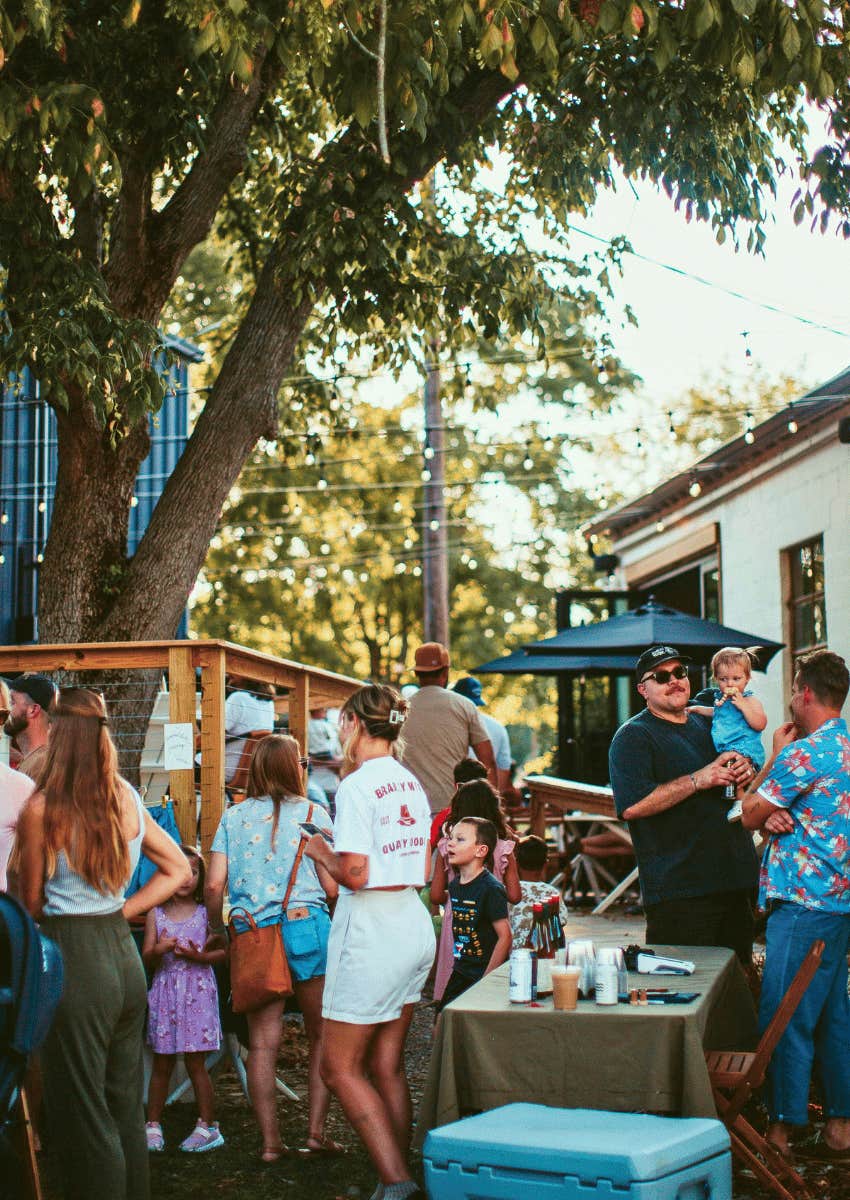
That’s why I made the effort to host two events for neighbors on my block in 2025 — a block party and a potluck. As far as hard things go, are block parties and potlucks on par with divorce? It depends on how you look at it. I’m an introvert prone to some degree of social anxiety who gets particularly anxious about feeling responsible for social events. I organized a neighborhood block party back in 2021 that kept me up at night for weeks. Everything went well, and I told myself I’d do it again the next year. The next year came and went. Then the year after that, and the year after that.
Last year, the year during which one could argue I had the most on my plate, I decided to go for it. I sent an email; another neighbor started a text thread. I fretted, yes, but I also told myself that whoever showed up would show up, and we’d all have something to nibble on and something to sip on, and we’d pass a pleasant afternoon. That’s exactly what happened, and the next day I waved and greeted three different sets of neighbors by name whom I’d never talked to before. All people who are just “there.” One woman took it upon herself to apply for a grant so we could paint the intersection on one end of our street at next year’s block party.
I didn’t want to lose the momentum, so a couple of months later, I sent out a text offering to host a holiday potluck. Then I immediately regretted it. It had been a long time since I’d hosted anyone in my home beyond close friends, family, or my kids’ friends. Yes, I felt stressed. Yes, I felt frustrated that no one seemed to be able to RSVP or commit. Yes, I worried about getting my home in order and whether or not there would be enough food.
I also knew that it would all work out, one way or another. Maybe five people would show up, maybe 50, and either way, we’d find a way to enjoy ourselves. Over the course of the evening, about 25 people filtered through my home, ranging in age from four to 64, all within walking distance. They might not all be people I’d choose to be besties with, but there’s a lot to be said for talking to a body piercer, missionary, and military vet about why American men feel so uncomfortable dancing while getting occasionally pelted by NERF pellets. Yay for multigenerational gatherings with people from all different walks of life!
We don’t typically get to choose our neighbors, but we can choose how we interact with them — or whether we interact at all. My kids might spend more time home alone in a one-parent household, but I hardly worry about it because they know who lives next door, across the street, and down the way. When people are just “there,” it makes all the difference.
5. I unselfconsciously did things by myself
On Christmas Eve, I sat myself at the bar of a Longhorn Steakhouse near the Kansas City airport. I ordered a sirloin (medium-rare), a loaded baked potato, and an IPA. How and why I came to be in Kansas City by myself on Christmas Eve is another story for another time, but if anyone in that Longhorn Steakhouse pitied this middle-aged woman alone at the bar, I’m glad they kept their pity to themselves. I had no use for it.
A man sat down next to me. I didn’t take my eyes off my book, radiating friendly but firm “don’t talk to me vibes.” He respected them. When I was done, I took a walk in the fading sunlight of the day along the wide streets of airport suburbia, soaking in the unseasonal warmth.
There is the cliché midlife crisis, but what I see in so many fellow middle-aged mothers is more of a reckoning. A return to autonomy, but without the self-consciousness and niggling desire to please that many of our younger selves lugged with us. As a young adult, I did quite a bit alone, but I never would have thought to, say, grab an afternoon beer alone or eat in public alone. Those things were meant to be done with people, and I didn’t want to look pathetic.
As my kids got older, I started dropping them off at classes and events and found myself with rare pockets of solo time. Forty-five minutes with a hazy IPA and my book while they were in Jiu-Jitsu. An hour to wander through Forest Park between events at a track meet. A plate of buffalo wings on a restaurant patio during a birthday party.
It never even occurred to me that someone might think I looked pathetic, and if they did, I was pleasantly surprised to find that I truly didn't care. This is the difference between being 45 and 25.
I took as many long, solo hikes in 2025 as my schedule allowed — which is to say, not enough — but when the opportunity presented itself, I scrolled through my AllTrails wishlist with all the filters set just so. My son is scared of heights, so I sought solo hikes with high elevations and sweeping views. My daughter generally refuses to do anything above five miles, so I aimed for eight or ten.
Not only did I see quite a few other solo hikers, but most of these solo hikers were women, and most of them were over 40. Apparently, there is a secret society of solo middle-aged female hikers, and they wordlessly welcomed me into their ranks.
On the trail, we walked. We breathed. We sweat. We unapologetically took and sought space.
If there was one theme that carried me throughout the year, it was re-learning how to navigate the world as an autonomous human being, but without the self-consciousness of my pre-marriage, pre-kid years. I focused on building an independent life, yes, but more importantly, I focused on building an interdependent life.
In 2024, my focus was no. I said no to the exploitation endemic to heterosexual marriage and no to the emotional abuse layered in mine. I said no to romantic intimacy and no to narrow definitions of ambition and self-worth. I said no to friends who weren’t really friends. I said no to self-help books and no to parenting books and no to all the so-called experts who peddled their stupid, generic formulas for happiness and success.
In 2025, I began exploring yes. I didn’t go into 2025 with any intentions of a Year of Yes, Shonda Rhimes-style, but I knew that no would only get me so far. Of course, I had to be strategic about yes. I wasn’t about to dive headfirst into anything without a clear understanding of my boundaries and intentions. Every yes included at least one clear no. Yes to neighborhood potlucks, no to networking happy hours. Yes to acts of service for communities that serve me, no to 24-hour news cycles and social media outrage. Yes to romantic intimacy, no to soul-sucking dating apps.
After building necessary walls, I am now focused on inviting love into my life — in all its various forms. I’m not forcing it or desperately holding onto it, but simply giving generously and creating space for connection. After a year of hard things, I’m heading into 2026 feeling very loved indeed.
Kerala Goodkin is an award-winning writer and co-owner of a worker-owned marketing agency. Her weekly stories are dedicated to interrupting notions of what it means to be a mother, woman, worker, and wife. She writes on Medium and has recently launched a Substack publication, Mom, Interrupted.

