
Why Men Are So Bad At Telling You How They Feel, According To Research
 AYO Production / Shutterstock
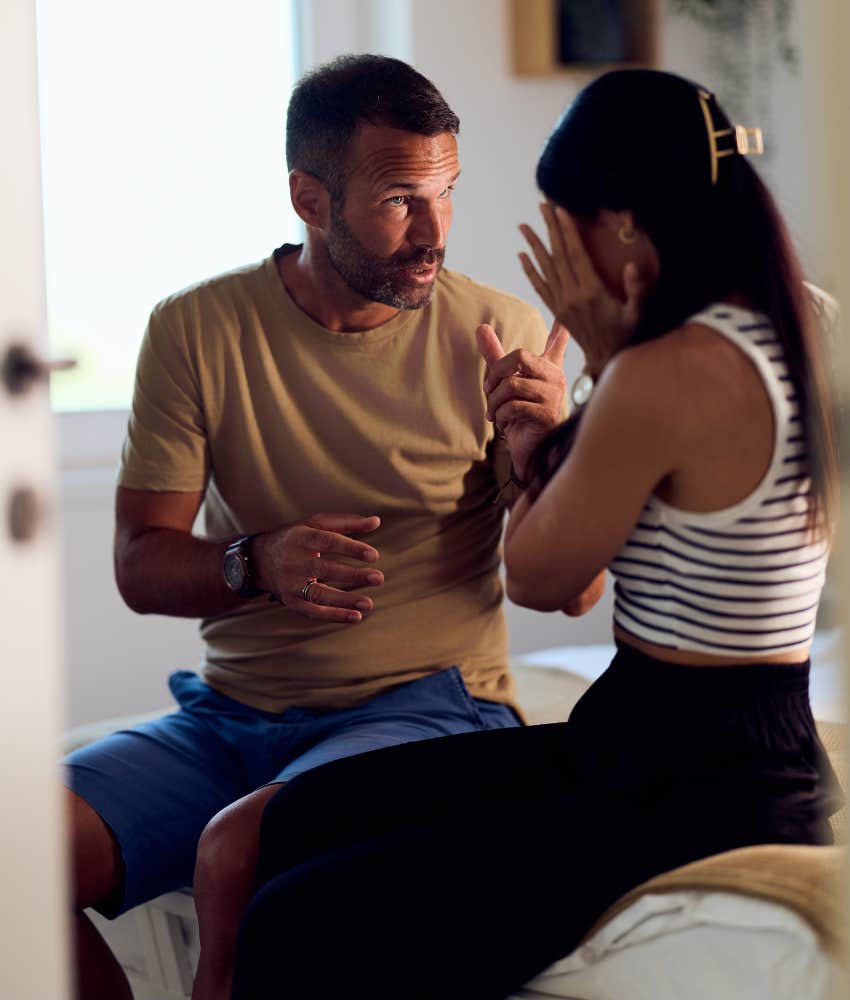
 Ever wonder why men are so bad at telling you how they feel? Emotional processing in male and female brains is not the same. Our brains have two emotional systems that work simultaneously — males seem to use one system more, and females seem to use the other system more.
As men reach puberty, their emotional empathy differs from a woman's, and that boundary exists to prevent men from being influenced by others. On the other hand, women take into account what others think of them while men do so less, and this makes men seem less empathetic. Why is this? Because biology has more to do with how we communicate than you might think.
Men are bad at discussing feelings because historically, they had to act on what they thought was best without waiting for approval.
In contrast, women's survival at a primitive level depends on others as a group process, and therefore, they developed more empathy towards each other. As men and women age, the gap in this emotional thinking seems to change in many ways. While men, as they age, become more aware of others' emotions, women become less dependent on the approval of others, especially after children are no longer young and dependent on them.
 Branislav Nenin | Shutterstock
As men age, they often begin to crave the emotional intimacy of their wives, but are not used to expressing it through words or facial expressions. Developing healthy communication with your spouse is one way to bridge the gap between the two of you. Understanding that just because a person doesn't always respond emotionally the same way you do doesn't mean they don't feel it.
For a woman, learning to ask her husband more direct questions about what she may need or want will help him get the job done without having to guess the meaning behind the question.
Men get confused and frustrated because women aren't always direct and think that a man should know what they want.
The truth is that unless women tell most men what they want, their brains are not wired to pick up on those subtle cues that a girlfriend or sister may sense. Listening to men having conversations with each other can give women a clue as to how direct they are with one another — when they want something, they don't beat around the bush.
The same is true about a woman; she is not wired to be as direct biologically or socially, so if she is trying to tell you something and you are getting frustrated, repeat what she said back to you. For example, "You are telling me that you are tired at night, and when you wake up in the morning, and the kitchen is not clean, it stresses you out?"
It will let her know that you heard what she said and also give you time to ask a more direct question. "Do you want me to take out the trash, sweep the kitchen, or put dishes away? What do you want me to do?" Be direct so that she does not have to and can just answer your question.
Societal norms have also shaped how men feel they are expected to act.
Boys have always been told to "act like a man" and be strong and tough, both physically and emotionally. As they grow up, they separate from their feelings and choose to deal with things internally.
 LightField Studios | Shutterstock
According to Psychology Today, this phenomenon is labeled as "normative male alexithymia." The term is used to describe the tendency of boys and men to conform to traditional ideas of masculinity and discourage vulnerability and the expression of emotion. Assael Romanelli, Ph.D., shares, "In fact, boys are born just as sensitive as girls. But through the socialization process, boys lose permission to feel and become disconnected from their core."
Fortunately, this isn't permanent. Men can relearn how to feel and express their emotions by allowing themselves to confront their feelings with a trusted partner.
Dr. Dawn Michael is a relationship expert, certified counselor, intimacy educator, intimacy researcher, author, and public speaker. She has been featured as an expert on national television, radio, and in magazines such as Cosmopolitan, Women's Health, Bride, Askmen, Huffington Post, Shape, and more.
