
Research Shows Moms With 2 Kids Develop Rare Abilities That Basically Makes Them Superheroes
 wavebreakmedia | Shutterstock
 For a lot of moms, thinking about having a second child can be a bit overwhelming. But according to research, moms of two may actually develop a surprising ability that helps them manage the chaos.
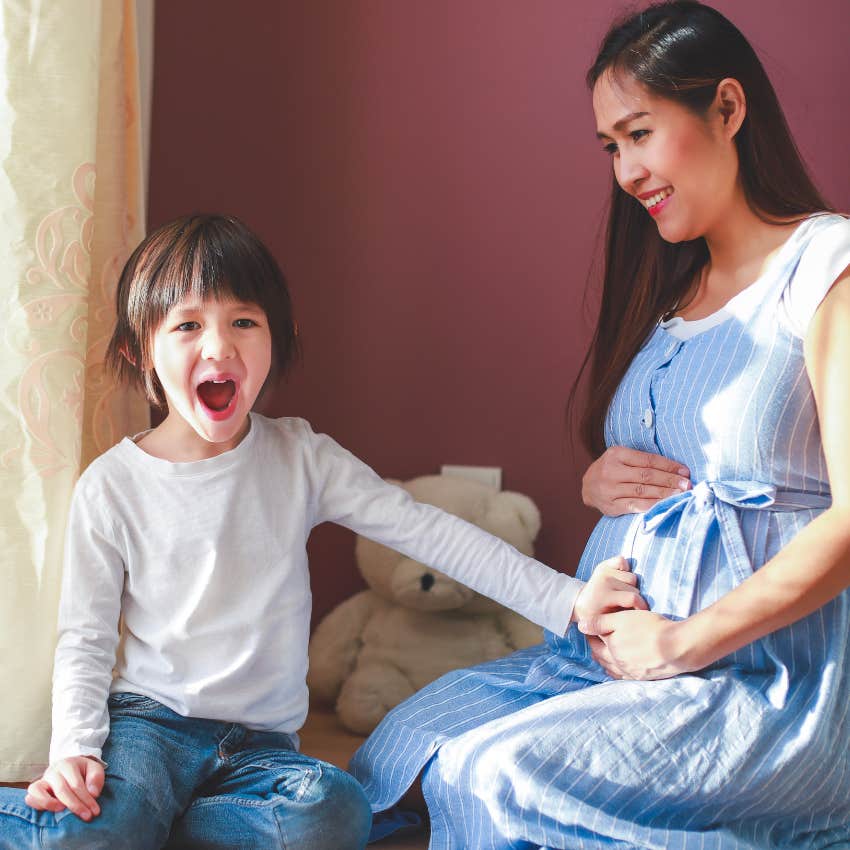
In fact, researchers found that a second pregnancy alters a woman's brain, giving her abilites that practically turn her into a superhero. Although a mother's brain changes with her first pregnancy, a second pregnancy changes her attention span and reaction to sensory cues, making it easier for her to care for multiple children.
Moms with two kids have enhanced attention spans and a heightened reaction to sensory cues.
Scientists at Amsterdam UMC, publishing in Nature Communications, have found that a second pregnancy can reshape a mom's brain. Prior research by neuroscientist Elseline Hoekzema and her colleagues demonstrated that a woman's first pregnancy changes the structure of her brain. They also discovered that pregnancy affects how the brain functions.
 Onjira Leibe | Shutterstock
During a first pregnancy, the Default Mode Network, the part of the brain that plays an important role in processes such as self-reflection and social cognition, changes the most, but the changes are only minimal during a second pregnancy. Instead, greater changes occurred in brain networks that direct attention and respond to sensory signals.
Researchers conducted an experiment with 110 first-time mothers, mothers of two kids, and childfree women.
The participants’ brains were repeatedly scanned to highlight the changes. Researcher Milou Straathof explained, "It appears that during a second pregnancy, the brain is more strongly altered in networks involved in reacting to sensory cues and in controlling your attention."
"These processes may be beneficial when caring for multiple children," she continued. Researchers were also able to discover a relationship between pregnancy-related brain changes and the emotional bond between a mother and her child. This connection was stronger for women experiencing their first pregnancy than for those having a second child.
By examining both first and second pregnancies, the research filled in gaps in women's biology. It's no secret that studies and research about women's reproductive systems and health are severely underfunded. The findings from this study can hopefully help better understand things like postpartum depression and how to treat it.
There is a growing trend in families with only one child.
The percentage of women 40 to 44 who have one child nearly doubled from 10% in 1980 to 19% in 2022, according to Bowling Green State University’s National Center for Family & Marriage Research. While some of the reasons included infertility struggles, the rising cost of parenting, and childcare, along with the cost of living in general, have many families choosing to stay small.
 Connect Images - Curated | Shutterstock
Then, of course, many women are now getting married and having children much later in life, which means they're faced with the reality of wanting or being able to have only one child. Kellie Wicklund, LPC, PMH-C, a psychotherapist, explained that she’s been seeing more and more families in her practice choosing to have one child for financial reasons as well.
But another reason more women are deciding to be one-and-done, according to Wicklund, is that they are prioritizing careers and professional pursuits. While the study has found that women with two kids undergo impressive changes to their brains, becoming a mother, whether with one or three kids, can still reshape both the mind and her overall outlook in life for the better.
Nia Tipton is a staff writer with a bachelor’s degree in creative writing and journalism who covers news and lifestyle topics that focus on psychology, relationships, and the human experience.
