
How To Manipulate Your Cat Into Sitting On Your Lap & Loving You More
 larisa Stefanjuk | Shutterstock
It might seem impossible to get a cat to like you, especially if they've clawed or injured you in the past. But there are people who love cats, so there must be some sort of trick to it, right?
Domestic animals can sense your fear and will then be afraid of you just as much as you are of them. Luckily, a study by the Universities of Sussex and Portsmouth determined the best way to get a cat to like you.
According to the study, cats are sensitive to human cues that facilitate competition between different species in the same ecological area, including cues to the emotional state.
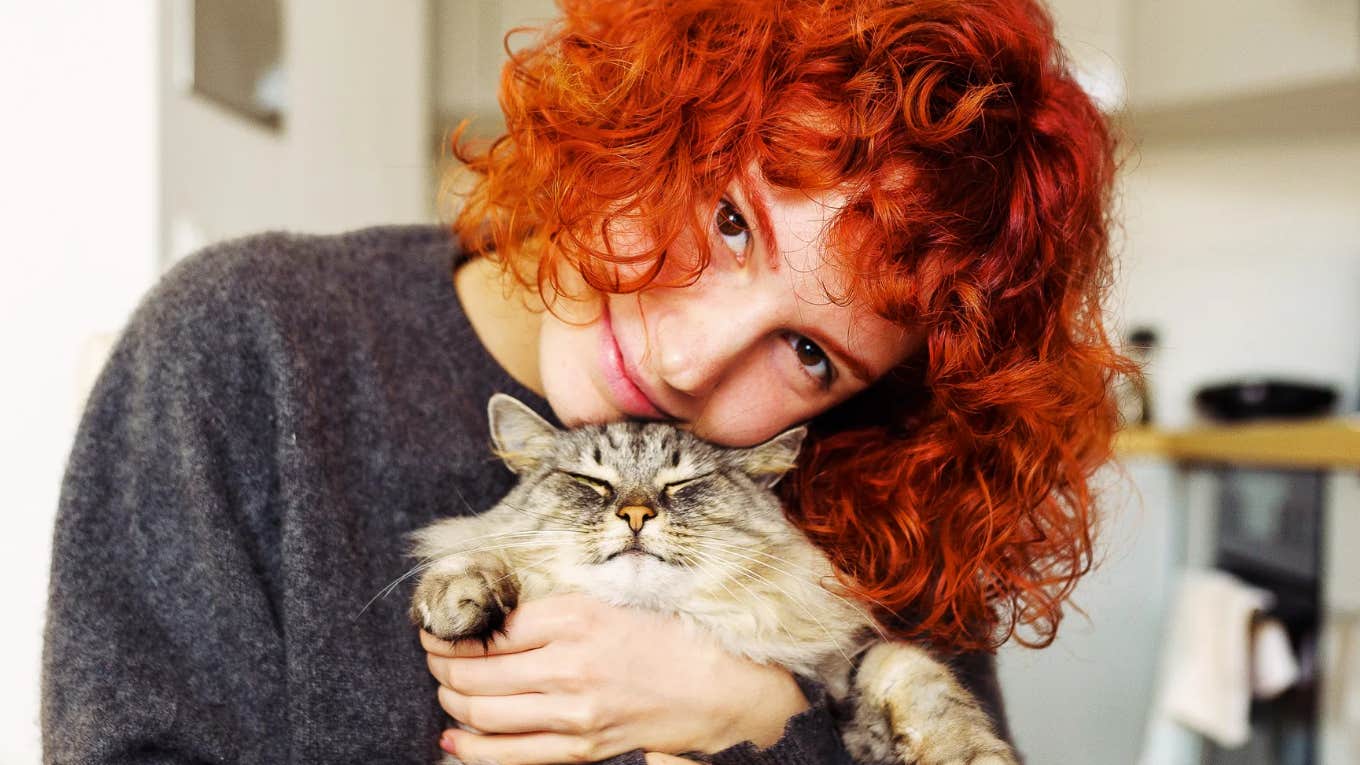
The study determined that if you slow blink at your cat, they'll love you more and might even sit on your lap
 Iryna Imago | Shutterstock
“The eyes are important in signaling emotions, with the act of narrowing the eyes appearing to be associated with positive emotional communication in a range of species," said Karen McComb, professor of animal behavior and cognition, and one of the researchers who conducted the study.
According to McComb, slow blinking “involves a series of half-blinks (where the eyelids move towards each other without ever fully closing the eye) followed by either prolonged narrowing of the eye aperture or a full eye closure.”
To perfect this body language, you begin with a neutral face, then close your eyes to a half-blink, then fully close your eyes, and when you open your eyes back up, you have a sort of eye-narrowed expression.
The team, led by McComb as well as Dr. Tasmin Humphrey, a psychology researcher who studies emotional signaling in animals, examined how people are able to build a harmonious relationship with a cat by using the widely reported cat behavior technique called eye narrowing, AKA the slow blink sequence.
Essentially, the eye-narrowing technique performed by humans generates a cat "smile" that makes the human more attractive to the cat.
To figure this out, researchers performed two different experiments. In the first, the owner waited until the cat was settled and then tried the slow blink one meter away. In the second experiment, researchers from the team did the slow blink or posed a neutral face with no direct eye contact.
The second experiment also tested the context in which the cats preferred to approach someone they didn’t know, with the researcher laying a flat hand with the palm facing upwards while sitting next to the cat.
Using behavioral coding and statistical analysis, the first experiment revealed that when you slow-blink at your cat, they do it back. The second experiment found that when meeting an unfamiliar person, cats are more likely to approach a stranger's outstretched hand after they’ve slow-blinked, compared to if they had a neutral expression.
Of the findings, McComb stated, “Our study provides the first systematic investigation of the role of slow blink behavior in cat-human communication. We show that slow blink interactions appear to be a positive experience for cats, and maybe an indicator of positive emotions.”
While this study found that a slow blink is important in getting a cat to trust you and how it helps you become more appealing to a cat, there are other ways to win a cat's favor! The most important thing to remember is that cats are not dogs, so treat them as such.
How to manipulate your cat into sitting on your lap and loving you more:
1. Be cognizant of where you pet a cat
Because each cat has its own likes and dislikes, you may find that the cat you're trying to win over doesn't like being pet in certain areas. In fact, a study from the Veterinary Humanities and Social Sciences Journal determined that cats much prefer being pet on the head and cheeks, responding with purrs and blinks.
When first meeting a new cat, don't immediately start trying to pet their backside, tail, or belly; instead, stick to their head. Cats are very sensitive to touch and may not like stimulation in these other areas.
2. Let them come to you
As adorable as cats are, you should never immediately approach a cat and try to pet them. This can result in you scaring the cat, who may then run away or even swat at you. The best thing to do instead is to ignore them, as this has been shown to lead to a more positive interaction.
A cat's love must be earned, as their behavior has proven time and time again. But other than ignoring them and letting them warm up to you slowly, especially for shyer cats, get on their level, extend your finger or hand, and let them come to you, says Dr. Laura Finka, an expert in feline behavior and welfare at Nottingham Trent University.
If the cat sniffs you and rubs on you, you can pet or scratch their head lightly; if they walk away, don't chase after them.
3. Observe the cat's response to your body language
 Wanwajee Weeraphukdee | Shutterstock
Not every cat will be as friendly as the kitty you had growing up. Be smart about not only how you move around them, but also the volume and tone of your voice.
Pay close attention to the way a cat responds to you. Positive reactions include purring, kneading, and eye blinks, whereas negative responses include hissing, biting, swatting, or a rapidly moving tail, according to the Cornell Feline Health Center.
Respect the cat's response in order to build trust over time and prevent aggressive behaviors in the future. You want to make sure cats always feel comfortable and safe.
4. Play for the proper amount of time
Playtime is an essential part of any house cat's health and mental well-being. But first, you must observe whether the cat is in the mood to play.
Once you've established this through their body language and overall interest, use interactive toys to spark their curiosity. Other signs they are interested can include being approached by the cat, allowing you to touch them, or showing that they feel safe.
But there will be a time when the cat is no longer interested in playing. When they show through body language that they want to move on, don't force additional playtime on them. Your cat will let you know when to stop.
5. Stay calm and patient
Because cats can pick up on emotional signals, research from the Journal of Animal Cognition explains that they will be able to sense your fear. Be sure to remain calm and positive, and don't react with panic or sudden movements.
Another tip is to make sure every interaction ends on a positive note. You can also use treats or cat food as a way to make these interactions positive.
Additionally, it will take time to earn the trust of a cat. Sometimes it might take a month or two! But that's totally normal. Above all, a cat's comfort is of the utmost importance when getting them to like you. Let the cat guide the way, instead of the other way around.
Samantha Maffucci is a senior editor for YourTango who has written hundreds of articles about relationships, psychology, self-help, and the human experience.
