
The Question My Marriage Counselor Should've Asked Me From The Very Beginning
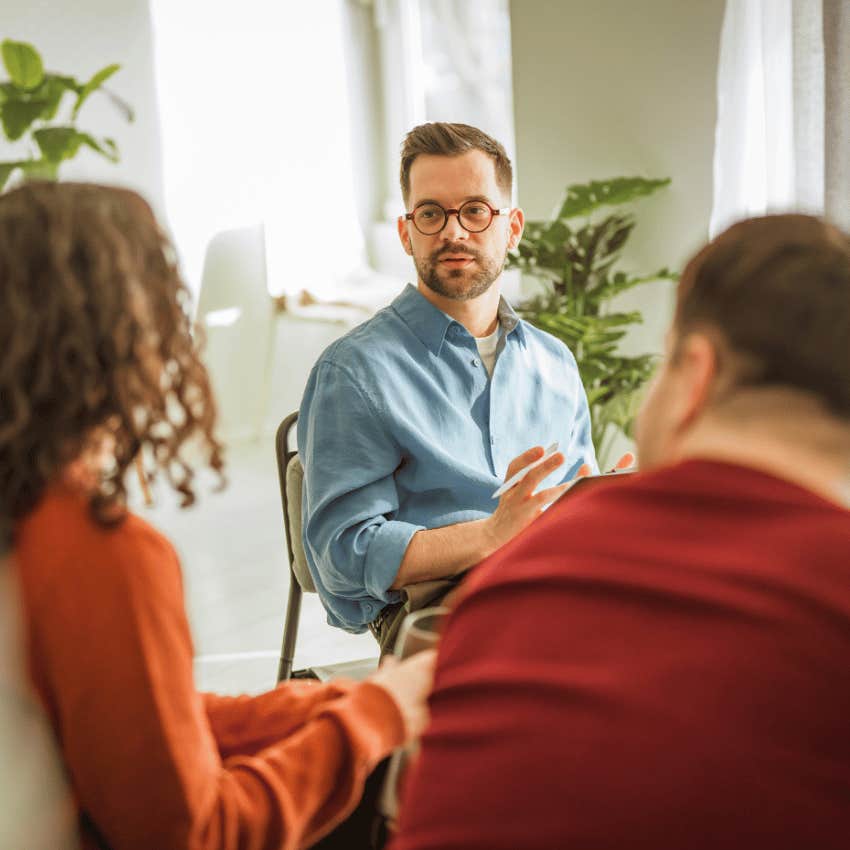
 Antoni Shkraba | Canva
 I could see the fear in his eyes. Though our marriage counselor had a good six inches on my husband, he was gangly and narrow-shouldered, and I had no doubt who would win if their confrontation came to blows. My husband had ample muscles and was currently reminding our marriage counselor of his superior strength by puffing out his chest and flexing his arms.
Our marriage counselor was backing away from my husband and saying, “Whoa, whoa, whoa!” He was startled at first, and then the fear took hold. I didn’t think my husband would strike him, but I could no longer predict what my husband would or wouldn’t do. My mind was racing, trying to remember if any beer had yet been consumed that day, and if so, how much.
Looking back now, I cannot, for the life of me, remember what it is we were talking about that led to this state of affairs. I am certain that I was trying to tell him, as I’d tried to tell him so many times before, that we needed to make some room in our marriage for me. Maybe I was using a different combination of words this time. Maybe I’d preceded my carefully crafted request with, “The story I’m telling myself is…” Or maybe I’d deviated from whatever script we were working on that week by challenging something he’d said.
Whatever had happened, I’d upset him. This was something I’d gotten particularly good at as of late. Which was ironic, because I spent most of my days tiptoeing around his triggers, trying my hardest not to upset him. And here I’d gone and done it again. I’d upset him so badly, in fact, that he’d lost his cool, and when our marriage counselor tried to convince my husband to hear me out, my husband turned on him.
Ultimately, no punches were thrown. My husband gave our marriage counselor his slightly crazed “I-could-beat-you-up” look, which he’d been fastening on me with increasing frequency over the last few years. Then he strode out of the room.
To his credit, he left me the car and walked the 52 blocks home. After a stunned silence, my floodgates burst. The tears streamed, the words tumbled. Our marriage counselor sat down, clearly shaken, and resumed his “therapist pose” — notebook on knee, nodding and intermittently scribbling.
I told him that this was how so many of our conflicts ended, with him in my face, reminding me of his physical strength. Not wielding it, but making sure I didn’t forget. And if a conflict didn’t escalate to that point, there was still yelling, lots of yelling. Not mutual yelling. Me being yelled at. Called names. Degraded. Dismissed. Sometimes I felt like we made headway during our sessions, but it never lasted. Nothing I said in this room seemed to stick.
Our marriage counselor nodded and scribbled, nodded and scribbled. Then he looked up at me, thoughtfully. He said, “Do you think, maybe…”
He paused. The question poised on his lips was undoubtedly a serious one. I’m not sure what question I expected him to ask. I didn’t know, at the time, what question I needed him to ask.
But the question my marriage counselor proceeded to ask was neither the question I expected nor needed
 Miljan Zivkovic / Shutterstock
“Do you think,” my therapist started again, “you might be playing the victim?”
With the benefit of hindsight, the question I needed at that particular moment in time was: “Do you feel safe?”
But not one of the four marriage counselors we’d seen had ever posed that question. They’d listened while we chattered on about our petty conflicts and asked us to frame requests in certain careful ways and list things in columns on pieces of paper that would end up scattered amongst receipts and cereal boxes in our recycling bin.
Our first counselor, with whom we engaged over the phone, thought we were doing pretty well — that is, until she heard us in the thick of an actual argument. My husband raged on while she occasionally tried to insert herself, but she learned quickly, as I had, that there was no interrupting my husband’s rage.
This counselor was deemed too female to get us anywhere, so I found us a male counselor whom my husband seemed to like. Mostly, this was because the counselor spent an inordinate amount of time talking about the Tesla Model S that my husband wanted to buy for himself as a reward for graduating from his doctoral program. I did not think we could reasonably afford a Tesla Model S; I did not want one; and I thought maybe I, too, deserved a reward for supporting him through 11 years of school. But we didn’t talk much about any of that.
When our counselor grew tired of gushing about Tesla torque specs, he proceeded to describe to us in great detail, with accompanying hand motions, the key differences between Viagra and Cialis. Because clearly, all our problems would be solved by halfhearted activity sheets, a luxury car, and a sustained you-know-what.
I found us our next two counselors, too, because finding therapy for my family was one of the many duties I had unknowingly agreed to when I signed my marriage license. It must have been in the fine print. The next two were both male, one white and one Black. The white man I liked well enough — he mostly let us talk, nudging us occasionally with gentle questions. I tried to believe he was nudging us toward something better, though I couldn’t quite discern a methodology behind his questions.
It was the Black marriage counselor who was the ultimate find; he was the one who would save us
How fortuitous to find a culturally competent counselor who shared my husband’s racial identity, had an opening, and took my insurance! Not only that, he’d come highly recommended by the counselor at my children’s school, the one who found me weeping in his office after I’d dropped my kids off in the same clothes they’d worn the day before.
During the course of the preceding evening, we had all been witnesses to a particularly frightening Rage Incident, and I’d frantically asked my kids to “gather their things” before fleeing to a hotel. Perhaps I should have been more specific. My daughter packed her drawing supplies, and my son packed his shark stuffie, but neither packed clean underwear or a change of clothes.
This Black male counselor, I believed, would understand my husband’s trauma, and therefore he might be able to tell me how to craft my words in a way that the other counselors hadn’t been able to, and therefore my husband might hear me.
It was this promise — absurd in retrospect, but entirely plausible to me at the time — that made me feel OK about reuniting with my husband five weeks after the Rage Incident and shortly thereafter spending Thanksgiving as a family in a cabin in rural Washington.
As a precaution, I concocted a reason as to why it made sense to take two cars — something about my husband’s work schedule — so I could flee with the kids if need be. Of course, if he were to pursue my 15-year-old Honda Civic with his Tesla Model S, I knew he’d catch up easily, what with his superior torque and all, but I didn’t let myself dwell on potentially grisly outcomes. After all, I had a new dialogue script! Things would be okay.
Things were okay. That’s the mind game of being in an abusive relationship. Things can be so okay sometimes that you start to wonder if maybe you were imagining the not-okayness, or exaggerating it, or being too sensitive. I spent that Thanksgiving giving thanks that things were okay and that our marriage counselor, our new savior, would help keep them okay.
For six months, we treaded carefully. We practiced our stilted scripts. I saw, but tried to ignore, the small bubbles threatening the surfaces I was so desperately trying to keep smooth. I began to feel that familiar pit of dread, heavy and wet in my stomach. I knew something was going to happen. I didn’t know where or when. I didn’t know exactly what would trigger it.
And then there it was, my husband face to face with our savior, puffing out his chest and flexing his arm muscles. Our savior no longer looked like the confident man who sat across from us, nodding and scribbling notes. He looked scared, and I couldn’t blame him.
In the ensuing 20 minutes, after my husband left the room, I needed my so-called “savior” to help me name what I was experiencing. I had never, not once, referred to it as “abuse,” and neither had any of our four marriage counselors — even though, by this point, two of them had experienced it personally.
I needed my therapist to ask me if I felt safe, and when I responded with a resounding no, I needed him to tell me that I was never going to solve abuse with better communication
 Andrii Iemelianenko / Shutterstock
And while I didn’t require an apology, I would have appreciated an acknowledgment that perhaps we had delved into the tools and scripts prematurely, and that it would have been prudent to assess first whether we were solving the right problem.
That perhaps, ultimately, it had done me more harm than good to place my hope and faith in the promise of these tools and scripts, and to then chastise myself for clearly not doing it right when I inevitably failed to communicate my needs.
What I did not need him to do was ask me: “Do you think you might be playing the victim?”
I had spent years feeling stuck, but I don’t think anyone who knows me would ever accuse me of “playing the victim.” If anything, I made excuses for my husband and blamed myself. I’ve spent over three years in recovery unpacking my own role in our relationship — the unproductive behaviors I brought to the table, the multiple ways I enabled him, the things I did in the name of “helping” that weren’t ultimately helpful.
I didn’t wallow in self-pity; even if I wanted to, I didn’t have time. I was too busy orchestrating our family life, creating the conditions that would get us to the next milestone, the one that promised our happily ever after. I held onto a lot of fanciful notions, but “being a victim” wasn’t one of them.
A person in an abusive marriage has one of three options: to tolerate the abusive behavior while clinging to hope that their loved one will change; to attempt to set their own terms, whether or not their loved one takes it upon themselves to change; or to terminate the relationship. I progressed through all three options in that order.
It was my recovery group that helped me name the abuse for what it was, which ultimately gave me the clarity I needed to leave. I didn’t need a marriage counselor to tell me to leave (unless you’re “Jimmying” it on Apple TV; most counselors would agree that’s beyond their scope), but I did need a counselor to help me toward this clarity. To ask the right questions. To stop forcing solutions that didn’t fit.
Communication can work in interpersonal conflict, but it is predicated on mutual investment and trust. All too often, these two key ingredients are missing from straight marriages. I have written before about how marriage counseling and relationship advice generally ignore implicit power dynamics, glossing over that marriage is a social institution existing in a social context.
When a wife is more invested in the household and caregiving labor and when the husband feels entitled to his wife’s labor, attention, and time, the core issue is not an individual failure to communicate. It’s not a story wives are telling themselves. It’s a structural failing that has profound implications for women’s mental, emotional, financial, and physical health.
When this systemic abuse gets tangled up in other forms of abuse, communication becomes an even more ludicrous “solution.” We can’t talk our way out of not feeling safe.
In hindsight, the abuse I contended with seems so glaringly obvious, it’s hard to believe that it took me so long to name
But I was told, time and time again, by marriage counselors, that marriage is hard, that it requires compromise. That I had to learn how to advocate for my needs. That I had to learn how to frame them in ways that my husband would find palatable. That if he wasn’t hearing me, I needed to try a different approach. That if he still wasn’t hearing me, maybe I was asking for too much. That maybe I was just being difficult.
I heard these messages from broader society, but none of them were directly challenged by any of the four marriage counselors we saw, and if anything, they were only reinforced.
There was only one professional my ex-husband and I engaged with who told us, in no uncertain terms, that she wasn’t equipped to help us. She was the mediator during our divorce proceedings and was honestly good at her job.
She established expectations clearly and up front, and when the conversation inevitably devolved into yelling, she told us politely but firmly that we weren’t going to get anywhere. I could have told her that from the start, but I appreciated her efforts and appreciated her honesty even more. Though she didn’t explicitly name the abuse, she knew that she didn’t have the right tools in her toolbox to offer any meaningful assistance.
The day my husband got in our marriage counselor’s face, the day our marriage counselor asked me if I was “playing the victim,” I got in the car at the end of the session, not sure where to go. I didn’t feel safe going home, but our kids would be returning home from school shortly, and I worried about their safety if I wasn’t there. I felt more isolated and more despondent than I’d felt before the session started. I had no answers, only more questions.
Our marriage counselor would never be our savior — I know that now
I probably knew that then. That was never his job. But his job wasn’t to help us communicate better, either. That might have been his job for some couples. It wasn’t his job for us.
I needed to understand what I could and couldn’t change. I needed to stop believing that the things I did or didn’t say could lead us both to a better place. I needed to stop blaming myself, stop putting my faith in false promises, and start accepting the reality of the situation.
My husband, meanwhile, needed to go on his own journey of his own accord. He had (still has) real, deep traumas to unpack and socialized behaviors to untangle. But I couldn’t make him go on this journey, nor could I dictate the timeline or terms.
For those of us grappling with abuse and entitlement, marriage counseling is nothing more than snake oil. And if we’re not realistic about what it can effectively address, it ends up doing more harm than good.
If you or someone you know is experiencing domestic violence, the National Domestic Violence Hotline has advocates available 24 hours a day, every day of the year, with support in more than 200 languages. Call 1-800-799-7233, text START to 88788, or chat at thehotline.org.
Kerala Goodkin is an award-winning writer and co-owner of a worker-owned marketing agency. Her weekly stories are dedicated to interrupting notions of what it means to be a mother, woman, worker, and wife. She writes on Medium and has recently launched a Substack publication, Life Beyond Marriage.
