
The Weird Reason Why Cats Always Land On Their Feet, According To A New Scientific Study
 Larisa Lo | Shutterstock
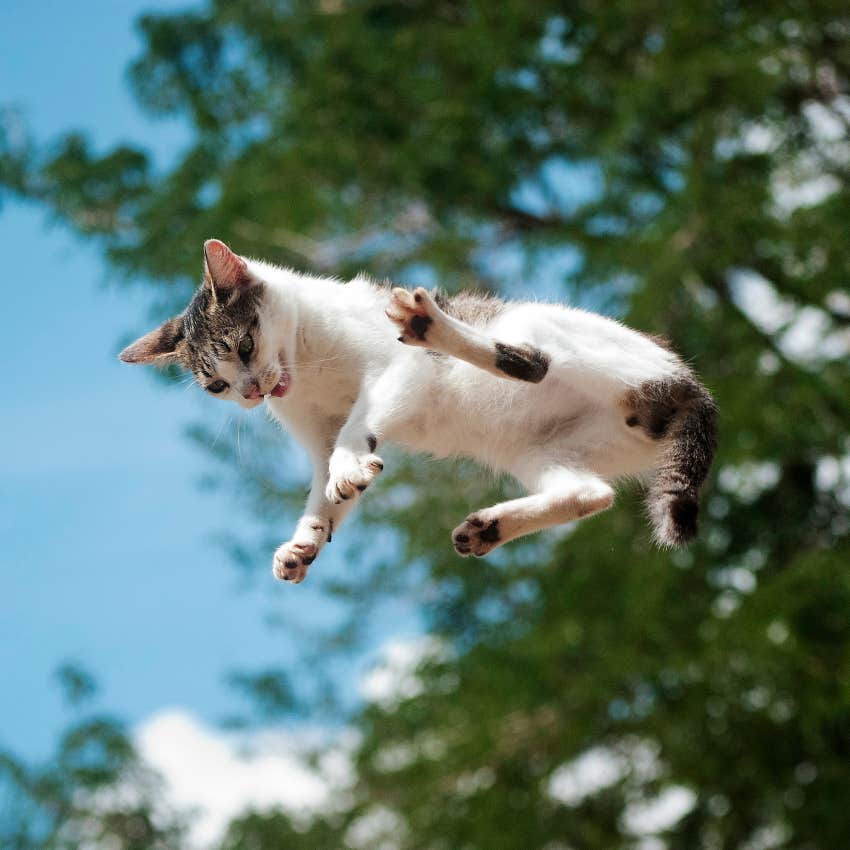
 It's commonly known that cats have a tendency to always land right side up. Even falling from a great height, they have a special ability to seemingly defy the laws of physics to protect themselves.
However, new research has found another explanation for this phenomenon, and it's a huge step forward in better understanding our furry feline friends.
A recent study found that cats always land on their feet due to the flexibility of their spine.
Led by veterinary physiologist Yasuo Higurashi of Yamaguchi University in Japan, the research team discovered that cats have a certain kind of flexibility along their spine that other animals don't have. Though previous research has been done over the last century to figure out how exactly they are able to do this, the results of the study confirm that it's likely due to differences in their anatomy.
 yordanka caridad almaguer | Shutterstock
The team measured the torque, rotation angle, stiffness, and neutral zone of each section of a cat's spine using donated cadavers. The front half, known as the thoracic spine, actually twists more readily than the lumbar spine in the back half of the cat. According to the study authors, "trunk rotation during air-righting in cats occurs sequentially, with the anterior trunk rotating first, followed by the posterior trunk, and that their flexible thoracic spine and rigid lumbar spine in axial torsion are suited for this behavior."
Known as the "falling cat problem," many past studies have looked at the physics of how cats rotate in the air. In 1894, French physiologist Étienne-Jules Marey introduced the concept and captured a series of images depicting cats rotating when dropped from a height. However, recent scientific developments have shifted the focus to exploring their anatomical design to help answer the longstanding question.
The researchers proposed that cats right themselves in sections, rather than as a whole unit.
They decided to take it a step further and test their theory in action. Using a high-speed camera, they recorded footage of dropping two live cats multiple times from a height of roughly 3 feet onto a soft cushion.
 The Cow Whisperer | Shutterstock
As suspected, both cats rotated first with their front halves, then with the back half of their bodies after roughly 70-90 milliseconds. This proves that the lighter, more flexible front half initiates the turn, while the stiffer, heavier rear end follows shortly after. It's also believed that this agility and flexibility have other applications for the animal, such as when galloping and turning at high speeds.
Though it doesn't fully solve the "falling cat problem," Dr. Ruslan Belyaev, a zoologist at the Severtsov Institute of Ecology and Evolution in Moscow who was not involved in the study, claims the study provides "insights for physicists on how to adjust their mechanical models to better match the real-life properties of a cat." Dr. Higorashi and his team plan to continue their research and create more accurate mathematical and 3D models of the science behind this unique ability.
Kayla Asbach is a writer currently working on her bachelor's degree at the University of Central Florida. She covers relationships, psychology, self-help, pop culture, and human interest topics.
