
Man Does The Math To Show That Minimum Wage Should Be $52 To Actually Make Sense
 MAYA LAB | Shutterstock
 In 2023, Elyon Badger shared on TikTok that by doing the same math as when minimum wage was instituted, it should be $52 an hour by now. Three years later, not much has changed.
We tend to think of minimum wage jobs as being for teenagers and the uneducated, a mindset that makes it easy to forget what it was intended to do when it was first implemented: provide a livable wage for everyone, no matter what kind of work they do.
That, of course, is not at all how it's shaken out in the decades since. Though many states set their own standards, the federal minimum wage is a laughable $7.25 an hour and has been since 2009. Nobody can seriously argue that such a rate is reasonable, especially since what the math says the minimum wage should be is downright shocking.
A man did the math and determined the minimum wage should be $52 an hour.
The federal minimum wage was instituted in 1938 by President Franklin Delano Roosevelt for reasons that are still all too resonant now. Roosevelt's Fair Labor Standards Act established the federal minimum wage largely due to Depression-era union movements protesting the corporate greed that helped cause the Depression in the first place.
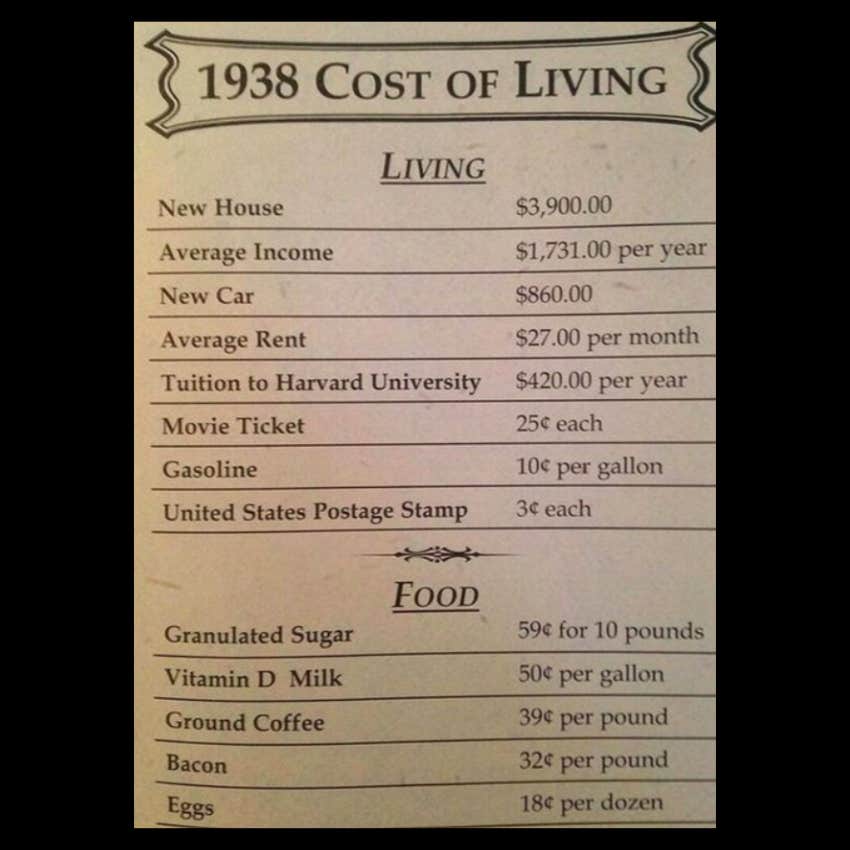
Roosevelt's legislation established a minimum wage that provided a livable income of $.25 per hour, or about $480 per year, to U.S. workers. And it was livable in the literal sense, since even big-ticket items like a Harvard education cost only $420 a year (he said, bursting into tears and screaming into a pillow until his vocal cords snapped like twigs).
Times have, of course, changed. A lot.
 Reddit
The man explained that Roosevelt's minimum wage meant any worker could theoretically afford to buy a house.
Badger broke down the actual math in his TikTok, using numbers from 1932, the year Roosevelt first proposed a federal minimum wage. (It was passed by Congress in 1933 but struck down as unconstitutional by the Supreme Court in 1935.)
Badger used a 1932 house price of $3900, which would have been about $1000 lower than the national average at the time, so think humble, no-frills "starter home," right? Converted to today's dollars, a $3900 home would cost about $87,000 in 2023. In 2026, that number is $92,268.31. You'd be hard-pressed to even find a livable house for that price in most of the United States nowadays.
Badger then calculated what your mortgage would cost in 2023 for a house priced around $85,000, with a $358 monthly payment. Which, as he showed using another mortgage calculator, would require a pre-tax yearly income of $13,429, nearly $500 less than the yearly pay the current minimum wage would get you.
Not only is an $85,000 house unrealistic, but as of July 2025, the average cost of a house was $435,300, nearly five times that modest 85 grand. According to Zillow, you'd have to earn $120,000 a year, have no debt, and put a $20,000 down payment to afford a $431k starter home.
This is in part because of inflation and supply and demand issues, of course. But it's also because, as homeownership increased in the years and decades after Roosevelt's New Deal, mortgage companies and Wall Street firms began using mortgage debts to create sophisticated financial instruments like mortgage-backed securities to sell to investors.
These instruments are part of what caused the 2000s housing bubble and the 2008 global economic collapse, as Margot Robbie famously explained in "The Big Short."
You can probably see where this is all going. Badger ran the numbers on a $400,000 home, which, again, is below the national average, just like $3,900 was in 1932. But even a regular middle-class American, let alone a minimum-wage worker, can't even come close to affording that.
To afford a $400,000 house, you need to make about $102,000 a year, which comes out to about $52 an hour.
 fizkes | Shutterstock
Obviously, not much has changed since 2023. That $52 minimum wage would need to jump to about $55 thanks to inflation. So if homeownership is still considered the gold standard not only for "The American Dream" but also for the health of our economy, then the minimum wage should be around $55 an hour, and since we're looking at extremely modest homes, that minimum wage is also on the modest side of things.
Instead, it's languished at $7.25 for 14 years, a wage that doesn't even pay for a squalid apartment, let alone a livable one, in a country where even many people making orders of magnitude more than that can't afford rent and are forced to sleep in their cars.
And, as is so often the case, America is unique in this respect. Aside from how shockingly low ours is, in most wealthy countries, the minimum wage is set and managed by economists. Ours is set and managed by politicians. And you can see how well that's gone.
Housing should be a human right, which means the minimum wage should reflect the cost of housing.
Suffice to say, things should not be this hard and economically usurious in the richest country on Earth. Sure, a $52-$55 minimum wage is at best a pipe dream, and most business leaders would tell you it would tank the economy. Heck, they say that about a $15 minimum wage, let alone a $52 one.
But here it's best to remember Roosevelt's words about the minimum wage back in 1938 during one of his famous fireside chats: "Do not let any calamity-howling executive with an income of $1,000 a day, who has been turning his employees over to the Government relief rolls in order to preserve his company's undistributed reserves, tell you — using his stockholders' money to pay the postage for his personal opinions — that a wage of $11 a week is going to have a disastrous effect on all American industry."
Good advice then and especially now, when many CEOs make more in a day than most of us will make in our entire lives. Demand better. It doesn't have to be like this.
John Sundholm is a writer, editor, and video personality with 20 years of experience in media and entertainment. He covers culture, mental health, and human interest topics.
