
Research Confirms Today’s Music Really Is As Bad As You Think It Is & It’s Only Getting Worse
 Kues | Shutterstock
 Have you ever caught yourself complaining about today's music? Maybe you just don't think it's as good as what you grew up listening to. You're not wrong, and research has proved it.
You're listening to your Spotify Daylist and hear a song that sounds oddly familiar: maybe you've heard something like it in a bar, on the radio a decade ago, or while grocery shopping. That's because you probably have heard it before, just in a different variation.
The recycling of note patterns within modern music has tired out the industry, and while artists may promote their newest releases as a "game-changer", chances are there's another song out there just like it.
Research confirms that today's music is as bad as you think because it has been simplified by technology.
Modern music can easily become mainstream due to the plethora of streaming apps available. While having a variety of applications to pull music from has made artistry more accessible, it has also homogenized music, so that across genres, there has been an epidemic of similarly sounding songs.
 F8 studio | Shutterstock
Music from the 20th and 21st centuries featured more complex structures within pieces, creating a unique sound. Back then, regional variation in music was more popular as a way to represent cultural pride, but as we move further into the modern age, the influence of Western music is taking over globally.
Current music features repeated harmonies, resulting in lower efficiency values.
A team of researchers in Italy noticed the drastic simplification of sound within mainstream music and began to analyze the structure and note repetition, using 17th-century classical compositions as a basis to compare to modern anthems.
They examined well over 20,000 pieces of music, ranging from 20th-century jazz to the resurgence of shoegaze in 2020. Just looking at the instruments used in these genres alone, it is apparent that there is less diversity in sound nowadays; instruments like the harpsichord or organ were replaced by the bass or keyboard.
Using network science to convert songs into a makeshift digital map, researchers were able to collect data on the evolution of notes. These digital maps were made up of music files that purely represented transcriptions of notes, timing, and duration, but no audio.
 SeventyFour | Shutterstock
They also used a system of mapping that paired nodes with notes so that each time a progression of notes was repeated, a line was moved between Note A and Note B. A similar practice was done to measure the weight of transitions, with the line path thickening each time a sequence is repeated.
Their findings revealed that older, classical-leaning music exhibited higher weighted efficiency. This means that there were fewer repeated tunes within the genre and a wider range of notes. In comparison, modern music genres like rock, pop, hip-hop, and jazz have a much lower efficiency value; we see a repetition of note progression as well as sound sampling that is helpful to get on the radio, but lacks musical depth.
21st-century audio also has a high reciprocity, which is a repeated two-way shift between note sets, showing up multiple times within the song in order to create a catchy tune.
People in the music industry have shifted their focus from artistry to popularity.
With improvements in sound quality on the radio and other audio technologies, there is less stress on live performances. While they are still something of a spectacle, tools like auto-tune can be used by artists to enhance vocals and other rhythmic elements.
Prior to the 20th century, music was a lot less accessible. Artists had to rely on live performance and unique sounds in order to stand out from the crowd. Nowadays, it seems that the crowd is where everyone wants to be; getting onto streaming platforms is a lot easier when inspired by other artists within the genre.
The shift toward simpler music occurred from the mid-50s to the late '70s and continued to progress over time. This is also the age when audio devices like portable mixers, amplifiers, cassettes, and vinyls were gaining popularity, and making music something that could be accessed anywhere, not just in the concert hall.
The shift away from streaming platforms as a source of listening has allowed for a more unique sound to resurface.
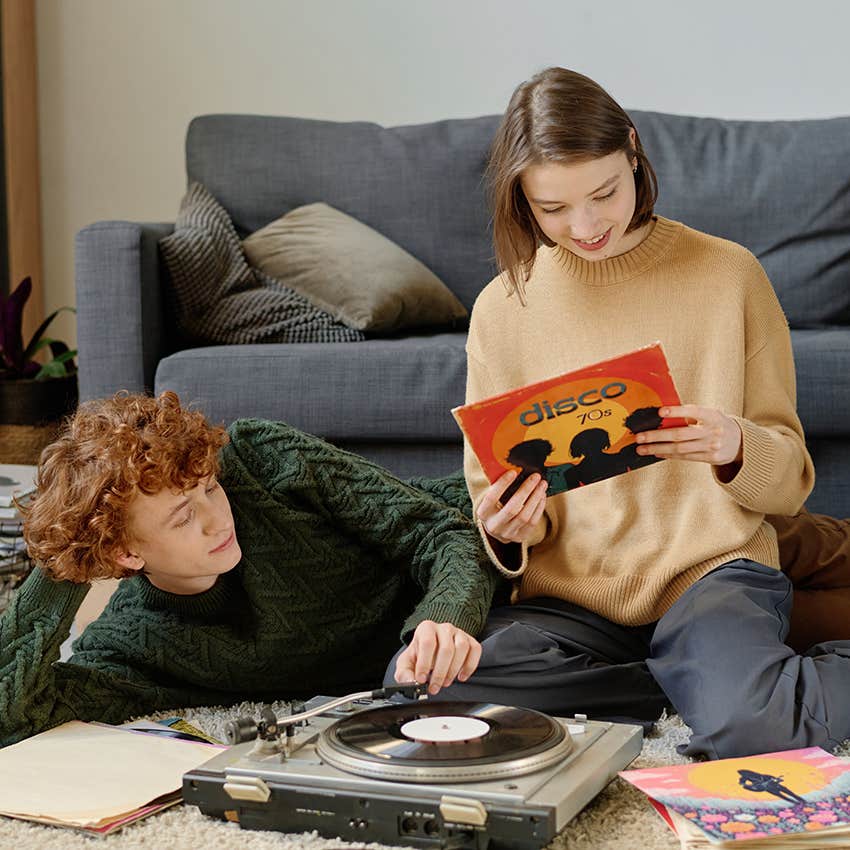
Those who have noticed and found fault with the homogenization of modern music have begun to revert to their roots, seeking physical media. The hunt for CDs, vinyls, and cassette tapes has grown as listeners search for a niche sound, with experimental music popping up the further back in time they go.
 AnnaStills | Shutterstock
When reaching further than just the Billboard Top 100 or the recommended songs on Apple Music, you're able to find a more diverse range of sound and a beautiful representation of artistry. If you're feeling tired of what's on the radio recently, don't fret: there are still communities out there producing distinctive work.
Or you can always revert back to the oldies.
Gabrielle Mattes is a writer working towards a Creative Writing degree. Her focus is lifestyle, wellness, human interest, and relationships.
