
People Who Use Cash Envelopes To Manage Their Money Often Make 5 Huge Budget Mistakes, Says Finance Expert
 Grusho Anna | Shutterstock
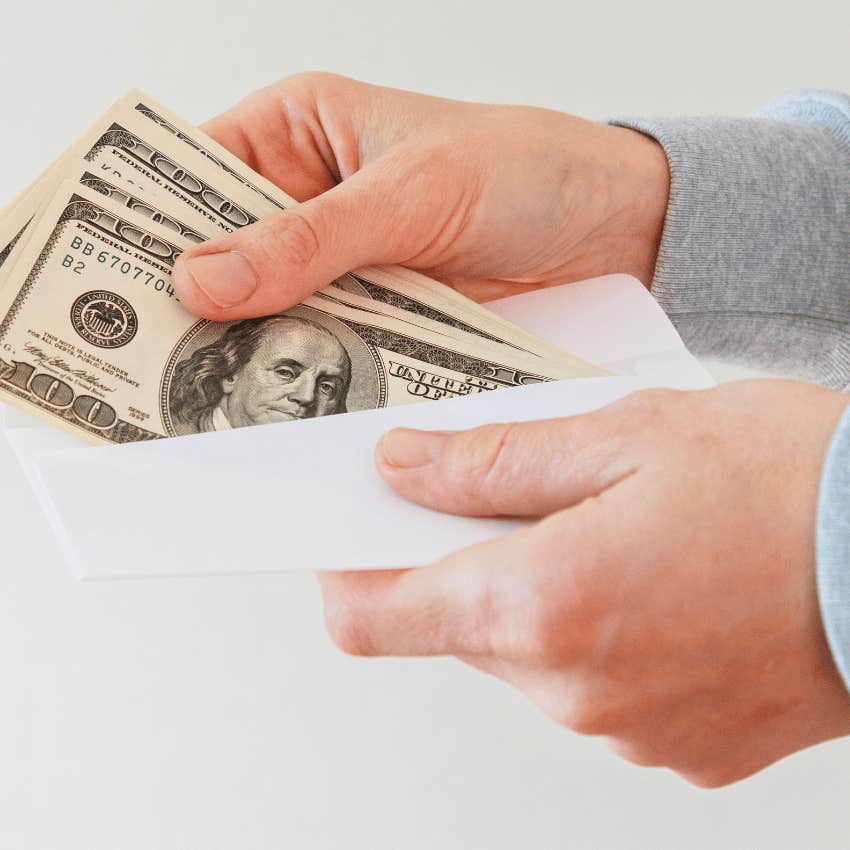
Cash-stuffing, aka the cash envelope system, is a way of budgeting that winds the clock back to the old days before online payments, iPhone Wallets, and even debit cards, and deals exclusively with cash, stuffed into envelopes for different spending categories.
You make a budget and then create an envelope for rent, utilities, groceries, savings, your social life, etc., and then stuff them with the proper amount of cash each payday. The money for bills is then ready to go by the due date, and when it comes to discretionary purchases, once the envelope is empty, it's empty. No overspending.
Tedious and weirdly analog? Definitely, but it makes your spending tangible rather than a thing you can easily ignore by simply never logging into your bank account. The envelopes are like little accountability partners!
But finance expert Fred Harrington of investment platform Vetted Prop Firms says the method is full of pitfalls that not only leave money on the table but can actively sabotage people's financial efforts. "Cash-stuffing can be an incredibly useful tool for visual learners and impulse spenders," he explained. "However, I'm seeing people fall into traps that completely defeat the purpose of smart money management." Here are those five traps.
People who use cash envelopes to manage their money often make a few mistakes:
1. Their money loses value while just sitting in envelopes
 SOFIA KIM ART25 | Shutterstock
Harrington warned that cash-stuffing erodes the worth of your money in two key ways: One, while it's sitting in the envelopes, inflation is quietly eating away at the value of every dollar bill you're cramming into them.
Meanwhile, it could be bearing interest, especially if one of your envelopes is for savings. "I've seen people keep $2,000 in cash envelopes for months,” Harrington said. “That same money in a high-yield savings account could earn $100 or more annually. It seems small, but those missed opportunities add up.” It's leaving money on the table, or in an envelope, as it were.
2. There's inherent security risks
Money kept in a bank account is, in most cases, insured by the federal government. And while that may not exactly inspire much confidence nowadays, given (gestures broadly in the direction of Washington, DC), it's still a heck of a lot more secure than your sitting-duck envelopes.
If your debit card gets stolen, you can lock it down, and most banks will replace any funds lost to fraud. If your house gets broken into? Or God forbid, burns down? All your money is simply gone, forever. "One client told me she lost $400 in stashed grocery money when her purse was stolen,” explained Harrington, "a significant setback that could have been avoided with proper digital protections."
3. They open themselves up to late and overdraft fees, and other costs
 Grusho Anna | Shutterstock
The envelopes may be a good budgeting tool, but unfortunately, your utility bills, credit card bills, insurance premiums, subscriptions, rent, and basically everything but groceries and your social life can't be paid for with cash.
This not only creates a tedious system where you have to be constantly depositing cash into ATMs, but also leaves you vulnerable to things like overdraft fees if you don't deposit in time for an automated payment, or late fees if you turn automatic payments off and forget to pay a bill. These fees are often so high and compounding that they can "completely wipe out any savings from careful cash management," Harrington warned.
4. The cash-stuffing method can lead to emotional overspending
The whole point of cash-stuffing is to avoid spending beyond your means, but Harrington said he's seen this backfire entirely for many people. Basically, when one envelope runs empty, say for groceries or your social life, the temptation to "borrow" from another envelope can be hard to fight.
Not only does this throw the whole system out of whack, but Harrington said it can have a heavy emotional toll, making you feel that you've betrayed yourself and your best-laid financial plans. And if being an emotional spender is what led you to the envelope method in the first place? Well, you can see where this is going. "People often end up in an all-or-nothing mindset where one mistake leads to abandoning the system entirely," Harrington said.
5. Emergencies and one-off expenses often don't get accounted for
When your car breaks down, you get sick, it's time to buy holiday gifts, or when any of the numerous financial surprises that can hit us several times a year crop up, your envelopes probably haven't accounted for this.
Unless you've specifically dedicated one to emergency funds for these things, these unexpected costs are likely to force you to "borrow" from the other envelopes, which sends the whole system into disarray.
Harrington said a better approach is to have a hybrid method that uses envelopes ONLY for things that can be paid with cash, and which comprises no more than 30-50% of your income. Savings should be set aside in a high-yield savings account, and emergency funds should be placed in a secure account, not in envelopes.
And a monthly review is key. "The biggest mistake I see is people setting up their envelopes once and never adjusting,” Harrington said. “Your budget needs to evolve with your life circumstances.” None of this means you need to abandon the method entirely if it works for you, but a careful, more detailed approach will not only keep your money safer but also allow it to grow, too.
John Sundholm is a writer, editor, and video personality with 20 years of experience in media and entertainment. He covers culture, mental health, and human interest topics.
