
People Who Do These 7 Things At Their Wedding Pretty Much Always Have Problems Later, Says Divorce Attorney
 NataKor! | Canva
 If you’re on social media, you’ve probably seen the wedding videos that go viral for all the wrong reasons. The groom who threw the cake across the room. The mother-in-law who forcibly wiped off the bride’s lipstick. That guy with the horrendously raunchy vows who mortified his new wife in front of all her friends and family.
The comment sections are filled with people saying things like, “It’ll never last,” or “Their marriage is doomed.” But according to an expert, some red flags aren’t as obvious. To get a professional’s take on wedding behaviors that spell trouble, I went straight to the source: I interviewed a divorce attorney.
“Wedding planning is essentially the first major stress test of a marriage,” said Michelle T. Dellino, the CEO and founding attorney of Dellino Family Law Group. Dellino has been in the industry for 20 years, and the patterns couples establish during wedding planning are the exact patterns she sees in dissolution petitions years later. In other words, “Wedding behaviors aren’t symbolic. They’re diagnostic.”
People who do these 7 things at their wedding pretty much always have problems later:
1. Letting relatives overstep boundaries
Unless you live in Utah, marriage is supposed to be a partnership between two people. “Failure to establish boundaries with in-laws at the wedding is one of the most reliable divorce predictors I see,” said Dellino, who calls it the “three-party marriage problem.” When couples let their parents make unilateral decisions about the venue, food, and guest list, it’s only a matter of time before they’re making unilateral decisions about homes, finances, and grandkids.
Dellino cites a 26-year study from the University of Michigan, which found that wives who are overly close with their husbands’ families are 20% more likely to get divorced. Interestingly, husbands who are close with their wives’ families decrease the risk of divorce. In my opinion, it’s because women are held to higher ethical standards.
We’re expected to remain kind, polite, and accommodating — even when our boundaries are crossed. Statistically, women have a harder time saying no, especially to people we care about. We also face harsher social and professional backlash when we do.
Once a couple ends up in Dellino’s office, family enmeshment makes property division and custody negotiations much harder: “You’re not just mediating between two spouses. You’re dealing with extended family members who have no legal standing, but tremendous emotional leverage.”
2. Smashing cake in your partner’s face
 Roman Shatkhin / Shutterstock
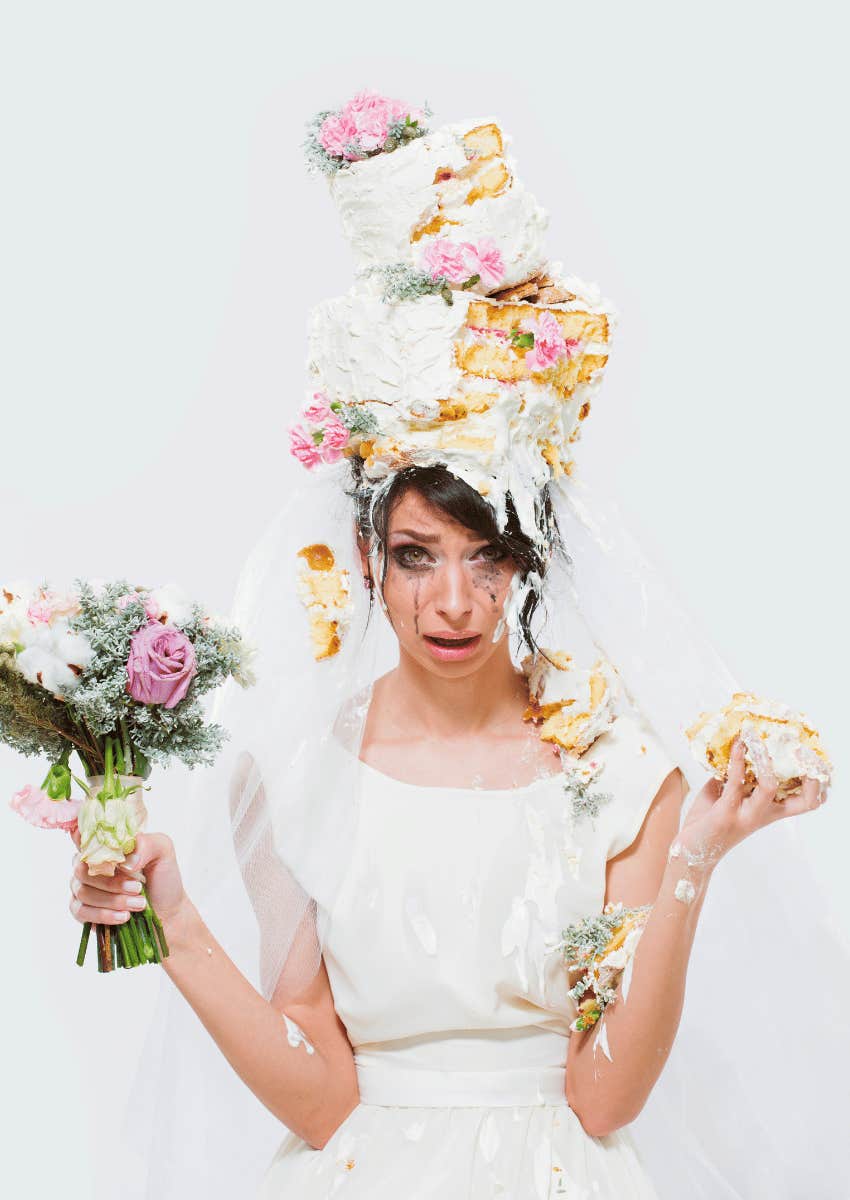
This one is probably the most obvious. In fact, I once heard a wedding photographer say she’s never seen a marriage survive a non-consensual cake smash. But clearly, it’s not obvious enough, because people keep doing it.
Including the dress, hair, and makeup, brides spend an average of $2,982 to look their best. Most don’t want to ruin it with frosting (or anything else). “When one spouse explicitly says ‘Please don’t smash the cake,’ and the other does it anyway for laughs, that’s a preview of how consent and boundaries will be handled throughout the marriage,” Dellino said.
It’s public humiliation, and it doesn’t stop there. It escalates: “The cake incident often becomes evidence of a long-standing pattern where ‘no’ doesn’t mean ‘no.’” Dellino’s clients often report that non-consensual cake-smashing at their wedding evolved into decades of dismissed boundaries; this time regarding “finances, parenting decisions, and major life choices.”
3. Overspending on the wedding — especially in secret
Finances can be a huge strain on relationships. Given that the average wedding in America costs $33,000, most couples feel that strain before their marriage even begins. A study from Emory University found that couples who spent more than $20,000 on their wedding were 1.6 times more likely to divorce than couples who spent between $5,000 and $10,000. Couples who spent under $1,000 were the most likely to stay together.
But “it’s not just the amount,” Dellino said. “It’s the financial dishonesty that accompanies overspending.”
According to Dellino, who cites the Foundation for Financial Education, almost half of American couples with combined finances are dishonest about their spending… Yet “marriage creates a fiduciary relationship where spouses owe each other complete financial transparency.”
Basically, you’re required to be honest with your spouse about shared money. When a partner lies about wedding costs or hides credit card debt, they’re violating their fiduciary duty, and lying about assets during a divorce is downright illegal. While preparing divorce paperwork for clients, Dellino frequently discovers that hidden wedding debt was the first omission in a string of financial lies that poisoned the marriage.
4. Making disparaging jokes about marriage
 Hoi An and Da Nang Photographer / Unsplash
I’ve already written about how sitcoms convinced a whole generation that marriage sucks. Baby Boomers largely felt forced into nuclear families, so they made shows, movies, stand-up routines, and countless casual comments about how commitment is a prison.
But now more than ever, marriage is a choice. And if you can’t stop yourself from making “jokes” about how terrible it is, it’s not the right choice for you.
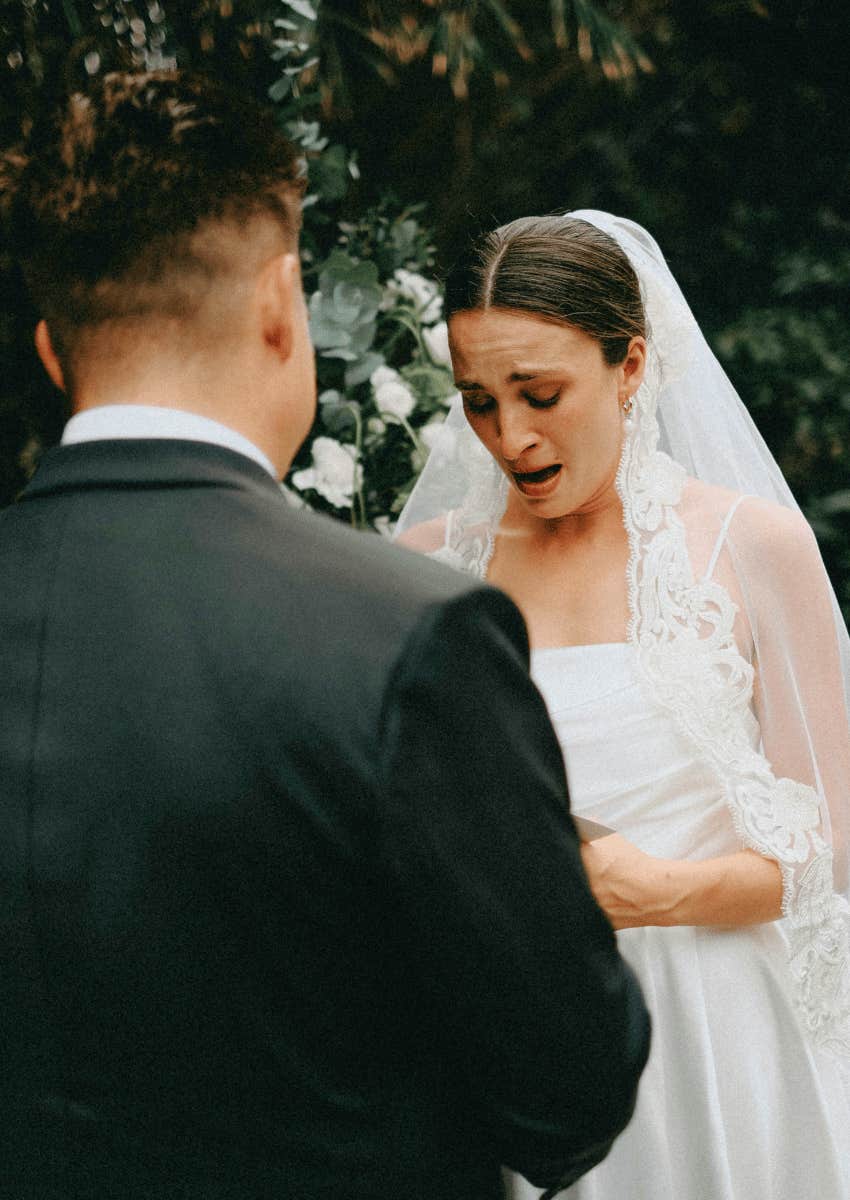
“Pay attention to public complaints about marriage before it starts,” Dellino said. “When someone makes ‘ball and chain’ jokes during toasts or disparages married life on their wedding day, believe them. Those aren’t jokes. They’re declarations of unwillingness to be a spouse.”
Dellino said she’s had ample clients whose exes made those comments on their wedding day. In retrospect, they wish they’d called it off rather than laughing it off.
5. Walking ahead of your partner
In most ceremonies, the groom walks down the aisle long before the bride does. But if one partner is also yards ahead on their way to the entrances, photos, dance floor, or buffet table, it’s a cause for concern.
Walking ahead of your partner indicates that you don’t see them as an equal, Dellino said: “It signals that one spouse views themselves as the primary party and the other as an accessory.”
If left unchecked, this habit could manifest as inequality and emotional unavailability later on in the relationship. According to Dellino, the partner who walks ahead is often the same partner making unilateral decisions about plans, parenting, money, and household responsibilities.
Dellino believes that physical positioning reveals power dynamics. You can’t walk through a marriage as equals if you can’t even walk side by side on your wedding day.
6. Being rude to vendors
 RDNE Stock project / Pexels
According to psychology, the way you treat servers says a lot about your values and morality. Those who are rude to service workers are more likely to show signs of hostility, low empathy, and narcissism. Since they perceive waiters as subservient, they get off on feeling superior. People who mistreat wedding vendors are no exception.
“Watch how couples handle vendor interactions,” Dellino said. “If one spouse screams at florists, berates caterers, or demeans venue staff, that behavior doesn’t stay contained.” Soon, they’ll direct this superiority complex towards their partner.
And if you split up after having kids, these behaviors could become courtroom evidence.
Personality traits like aggression and narcissism directly affect children’s welfare, Dellino explained. “Judges can admit character evidence in family law cases, [which] becomes relevant in custody proceedings when we’re evaluating each parent’s ability to provide a safe, stable environment.”
7. Showing contempt for your partner
Last but definitely not least, watch for tiny body language cues that foreshadow big problems. Contempt, Dellino said, is the deadliest:
“Dr. John Gottman’s research shows contempt is the single strongest predictor of divorce, and that’s exactly what I see in my practice. […] Eye-rolling, mockery, and treating your partner with disdain become documented patterns of emotional abuse that affect everything from spousal support to custody arrangements. […] If these communication patterns are visible during wedding planning, they predict divorce with 94% accuracy.”
What to do if your partner exhibits these behaviors. Here’s Dellino’s advice for tackling these issues before they end in divorce:
- Spend money on premarital counseling, not an expensive wedding. “Research shows premarital counseling reduces divorce risk by 31% or more,” Dellino said. “The return on investment couldn’t be clearer.”
- Establish firm boundaries with extended family ASAP — ideally before the wedding, and definitely before they infiltrate your marriage. “Your parents’ role is to support your marriage, not direct it.”
- Draft a prenuptial agreement, even if you don’t think you need one. According to Dellino, it’s protective, not pessimistic. There’s no correlation between prenups and higher divorce rates, and it forces couples to have honest conversations about their finances.
- Be fully transparent about your money from day one: “Share every cost, every debt, every financial decision. If you can’t be honest about wedding expenses, you won’t be honest about the mortgage, the 401k, or the credit card debt.”
- If you consistently see signs of contempt, dishonesty, and disrespect, Dellino recommends calling it off. “Those behaviors won’t improve with a signed marriage license,” and “annulment is far simpler than dissolution.”
Successful couples treat wedding planning as practice for their lifelong relationship: They communicate, maintain boundaries, and make decisions as equals.
“If you can do that during the wedding, you can do it during the marriage,” Dellino said. “If you can’t, call me before you send the invitations, not after you’ve retained separate counsel for equitable distribution proceedings.”
Maria Cassano is a writer, editor, and journalist whose work has appeared on NBC, Bustle, CNN, The Daily Beast, Food & Wine, and Allure, among others. She's in the process of publishing her memoir.
