

The Newlywed Catch-22: Why The First Year Of Marriage Is So Tough
A new wife finds it tough to live with or without her husband.
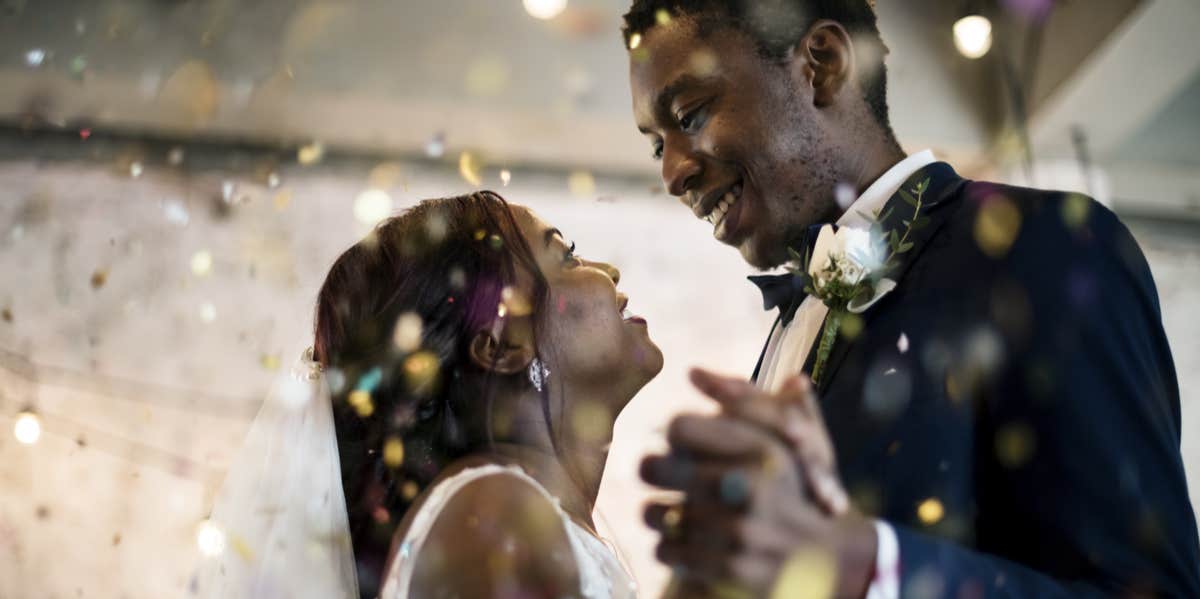 Rawpixel.com / Shutterstock
 I fantasized about an idealist who could quote Thoreau and Emerson; I fell in love with a Prada-loafer-wearing lawyer. I dreamed of lazy weekend mornings in bed; Eric worked seven days a week, and for the few hours that he did sleep, he snored.
When I accepted his proposal of engagement, I was well aware that I was agreeing to marry a 37-year-old whose dirty clothes would never meet a laundry basket, and who still called his parents "Mommy" and "Daddy." Despite all the relationship advice I found, I realized that it wasn't perfection, but it was right.
In just one date, I had been transformed from a boy crazy, what-if-the-grass-is-greener tease into a monogamist. When I was with Eric I was present in a way I didn't know I could be. I trusted him. After our first fight, I didn't want to slam the door or run away; I wanted us to hold each other and talk it through.
I loved him and he loved me back in just the right way. This was it.
And yet, here I was, married less than a year, staring at this man, my husband, both of us newlyweds, wondering how I got to this place, and if it was really going to be forever. It felt as though I were the first newlywed to let such horrible thoughts cross my mind, and I wondered if I was destined to become part of the 40 percent divorce statistic.
The truth, I've since discovered, is that many women are filled with doubt in the early days, but keep it to themselves primarily out of a fear of being judged.
Only after promises of anonymity did dozens of married women reveal the truth about their first year of supposed wedded bliss, calling it "a shock," "like whiplash," and "hell on the heels of a beautiful honeymoon."
"Couples have expectations that once you find your 'soulmate,' marriage is going to be great," says Cara Gardenswartz, Ph.D., a clinical psychologist in Los Angeles. "But no one person can meet all your needs, and no two people are perfect for each other. That realization, especially after the wedding, can be disenchanting, embarrassing, and alienating."
I hadn't expected happily ever after, but I had expected happiness right now. When people asked, "How's married life?" with the overt expectation that we were living in newlywed bliss, I wanted to blurt out that Eric's unwillingness to properly re-fold The New York Times sucked the pleasure out of my favorite Sunday morning activity, and that he no longer let me warm up my cold toes on him in bed the way he used to.
Little annoyances had begun to feel like a life sentence, and the differences that had once challenged us to be flexible and open-minded now seemed unbearable.
He'd walk three blocks for an overpriced cup of Starbucks, while I preferred coffee from the corner deli. I'd end up in tears whenever he neglected to recycle a can of Diet Coke, wishing I had Al Gore by my side so that Eric would take my pleas to protect the planet more seriously.
And where I had once admired his ambition, nights of crawling into bed alone when he was still toiling at the office left me questioning his ability to balance his professional and personal responsibilities — I feared that down the road, I'd practically be a single mom.
"It's like Prince said, 'It means forever and that's a mighty long time,'" says Ann Stein*, a graphic designer who's been married for nine years, happily for about eight of them. "Anyone with half a brain will question the idea of 'forever' with one person and wonder, 'Is he right for me?' After you come back from a romantic honeymoon, the reality hits that you'll never experience that feeling of falling in love again, and all you can see is the day-to-day forever-ness."
Jillian Straus has given a lot of thought to her own generation's fear of the ultimate commitment, but the author of Unhooked Generation: The Truth About Why We're Still Single was still unable to avoid trepidation about settling down herself.
"Maybe you think that when you actually tie the knot, the endless second-guessing about if you're ready will stop," says Straus, who got married last year. The writer has also found marriage to be extremely isolating.
"My single friends stopped confiding in me about their dates because I'm not one of 'them' anymore. At the same time, I'm going through new things, but it's taboo to complain about the everyday stresses of married life. You don't want to betray your spouse, and even if you could talk about it, people would think you have a bad marriage. It's very lonely."
This code of silence is just one of the reasons why Rabbi Sherre Zwelling Hirsch in Los Angeles requires all the couples she marries to meet with her six weeks after the wedding and again at the six-month mark.
"Six weeks, because that's when the party's over; and after all the excitement of the wedding, there's nowhere else to go but down," she explains. "At six months, couples are usually in a funk. A good percentage of their fantasies have been killed, relationships with friends are shifting, and they're thinking, 'This is not what I pictured it would be.'"
Hirsch's solution is to read couples the love letters she had them write to each other before the wedding — just the right antidote for two people who may have forgotten why they made a life commitment in the first place.
"The expectation in the first year of marriage is that you're happy, happy, happy," Hirsch says. "But the truth is that you don't feel completely safe or connected yet, you can't confide in anyone because you're trying to build a sacred space with your partner, and you're still mourning the loss of your previous life. It's the opposite of everything you expected in so many ways."
Emma Donahue*, who dropped the D-word in month one, expected to feel boundless safety and reassurance when the deal was sealed. "But I don't," admits the 32-year-old. "When we disagree on issues now, there's so much more at stake. My mind spirals to the worst-case scenario: How am I going to tell my family that we're divorcing? It’s all much harder than it used to be."
Insecurity is a common theme for newlyweds, according to Gardenswartz. "It's typical for one member of a marriage to seek more closeness and for the other to distance him or herself," she says, which can then lead to feelings of insecurity.
"It often happens in the early stages of marriage because it's a critical time when one or both individuals may be taking steps to hang on to their own identity to avoid feeling engulfed by the relationship. It's a polarizing process that can become a vicious cycle."
Another cause for bumps in the early days of marriage, especially for couples who are just moving in together, is the process of establishing roles. Even mundane requests can feel loaded for fear that lifelong precedents will be set.
For years, Straus had no problem picking up her boyfriend's dry cleaning. "It was convenient for me and it wasn’t for him, so it was no big deal," she says. "Now I read into everything. It's as if he's saying 'You're not my equal partner and I'd like you to be my errand-runner forever.'"
This "jockeying for position" is inevitable and a "normal pitfall" for newlyweds, says Peter Abrons, Ph.D., a couples and family therapist in New York City. To avoid arguments he suggests, "Ask yourself, are you trying to recreate the family you came from when your spouse has a very different way of going about things?"
For Marcella Lowey*, an "I do" was not enough to solidify her commitment to marriage. When her new husband lost his job, she admits, "My instant reaction was to think about self-preservation instead of our future together. I didn't trust that Martin* would put me first and that he was thinking of me as part of the greater plan. That confidence takes a while to build."
As tensions mounted, Martin made it clear to Marcella that she was his number one priority as he hunted for work, and that she, in fact, was the one who wasn’t thinking like a team.
"He said that he needed me to put both feet into the circle of our marriage," she says. "But it's scary to put all your eggs in one basket. It took me eight months until I started to feel that we were truly aligned and that I didn't need one foot outside. I've never experienced the healing effects of time more dramatically than in my marriage. I literally had to see again and again that I would be put first, and now we've created that basis of trust."
Four and a half years into marriage, Amy Lake* laughs when she recalls the intensity with which she questioned her union during the first year.
"Right now, my husband's on a ski trip and I'm taking care of our sick baby while moving us into our new home!" says the stay-at-home mom, admitting that the "hot button issues" led to multiple arguments in year one still exist. "But we're much better communicators these days, so we're able to talk it through. I can look at the bigger picture and know that the good far outweighs the bad."
Communication and flexibility are essential skills that take time to develop, Abrons warns. "It gets easier when each of you looks at your own contributions to difficulties, rather than just focusing on the other’s transgressions," he says. "You've got to validate your spouse's And the more you're able to give a little, the easier it will be to get along and resolve issues quickly."
Stein, who's now the mother of two girls, needed about a year to realize that the net gain of her marriage was far greater than all that was left behind.
"Slowly, you get into a rhythm as a couple and truly connect," she says. "It becomes a much deeper commitment. Life becomes about the future and not the past, and that is a very bonding realization. You never stop feeling that it would be fun to have that experience of falling in love again, but what you have created is so much more than that."
And though bitter fights have left her husband sleeping on the couch more than once, Donahue gets sentimental. "Slowly, I can see that our relationship is deepening," she says. "Watching how we approach decisions now as a family makes my heart swell. When I wake up every morning and look at him beside me, I feel more connected."
As Eric and I approach our one-year anniversary, we're also getting into a groove — and a pretty good one too. Sure, the Sunday Styles section still looks disheveled by the time I get to it, but I can see that he made an effort to fold it on the creases.
He brings me coffee from the deli, deposits his empty soda cans in the right receptacles, and lately I've been the one working longer hours. And though his dirty socks continue to land on the floor, I now know that I can live with it.
Maybe I've started looking inward and stopped pointing the finger so much. After all, a marriage is made up of two people. And, I've got to be fair — I still call my parents "Mommy" and "Daddy," too.
Rebecca Raphael is a freelance writer and editor with more than 20 years of experience in multiple mediums — newspapers, magazines, digital, and TV. Learn more on her website.