
An Angry White Man's Perspective On Being Black In America
I don't know what it's like to be black ... but I do know the system is fucking broken!
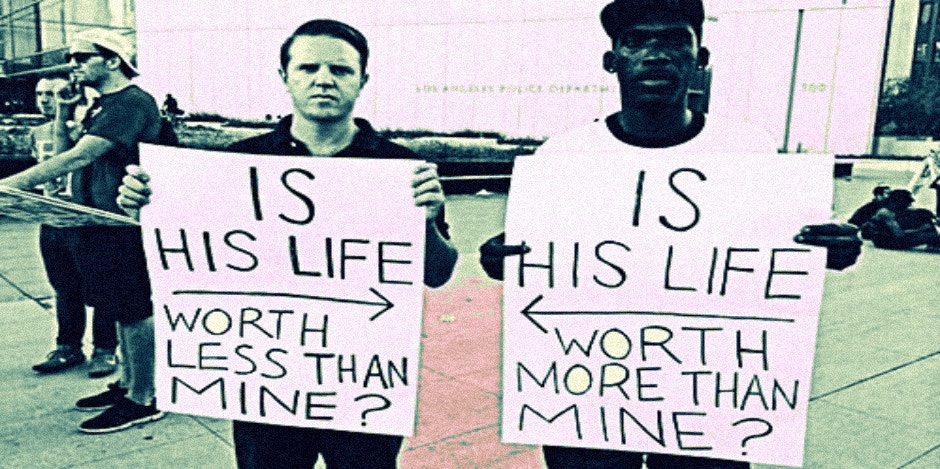 WeHeartIt
 For most of my youth, I was an active stage performer in Northern California. I performed in over 25 musical productions and a number of plays.
The most poignant performance ... the one I'll never forget ... was an adaptation of Harriet Beecher Stowe’s anti-slavery novel Uncle Tom’s Cabin. The director (a black woman) wanted to draw attention to racism and choose to make a politically-charged statement: She cast a white teenager as Tom. That teen was me.
The director wasn’t looking to create a parody of blacks or their struggle by putting a white person in blackface. She was looking to make a strong social statement about race. I’ve never been one to shy away from making people think, so I signed on as the lead.
We rehearsed for five weeks for a 3-day run of the show in the small, suburban town of Sunnyvale, California (the center of what is now known as Silicon Valley). For the technical and dress rehearsals, I was in full makeup — body, face, and hair. It was a very strange experience to sit in a chair for 3+ hours and look in the mirror as I turned from a Jewish/Sicilian kid of 16 to a young black "man" — face, neck, arms, hair, and period clothing.
After the final dress rehearsal — one night before opening — I was too tired to remove my makeup. I walked out to the parking lot, where my father was waiting to give me a ride home. As I walked, a car appeared out of nowhere at a high rate of speed, and the came screeching to a halt mere inches from where I was walking, nearly running me down.
I will never forget the people in the car or what they looked like: a man driving, a woman in the passenger seat, and their two young kids in the back — all white.
The man was visibly upset and angrily rolled down his window. I assumed he was as startled as I was and wanted to apologize … but instead, he leaned out the window and with a look of disgust yelled, "Watch where you’re going, you stupid nigger!"
As he stepped on the gas and swerved around me, tires screeching, I felt a rapid succession of emotions.
At first, I felt confused by the racial slur … until I remembered the makeup. I got in my father's car, visibly shaken and upset. I wasn’t upset for me, but for the inhuman nature of what was then exposed to my formerly calm, sheltered, suburban white kid existence.
When I shared my story with the director and my fellow cast-mates the next day, anger and seething hatred replaced my sadness.
I didn't just want to make change; I wanted to fight. I wanted to show these ignorant, racist horrors of humanity that they weren’t welcome on my planet. I asked my director if it was always this way for her as a black woman. She smiled and offered words I will never forget: "Welcome to the real world. It’s where all black people live."
Before the show even opened, she accomplished her mission of racial education and awareness.
In these recent years, I'm experiencing déjà vu simply by watching the nightly news. I sit on the couch and the endless stream of brutality, bigotry, and violence against black people washes over me, offered up by emotionless, Khaki-clad news anchors — Ferguson, Charleston, Baltimore, Chicago, Oakland, Cleveland … the list is virtually endless and now includes the most recent incident in McKinney, Texas.
With each account, my anger bubbles just as fresh as the day in that parking lot.
I'm not angry "because I know what it's like being black." In truth, I have no idea what it's like being black. That experience in my youth was a small moment in time. I went home that night and washed my makeup off … and my only thought in the shower was that black people can't take soap and water and scrub off the ignorant bigotry tossed their way every day. With every swipe of my washcloth I realized that by removing the makeup, I would never have a middle-aged white woman cross to the other side of the street or move her handbag out of my reach … or experience security guards eyeballing me, as I exit a clothing store with a backpack … or endless other scenarios I have no visibility into as a 45 year-old white male.
I’m not sad. Being sad is a passive emotion. I’m disgusted. I’m sickened. I’m angry.
I don't feel these emotions because I'm a white man feigning empathy "for those black people" with a stupid look of pity on my face. I'm angry because too many people experience gross injustice (every single day), and I hate it. Moreover, it's not just injustice … it's pure, unadulterated supremacy that is being force-fed to black people.
I know how all this might sound, because it’s always tricky when white people write about race issues.
As a white man, I run the risk of looking like I’m “trying to be black”, that I’m “cozying up” to black culture, or that I'm writing about an issue it's not PC for me to form an opinion about.
Let’s get something straight: Don’t add me up with Rachel Dolezal. I’m not pretending that I'm black; I’m offering my perspective and advocating for equality. In short, this piece isn’t really about race ... it’s about injustice.
If it was one occurrence of a black person experiencing injustice, it might be viewed as a one-off incident. But what we are reading about and watching in the media is not one-off … it's an obvious trend of black citizens being profiled, treated with suspicion, and hurt by those in authority (and it's been a trend for years, only truly brought to light with the instantaneous availability of information via social media).
But even with solid proof (video, witness accounts, and more), there are no punishments … no accountability … and no justice.
Technicalities reign, those in power drop themselves conveniently into the Code of Silence, officers take a few days off on "administrative leave" (the police version of "Go sit on timeout, Officer So-and-So, and think about your bad behavior"), and the media reports acquittal after acquittal after acquittal of white officers profiling and hurting black people.
The result is very predictable: People get angry and aggressive. They want change. They revolt. They protest and riot in an effort to gain attention because acting with kindness, calm and decency doesn't work.
Sometimes, you have to take a stand … and sometimes that stand is strong. And, sometimes, it's violent.
Perhaps Dr. Martin Luther King, Jr. said it best: "A riot is the language of the unheard." (Where Do We Go from Here: Chaos or Community?, 1967).
And how "wrong" is it really to riot when those in power blatantly ignore your voice and pretend the issues aren’t real or commonplace? After all, when the British treated the new Americans unfairly, the Sons of Liberty held the Boston Tea Party to protest the unfairness — which led to the American Revolution. Bottom line: If these organizations and legal institutions don't want civil unrest, they're going to have to listen to the facts, ignore the technicalities, and make some hard line calls that equate to justice.
(Point of interest: You rarely hear about white people “rioting.” In the media reports, white people “protest”… only black people seem to “riot.” A clear case of the media fueling the problem by villianizing black citizens.)
But who am I kidding? The same institutions that are dishing out racist injustices and inequality quell protests of this nature. The result: Complaints and attempts at awareness and change simply aren’t allowed. Society tells black people to smile, accept things for what they are, and patiently “allow the system to work”. And that is where I call bullshit.
The system is f*cking broken.
You can't have the same people who dish out abuse making rules for those who want to stop the abuse from happening. It's insane and utterly asinine.
Perhaps the worst part is where it all emanates from. Non-black people look at the riots and unrest and don’t understand how things escalate so quickly. To those people, I implore you to: 1) Do some research; and 2) Have a straight-up conversation with someone who is black.
In your investigation, you will quickly discover that in neighborhoods that don’t have a black majority, the average age for a child to first come in contact with the police is 15-17 years old. In predominantly black neighborhoods, the average age is 6 years old. 6 years old! And as these young black boys and teens grow up, they learn that many (if not all) police officers they encounter see them as "suspicious black thugs," not kids.
Oftentimes, these young black teens experience harassment, profiling, and random illegal searches — anytime, anywhere.
Example: If a police officer sees a young black teenage boy wearing a baggy sweatshirt and perhaps his pants a little low, that officer will go on-guard because the boy “looks suspicious”. But if that same young teenager is white, the same police officer will think he’s a college student.
In New York, the routine procedure of evaluating those who are "suspicious" is known as “Stop-and-Frisk,” and it’s based solely on the officer’s judgment of suspicion — suspicion based on an initial impression, not real evidence. And although the raw numbers have dropped, it’s still a standard practice that is a clear violation of civil liberties.
According to the New York Civil Liberties Union, in 2014, police officers stopped 46,235 New Yorkers for a Stop-and Frisk. Here’s how those numbers break down:
- 82 percent were totally innocent
- 55 percent were black
- 29 percent were Latino
- 12 percent were white
And it’s not just young black kids comprising that 55 percent. Cops even stopped black police officers — racial profiling at its finest.
And with each incident, resentment builds. Young black people become adults who don’t trust the system, because that system has treated them unfairly and violated their civil rights for years.
They're pissed, but they hold it together … until yet another story emerges of a young, unarmed black kid shot and killed by the same type of police officer they've had to deal with their whole lives. And they flip.
Who wouldn’t? I mean, I get angry when I get pulled over for speeding (maybe I was, maybe I wasn’t … but I’m still pissed). These people get stopped and harassed because the color of their skin, the style of their clothing, or the music they're listening to looks like it “might be a problem.”
If that’s not the seed of resentment and anger, I don’t know what is.
When does it change? When do we hold these officers accountable for their actions? And when do we hold those who aid them accountable for their inaction — namely incompetent/indecisive/in-denial district attorneys more concerned with winning their next election than dispensing justice?
Personally, I’ve had enough. I find it unfathomable that people of any color experience unfair treatment. But when obvious profiling is taking place, and is not only denied, it is subsequently and silently encouraged, proven by the lack of any consequences.
To any black people reading this, I’m not trying to compare my isolated experience as a 16 year-old to what happens in your life. I have no idea what your day-to-day life looks like, or the panic you feel when a police car pulls up behind you, the frustration you harbor from years past (or present). I got a very small taste of things 29 years ago, but that small taste was powerful enough that the experience never left me.
And as a fellow human, I just wish I could change things.
To those white people who want to tell me 'this and that' about whites being persecuted also, or that a few of the black men gunned down by police committed a crime, or whatever: Some of that might be true, but it hardly nullifies what I’ve written here.
People of all colors commit crimes (including white people), but if the system actually worked — sans profiling and racism — these black men would not end up shot on the street, unarmed with their hands up. Police would see them as human beings, and not as “black men,” regardless of their alleged crimes … and "innocent until proven guilty" would prevail.
Black and white aside, there is a larger issue. In reality, this is about injustice. It’s about the state of this country today.
The race issue is an easy one on which to center the spotlight … but what we're really discussing here is the unfair treatment of members of our shared society — Members of society being profiled and killed (or beaten to within inches of their lives), and those who inflict the violence just walk away, never held accountable. And it’s disgusting.
And with that profiling, allow me to call something out ...
Throughout this article I’ve used the term “black”, and that is purposeful. I don’t feel comfortable using the term “African-American” to cubbyhole people whose ethnic background I know nothing about. Perhaps their lineage originated in South America … or Trinidad … or Australia … or a hundred other places on this planet where people have a darker skin tone.
Besides, I wouldn’t expect anyone to refer to me as a “Jewish-Sicilian-American.” I’m just a human who lives in the United States … but I guess that’s easy to say when I’m white and I don’t run the risk of being beaten by the police because my “crime” is simply Living While Black.
It's not easy to speak up about racism as a white person. But if the issue weighs on your heart like it does on mine, watch documentaries, read great articles like this one and this one, or attend community workshops to deepen your understanding and learn how to affect positive change.
