

Photo: fizkes / Shutterstock
By Iain L. Root — Written on Mar 03, 2021
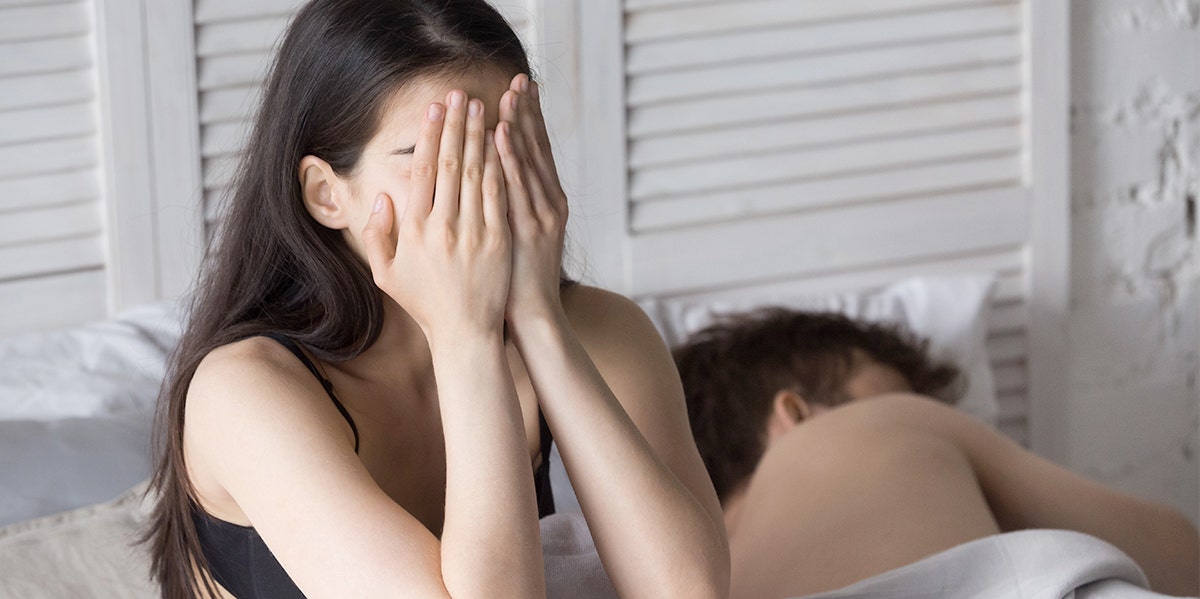
She called me on the way back from her doctor's office. Although we were on the phone, I could see the look on her face. Her voice was slow, controlled and low, full of rage.
The interrogation began.
Was I now sleeping with someone else? No.
At any time in the last six years of our relationship, had I slept with anyone else? No.
Then how did she get diagnosed with HPV today? I don't know.
The sneaky thing about many sexually transmitted infections (STIs) is that they may or may not cause obvious symptoms — like blisters, bumps or painful sensations — indicating something is wrong. The same is true of HPV.
In a slicing tone, she began my crash education about HPV's effects: increased risk for genital warts, RRP (recurrent respiratory papillomatosis, where growths sometimes occur on the larynx and lungs), as well as cervical and other cancers. The virus could even be passed on during pregnancy to any children she may have.
But why did it show up suddenly, six years into our monogamous relationship? I went online and checked the website for the Centers for Disease Control, which estimates that in 90 percent of cases, the body's immune system clears HPV naturally within two years. It had been three times as long as that since I was active with anyone else. I had trouble believing it myself, but 90 percent of cases isn't 100 percent of cases. We happened to be in that remaining 10 percent. My body still carried HPV.
We both assumed that her infection came via me. Though we could count the number of partners we'd both had on two hands, she could count hers on two fingers.
We had taken all the recommend precautions against STIs: using condoms, being monogamous, knowing your partner's previous history. Had we been born 10 years later, we may have received a series of vaccinations against some, but not all, strains of HPV. But the only sure way to prevent getting HPV today is, like every other STI, to avoid any genital contact.
We reduced our risk as best as we could — or thought we needed to (which was not at all). But the risk and the infection remained. What angered her most, though, was having the disease at all. She felt she took extra precautions to be healthy throughout her life, and by infecting her I doomed her to all those things she listed, and more. In her eyes, I, the man she'd loved for six years, had given her cancer.
I never thought she was overreacting. On the contrary, her emotional response seemed, and still seems, appropriate.
Look at that list of diseases again. Why wouldn't she be pissed?
As a rule, giving your partner an STD isn't good for a relationship, especially one quickly falling apart as ours was at the time. We broke up a few months later. The HPV wasn't a primary reason or cause but, like a boulder tossed into a sinking canoe, it wasn't helpful. Her resentment for me grew further after the breakup.
I recalled stories from friends and acquaintances with severe cases of herpes, how they had been quickly and brutally hurt, dismissed by others because of a disease. Rejection is always painful, but it's comforting to know you're not alone. I sought the advice of self-proclaimed relationship experts, aka my friends who were serial daters.
I first mentioned my situation one night to a friend when I was behind a warm and comforting shield of whiskey. I filled in the ugly and brutal details of the whole story, building up to the terrible secret and shame that I and my now-ex carried.
My friend shrugged. "That's it?"
"That's it?! I just told you I possess cancer-causing junk! I'm a freak! I should be dissected on a slab!"
My indignation was partly from the whiskey, partly from feeling I wasn't taken seriously. But the same revelation to others had the same lack of impact. I was told not to worry. HPV wasn't a big deal. But I knew two people for whom it was indeed a very big deal.
In my informal survey, I heard a wide variety of facts about the number of people who have HPV: two-thirds, every fifth person, 100 million. It turns out the CDC estimates that approximately 20 million people are currently infected with HPV, 6 million people will be infected this year, and 50 percent of all sexually active adults will have HPV at some point in their lives. I'm merely part of a very non-exclusive club.
One of the reasons that those numbers are so high is the stealthy nature of the virus. Anyone can carry it with no outward signs or symptoms, then flush it from their body without ever knowing they had it. Unlike other STIs, there's no reliable test to check for HPV in men. For women, fortunately, pap smears can catch HPV, which is how my ex discovered her news.
No one wants to go through life feeling different or deprived of normalcy. But I learned even knowing a little bit more about HPV, being open and sharing, can make the experience feel less isolating, less alone.
A year after the breakup, I had started dating again. I told myself I'd be honest and up-front about my recent past with any new partners.
I didn't look forward to explaining why sleeping with me might have more than the usual risks. Remember: I believed my genitals caused cancer.
I made it to the point of full disclosure several times. No matter where it happened — on couches, by bedsides, in street conversations — it was always awkward and uncomfortable. Imagine hearing some guy you'd like to sleep with talk about his ex: she has this STD, she got it from him, there's no test for it, and there's a chance that being physical with him, even with all other safety precautions, may lead to a whole terrifying smorgasbord of side effects, and that he'd like you to know all this before going any further. It can be a bit of a mood killer.
I bared myself before baring myself, braced for the moment of instant pariah-hood and quickly seeing the wrong side of a closing door. But that moment never occurred. My reveal was met not with raised voices or eyebrows but with exhales of tension and understanding tones.
Yes, HPV is prevalent. Yes, it's a risk. Yes, there's a lot of nasty things out there. At least it's not bedbugs.
I'm still in touch with my ex. Her initial fears of being an outcast were overcome. She's now in a new long-term relationship after dating several other guys. I'm also in a long-term relationship with a woman who's fully aware of both what's been in my past and what may come up in our future. I no longer consider myself some hideous freak of nature. I'm imperfect — just like every other person.
You may be one of the 43 million Americans with HPV or become one of the 13 million newly infected each year.*
Join HPV Alliance, Moffitt Cancer Center, and AdventHealth Thursday March 4, 2021 at 1PM EST for a Facebook Live event with leading physicians, researchers, oncologists, and celebrities impacted by HPV who will dispel HPV myths, supply facts on prevention, give advice on staying healthy with HPV, share compelling stories of diagnosis, and provide empowering tips for self-advocacy.
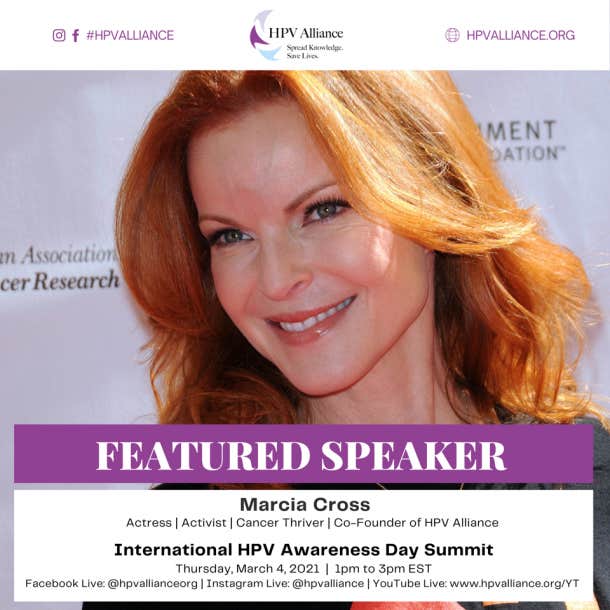
During the event, HPV Alliance will also share an Athleta promo code good for 20% off items at Athleta.com.
Register at www.hpvalliance.org/m4
Ways to watch:
Facebook Live: @hpvallianceorg
Instagram Live: @hpvalliance
YouTube Live: www.hpvalliance.org/YT
Think you may have HPV, or want to learn more? Check out the CDC's HPV Fact Sheet and their HPV Topic Page, which includes information about HPV symptoms, screening, the link between HPV and cancer, and more.